

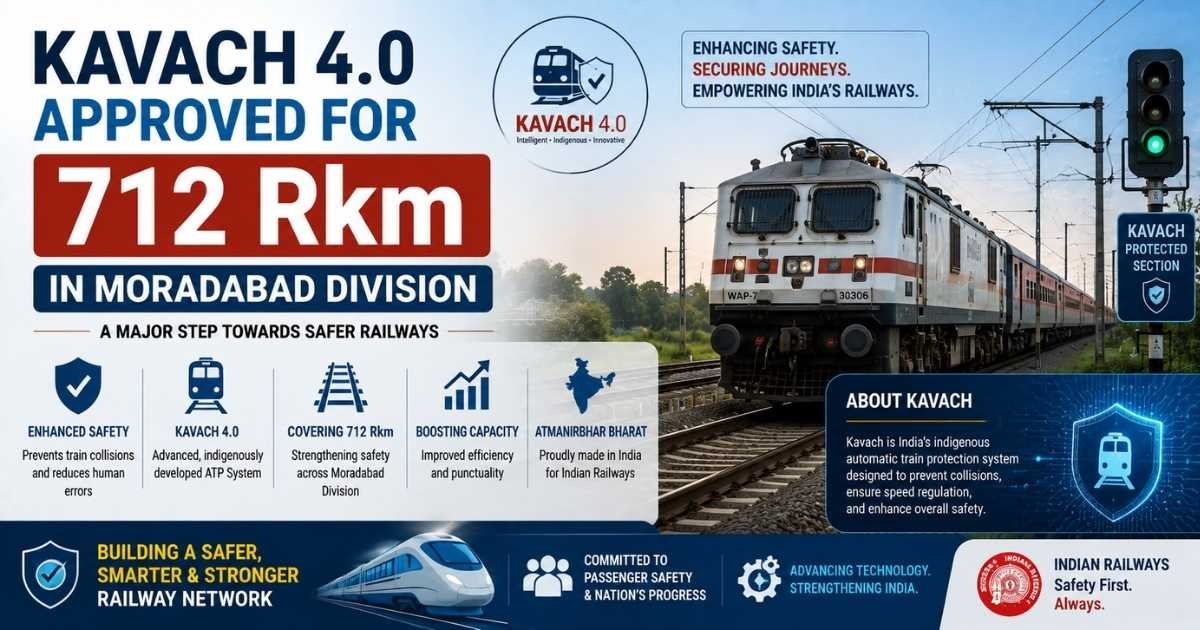
New Delhi: Indian Railways approved ₹170 crore to deploy Kavach 4.0 across 712 Route Kilometres of Moradabad Division. The project will strengthen railway safety on the remaining sections of the division.
The approved sections fall under Northern Railway. The work will expand coverage of the indigenous Automatic Train Protection system across the identified routes.
Kavach 4.0 will add an advanced safety layer to train operations. The system forms part of Indian Railways’ wider effort to improve train protection and signalling.
The approval also supports the expansion of Kavach coverage across the national railway network. In addition, it will help modernise safety systems on the covered sections.
The system is designed to address several risks during train operations. It can help prevent Signal Passing at Danger, known as SPAD.
When required, Kavach can automatically apply brakes to prevent unsafe situations. It can also control train speed during critical operating conditions.
These functions can reduce the risk of train collisions. Therefore, the deployment will strengthen safety measures on the identified routes.
Kavach 4.0 strengthens train protection
Kavach 4.0 is part of India’s indigenous railway safety technology. The Automatic Train Protection system works as an additional safeguard during train operations.
The new deployment will cover the remaining 712 Rkm of Moradabad Division. Indian Railways approved the work at a total cost of ₹170 crore.
The project will strengthen railway safety infrastructure in the division. It will also support the wider expansion of automatic train protection across Indian Railways.
Kavach uses automated interventions when operating conditions require them. It can help maintain safe speeds and respond to situations that could otherwise create operational risks.
Indian Railways has continued efforts to expand Kavach coverage across its network. The latest approval adds another 712 Rkm to these ongoing safety and modernisation efforts.
The initiative combines indigenous technology with upgraded railway signalling and train protection systems. As a result, the identified sections will gain an additional layer of protection for train operations.
