

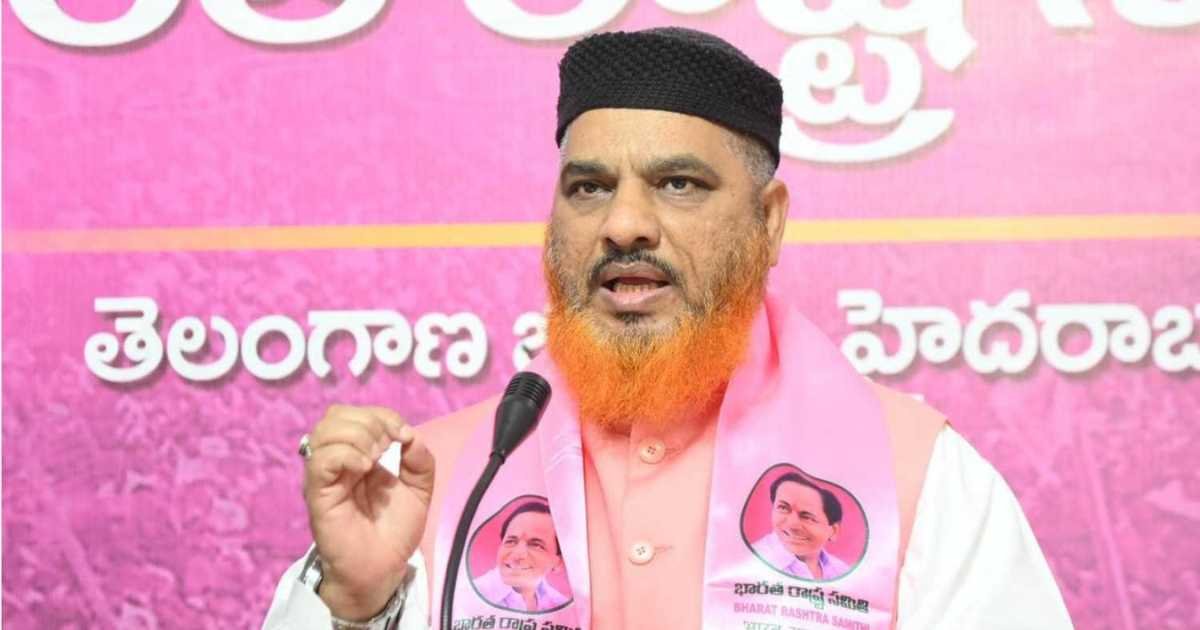
Hyderabad: Senior BRS leader Shaik Abdullah Sohail on Saturday accused the Congress government of failing to fully utilise minority welfare allocations. He also criticised AIMIM for not maintaining pressure on the government over pending welfare measures.
Sohail referred to figures presented during the recent Legislature session. According to the figures he cited, the government spent Rs 1,972.17 crore against Rs 5,100.97 crore allocated for minority welfare schemes over two financial years. The expenditure represented 38.7% of the total allocation, he said.
“This is not an allegation made by the Opposition. These are figures admitted by the government itself before the Legislature,” Sohail said. He argued that nearly two-thirds of the allocated amount remained unspent.
The BRS leader said utilisation fell further during the last financial year. The government spent Rs 1,010.63 crore against an allocation of Rs 2,844.02 crore, according to the figures he cited. That amounted to 35.5% of the allocation.
Sohail clarified that the figures covered the scheme budget. They did not include salaries, establishment expenses and other non-scheme expenditure of the Minority Welfare Department.
Minority welfare funds and implementation concerns
Sohail also said the government had acknowledged that minority welfare allocations did not correspond to the community’s 14.27% share of Telangana’s population. He alleged that budget announcements had not translated into adequate spending on welfare programmes.
“Congress makes grand announcements and displays impressive figures in Budget documents, but the money does not reach the ground,” Sohail said. He argued that unspent funds could not support education, poor families or employment.
The BRS leader then raised the issue of scholarships and fee reimbursement. He said the government had acknowledged pending payments across different communities during the Legislature session.
Sohail said minority students were among those affected by delayed payments. He also referred to the scholarship issue reaching the High Court earlier this year.
“Students do not study on Budget speeches. Colleges do not run on assurances,” he said. Sohail argued that delays in scholarships and fee reimbursement weakened the intended impact of welfare schemes.
He next criticised AIMIM over its role in raising minority issues. Sohail alleged that the party had reduced its interventions to what he described as “ceremonial interventions” inside the Assembly.
The BRS leader acknowledged that AIMIM legislators had raised fee reimbursement, scholarships and Waqf properties in the House. However, he said speeches and representations alone could not ensure implementation.
Sohail questioned AIMIM’s response to unspent minority welfare funds. He also asked about the party’s role during delays involving scholarships and payments to students and colleges.
“If AIMIM claims to be the voice of minorities, it cannot become vocal only when the Assembly microphone is switched on,” Sohail said. He added that accountability could not remain seasonal.
Minority welfare spending and Waqf protection
Sohail also targeted both Congress and AIMIM over Waqf property protection. He said Waqf properties had figured prominently in the Section 22-A controversy.
According to Sohail, pending matters included surveys, alleged encroachments and reconciliation of Waqf and revenue records. He also sought protection for disputed properties.
The BRS leader questioned whether fresh allocations could demonstrate commitment when earlier funds remained substantially unspent. “The government may announce another Rs 2,000 crore or Rs 3,000 crore tomorrow,” he said. “The real question is: how much will actually be released and spent?”
Sohail demanded publication of scheme-wise minority welfare data. He sought details covering allocations, releases, expenditure, beneficiaries and pending applications.
He said the recent Legislature session left two major questions unresolved. The first concerned the Congress government’s utilisation of allocated minority welfare funds. The second concerned AIMIM’s efforts to press the government on implementation.
“Minorities need neither Congress assurances nor AIMIM speeches,” Sohail said. He called for pending scholarships to be cleared, welfare schemes to be implemented and Waqf properties to be protected.
The Telangana government’s Minorities Welfare Department lists educational concessions, employment support and socio-economic development among its core functions. Its responsibilities include scholarships, training, employment schemes and protection of Waqf properties.
The latest figures cited by Sohail have therefore placed utilisation and implementation at the centre of his criticism. His remarks also brought scholarship payments, fee reimbursement and Waqf records into the wider debate over minority welfare in Telangana.
