
BRS backs Delimitation Bill, pledges support of three Rajya Sabha MPs

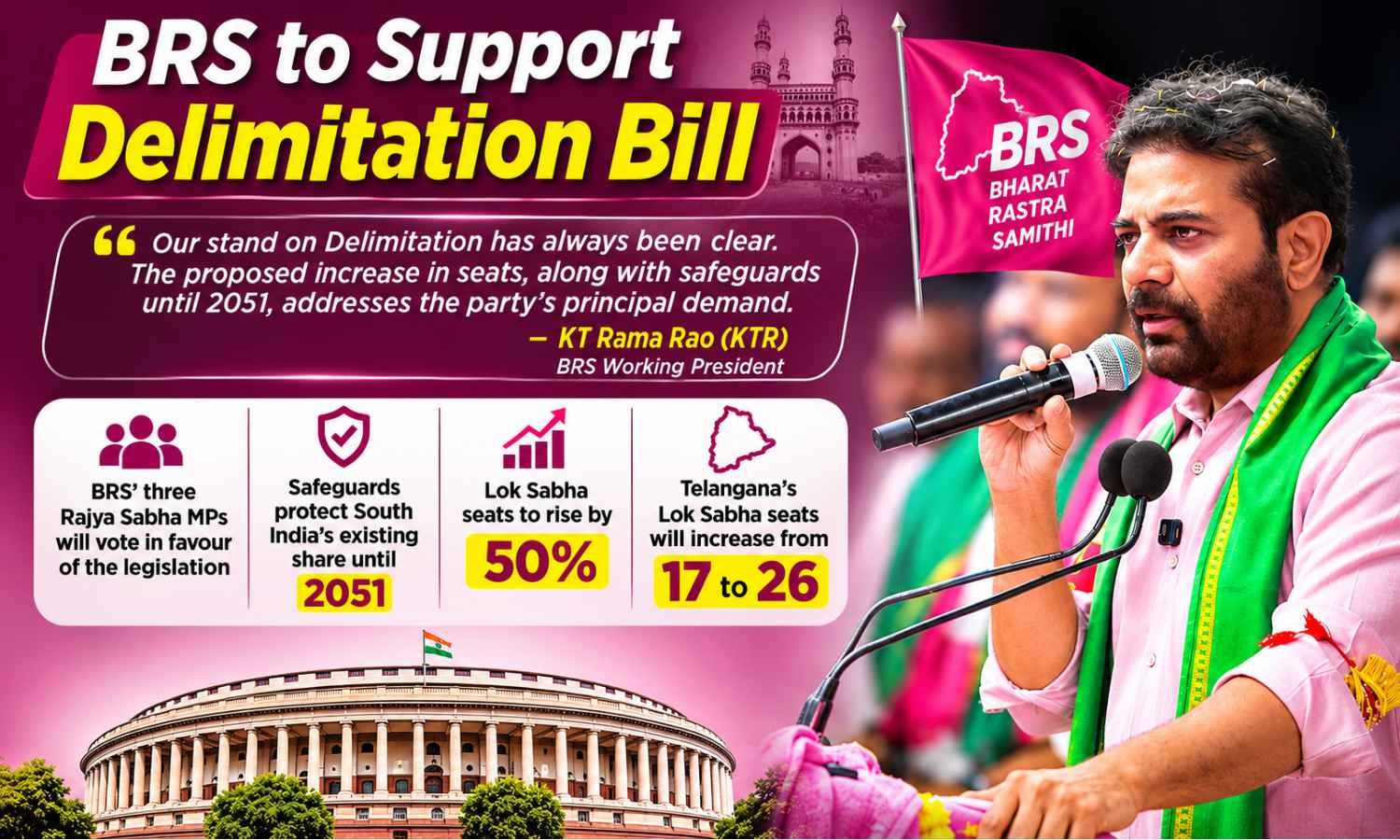
Hyderabad: The Bharat Rashtra Samithi (BRS) on Saturday announced its support for the proposed Delimitation Bill. Party working president K Taraka Rama Rao said its three Rajya Sabha MPs would vote in favour of the legislation. He cited safeguards protecting South India’s existing share of parliamentary representation as the main reason for the decision.
In a post on X, KTR said the proposed legislation addressed the party’s longstanding concerns over delimitation. The proposal seeks to increase Lok Sabha seats by 50 per cent while protecting the existing representation ratio between states until 2051. He said this would prevent southern states from losing their relative share of parliamentary seats.
KTR said the BRS had consistently demanded protection of South India’s existing 24 per cent share in Parliament. The party had opposed any delimitation exercise that reduced the region’s political influence despite its economic contributions and population-control measures. He maintained that the proposed safeguards addressed this concern without preventing an increase in parliamentary seats.
Under the proposed arrangement, Telangana’s Lok Sabha seats would increase from 17 to 26. KTR said the expansion would provide additional representation without reducing the state’s relative political strength. He described the protection of Telangana’s interests as the deciding factor behind the party’s support.
“Our stand on Delimitation has always been clear,” KTR said. He reiterated that the BRS would not accept any reduction in South India’s parliamentary representation or injustice to Telangana. However, he said the proposed increase in seats, along with safeguards until 2051, addressed the party’s principal demand.
“Keeping Telangana’s interests paramount, our three Rajya Sabha MPs will vote in favour of the proposal,” he announced. KTR also reaffirmed the party’s support for women’s reservation and its commitment to implementation.
The announcement marked a significant development in the BRS position on the proposed Delimitation Bill. The party had previously raised concerns that population-based redistribution could weaken the parliamentary influence of southern states. Its latest decision indicates support for expanding Parliament while maintaining the existing balance of representation between states.
KTR recalls earlier warnings over South India’s representation
Later on Saturday, KTR shared a video of his speech at the Fair Delimitation Joint Action Committee meeting in Chennai on March 22, 2025. He said the speech explained the party’s position on delimitation and its demand for greater protection of federal rights.
During that meeting, KTR had strongly opposed the redistribution of parliamentary seats solely on population figures. He argued that southern states should not face reduced political representation because they had successfully implemented population-control measures. He also questioned whether states with higher population growth should receive a larger share of parliamentary power.
KTR maintained that southern states had made substantial contributions to India’s economic development. However, he alleged that the Union government’s policies had failed to recognise their performance. He argued that political representation should not depend entirely on population while ignoring economic growth, governance and development.
Citing economic figures, KTR said Telangana accounted for 2.8 per cent of India’s population but contributed 5.2 per cent of national GDP. He also claimed that the five southern states together contributed 36 per cent of India’s GDP. He used these figures to argue that economically stronger states should not lose their relative influence in Parliament.
KTR had also criticised what he described as growing fiscal centralisation under the Union government. He alleged that the increasing use of cesses had affected the states’ share of central resources. According to him, reduced parliamentary influence could further weaken southern states in decisions concerning resource allocation and national policies.
At the Chennai meeting, KTR had proposed several alternatives to population-based redistribution. His principal suggestion was to preserve each state’s existing percentage of Lok Sabha seats even if Parliament expanded. He argued that this formula would increase the number of representatives without disturbing the political balance between states.
He had also suggested retaining the 1971 Census as the basis for a permanent freeze on seat allocation. Another proposal involved considering states’ fiscal contributions while determining their parliamentary representation. KTR argued that such approaches could recognise economic performance while protecting the federal structure.
The BRS leader had also raised the delay in increasing Assembly constituencies in Telangana and Andhra Pradesh. He recalled that the Andhra Pradesh Reorganisation Act provided for increasing Telangana’s Assembly seats from 119 to 153. Similarly, Andhra Pradesh’s strength was expected to rise from 175 to 225.
KTR questioned why these changes had not taken place despite the passage of more than a decade since bifurcation. He contrasted the delay with delimitation exercises conducted in Jammu and Kashmir and Assam. He alleged that the Union government had adopted different approaches depending on political considerations.
As another alternative, KTR proposed increasing Assembly seats across the country to improve people’s access to elected representatives. He argued that citizens generally approached MLAs more frequently than MPs to resolve local problems. Therefore, expanding state legislatures could strengthen representation without altering the existing parliamentary balance.
KTR had also called for wider consultations before implementing delimitation. He said the Union government should involve state governments, political parties, civil society organisations and other stakeholders. He maintained that major changes to parliamentary representation required broad agreement because they affected India’s federal structure.
The BRS working president reiterated that India was a Union of states and that federalism remained a constitutional right. He argued that no region should dominate another merely because of differences in population. He also warned against policies that could weaken smaller states or reduce their influence in national decision-making.
The BRS decision on Saturday reflected the central demand KTR had raised during the Chennai meeting. The proposed Delimitation Bill, according to him, would allow Telangana to gain additional Lok Sabha seats while protecting South India’s existing share. With these safeguards, the party has now committed the votes of its three Rajya Sabha MPs in favour of the proposal.
