

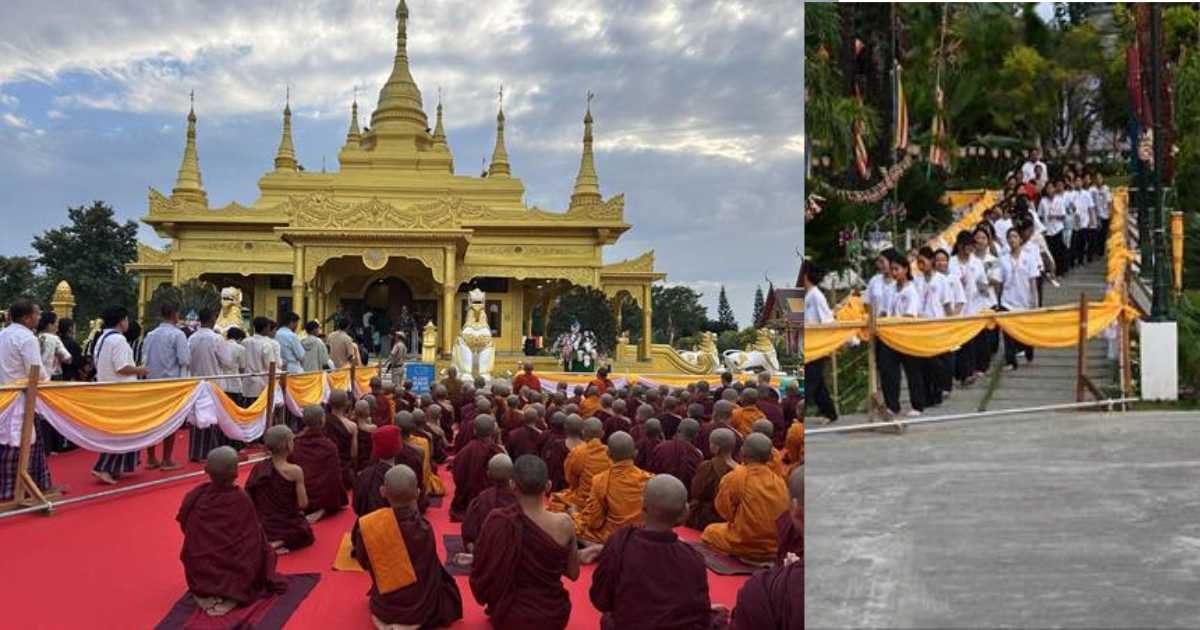
New Delhi: More than 12,000 devotees visited the Sacred Relics of Shakyamuni Buddha at the Golden Pagoda in Namsai on November 14 and 15. The exposition has attracted more than 78,000 visitors across three venues in Arunachal Pradesh. Tawang recorded over 31,000 visitors, while Bomdila received more than 35,000.
Devotees from Namsai district and neighbouring regions have gathered at the Golden Pagoda, also known as Kongmu Kham. They have offered prayers and paid homage to the sacred relics. Long queues at the venue reflect strong public interest and reverence for Buddhist traditions.
The Namsai event marks the third and final phase of the state-wide exposition. The programme runs from October 31 to November 21, 2026. Public darshan at the Golden Pagoda will continue from 6 am to 4 pm until November 20.
The exposition began at Gaden Namgyal Lhatse, or Tawang Monastery, on October 31. Union Minister for Culture and Tourism Gajendra Singh Shekhawat and Arunachal Pradesh Chief Minister Pema Khandu attended the inaugural ceremony. Buddhist monks and other distinguished guests also joined the event. The Tawang phase concluded on November 7.
The relics then moved to Thubchog Gatsel Ling Monastery, also known as Lower Gompa, in Bomdila. The six-day exposition there ran from November 8 to 13. Subsequently, the relics reached Namsai on November 14. Officials ceremonially received them and enshrined them at the Golden Pagoda.
Arunachal Pradesh Governor Lt Gen Kaiwalya Trivikram Parnaik (Retd.) inaugurated the Namsai exposition. Deputy Chief Minister Chowna Mein and International Buddhist Confederation Director General Raghav Prasad Bhatnagar attended the ceremony. State ministers, public representatives, Buddhist monks and other dignitaries also participated.
Buddha relics draw devotees from across the region
The district administration has announced a region-wise schedule to manage public participation. The arrangement aims to provide convenient access and ensure orderly movement. Devotees have been asked to follow the designated dates and cooperate with the authorities.
On November 16, the schedule covered Lathao Circle and Namsai Circle. On November 17, devotees from Piyong Circle and Lekang Circle were designated for darshan. The November 18 schedule covers Changlang, Jairampur, Bordumsa, Miao, Diyun, Tirap and Longding.
On November 19, devotees from Mechuka, Tuting, Gelling, Tezu, Anjaw (Meyor) and Lower Dibang Valley can visit. Defence personnel are also included on that date. Meanwhile, November 20 has been set aside for visitors from Assam and other northeastern States. Devotees who missed earlier dates can also attend on the final day.
The three venues have brought the sacred relics closer to people across Arunachal Pradesh. They have also highlighted the state’s diverse Buddhist traditions. Tawang and Bomdila are known for Mahayana and Vajrayana traditions. In contrast, Namsai has a strong Theravada Buddhist heritage.
The Golden Pagoda is an important centre of Theravada faith in eastern Arunachal Pradesh. The Tai Khamti, Singpho and other communities have preserved Buddhist traditions over generations. Their monasteries, festivals, art and religious practices form an important part of India’s Buddhist heritage. The Namsai event also gives devotees from eastern Arunachal Pradesh, Assam and other northeastern States an opportunity to pay homage.
The relics on display are preserved at the National Museum in New Delhi. They originated from Piprahwa in Siddharthnagar district of Uttar Pradesh. The site is associated with ancient Kapilavastu and the Shakya tradition of Lord Buddha. These objects hold exceptional historical, archaeological and spiritual significance.
The tradition of venerating Buddha’s relics began after his Mahaparinirvana. Devotees enshrined the relics in stupas, which became important centres of pilgrimage and devotion. The relics have returned to Arunachal Pradesh after a gap of 13 years.
Exhibitions showcase Piprahwa discoveries and Buddhist art
Two special exhibitions are open at the Golden Pagoda’s Meditation Centre. The National Museum and the International Buddhist Confederation have organised these displays. The first exhibition, titled “Unearthing the Sacred Piprahwa: The Story of the Holy Buddha Relics and Their Discovery”, presents the history of the Piprahwa relics.
Organised by the International Buddhist Confederation, it traces their discovery and subsequent archaeological excavations. It also explains the tradition of relic veneration and the objects’ spiritual importance. In addition, the exhibition presents the journey of the Piprahwa jewel collection. These precious objects returned to India in 2025 after more than a century.
The second exhibition, “Crossroads of Dhamma: Classical Legacies, Living Art, and Anthropological Perspectives”, has been curated by the National Museum. It showcases Buddhism’s artistic and cultural heritage. It also explores the influence of Buddhist teachings on art, culture and living traditions.
Both exhibitions aim to deepen public understanding of Lord Buddha’s life and teachings. They also highlight the importance of preserving India’s Buddhist heritage for future generations.
National initiatives support Buddhist heritage
The Centre has undertaken several initiatives to protect and promote Buddhist heritage under Prime Minister Narendra Modi’s leadership. These efforts include better infrastructure, connectivity and facilities at important pilgrimage destinations. The government has also promoted Buddhist scholarship, international conferences and cultural exchanges.
The recognition of Pali as a classical language in 2024 marked an important step in preserving Buddhist knowledge and literary traditions. Similarly, the return of the Piprahwa jewel collection in 2025 strengthened efforts to safeguard India’s cultural heritage.
India has also organised or supported sacred relic expositions in Mongolia, Thailand, Vietnam, Russia, Bhutan and Sri Lanka. These events have enabled devotees to pay homage and strengthened India’s cultural ties with Buddhist communities worldwide. Earlier this year, an exposition in Ladakh offered devotees in the Himalayan region an opportunity for public veneration.
The Namsai exposition continues these efforts by highlighting the Buddhist heritage of the northeastern Himalayan region. For more than two millennia, Lord Buddha’s teachings have guided people towards peace, compassion, wisdom and non-violence. These values remain relevant today.
The Ministry of Culture is organising the exposition with the Government of Arunachal Pradesh, the National Museum and the International Buddhist Confederation, New Delhi. Public darshan will continue until November 20. The sacred relics are scheduled to return to the National Museum in New Delhi on November 21, 2026.
