
Class 10 to 11 transition rate in India raises concerns as Telangana plans school reforms
By Shaik Ahmed Ali

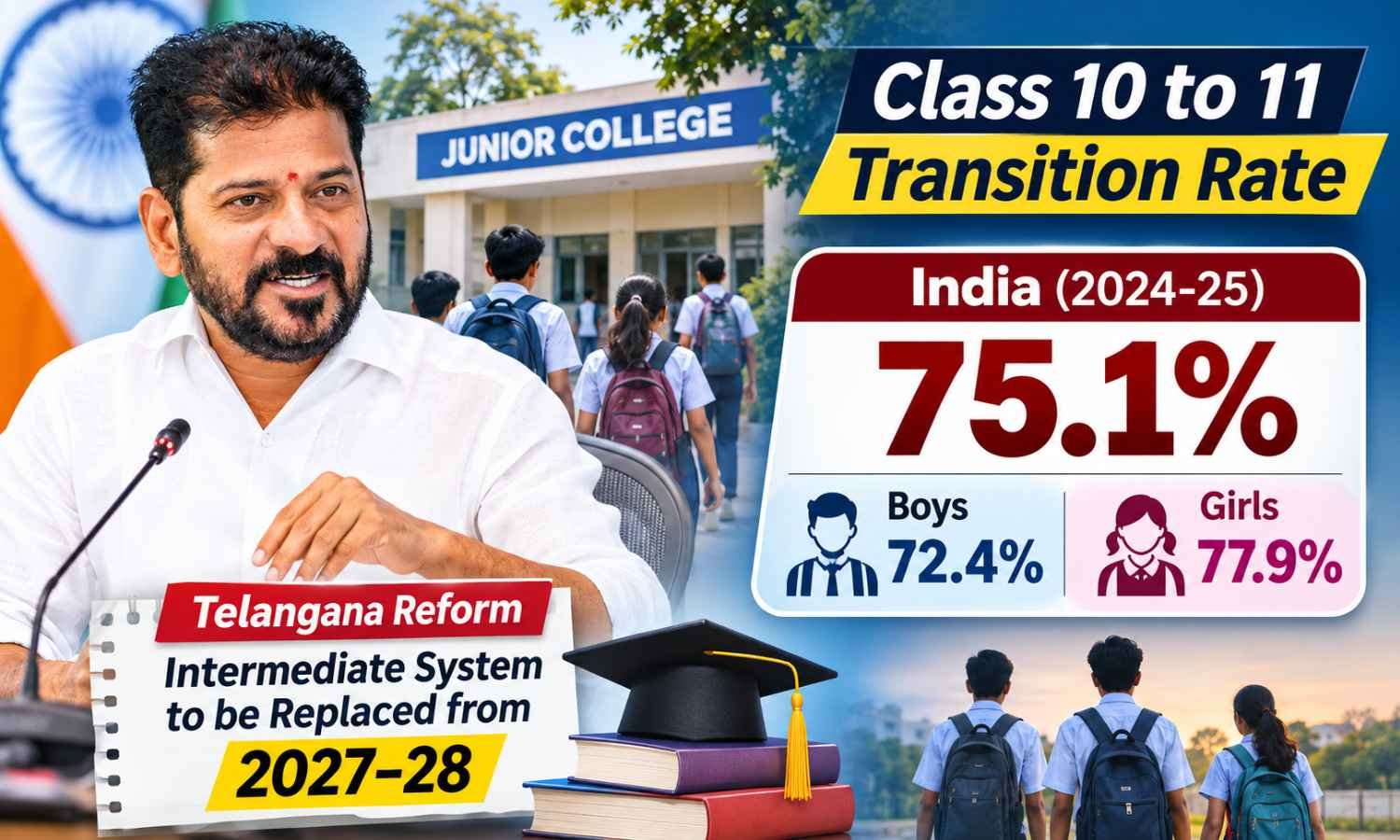
Hyderabad: The Class 10 to 11 transition rate in India stood at just 75.1 per cent in 2024-25, highlighting a persistent gap in the country’s education system despite significant improvements in access to elementary schooling. The issue has gained fresh attention following the Telangana government’s decision to replace its separate Intermediate education system with a continuous school structure from the 2027-28 academic year.
Chief Minister A. Revanth Reddy announced the proposed restructuring on Wednesday, directing officials to bring Classes 11 and 12 under the School Education Department. The move is intended to improve educational continuity, reduce dropouts and provide students with a more integrated academic environment. However, the national data raises a larger question: can merging schools and higher secondary institutions prevent students from discontinuing education, or does the problem require wider economic and social interventions?
According to NITI Aayog’s May 2026 report, “School Education System in India: Temporal Analysis and Policy Roadmap for Quality Enhancement”, the national transition rate from Class 10 to Class 11 was 75.1 per cent in 2024-25. The corresponding rate was 72.4 per cent for boys and 77.9 per cent for girls, indicating that a substantial proportion of students did not progress to the next stage in the recorded period.
The figures do not mean that every student who failed to enter Class 11 permanently dropped out of education. Some may have moved to vocational institutions, alternative academic programmes or other forms of training. Nevertheless, the data reveals a significant gap between secondary and higher secondary education that policymakers cannot ignore.
The problem becomes more evident when compared with earlier stages of schooling. NITI Aayog recorded a transition rate of 92.2 per cent from primary to upper primary and 86.6 per cent from upper primary to secondary education during 2024-25. The decline at successive stages indicates that retaining students becomes increasingly difficult as they advance through the education system.
Why the Class 10 to 11 transition rate remains a national concern
The transition from Class 10 to Class 11 represents a major educational and financial decision for millions of Indian families. Students must often choose new institutions, specialised subjects and career pathways at an age when they are still developing their academic interests. In several states, completing Class 10 also means leaving a familiar school and travelling to a higher secondary institution or junior college.
For economically weaker families, this transition can involve additional expenditure on tuition, books, transport and accommodation. Students living in rural areas may have to travel considerable distances because nearby institutions do not offer the required subjects. Others may be compelled to enter employment or support family occupations, particularly when household incomes are uncertain.
Academic difficulties also influence decisions about continuing education. Students who perform poorly in Class 10 may struggle to secure admission to preferred courses or lack the guidance needed to choose alternatives. The absence of counselling, vocational pathways and suitable institutions can further discourage continuation.
Social and geographical barriers add to these difficulties. Girls in some regions face concerns involving transport, safety and household responsibilities, while students from disadvantaged communities may experience multiple financial and institutional obstacles. Although girls recorded a higher national transition rate than boys in 2024-25, this does not mean gender-related barriers have disappeared across states and communities.
The availability of higher secondary institutions is another important factor. India has substantially expanded primary and upper primary schooling, but access to Classes 11 and 12 remains less uniform. Many students must change institutions after Class 10, increasing the possibility of discontinuing education.
Telangana’s proposed reform seeks to address part of this problem by integrating Classes 11 and 12 into the school education framework. Under the plan, Classes 9 to 12 will be treated as a specialised senior secondary stage. The government believes this arrangement can improve continuity while allowing students to develop stronger communication skills and subject knowledge before completing Class 12.
However, the presence of a continuous school system does not automatically guarantee higher retention. Students may still leave education because of financial hardship, family responsibilities, inadequate teaching or the unavailability of suitable courses. Therefore, the impact of institutional integration will depend on the supporting measures introduced alongside it.
Can Telangana’s school reforms offer a national solution?
The National Education Policy 2020 envisages a 5+3+3+4 curricular framework in which Classes 9 to 12 form the secondary stage. The policy promotes subject flexibility, multidisciplinary learning, critical thinking and greater continuity in education. Telangana’s proposed restructuring broadly reflects this approach, although the administrative merger of institutions is only one part of the wider educational reforms envisaged under the national policy.
India already operates different models of higher secondary education. Several states provide Classes 11 and 12 through schools, while Telangana and Andhra Pradesh have historically relied on separate Intermediate institutions. Other states follow combinations of higher secondary schools, junior colleges and different examination boards. These variations demonstrate that continuous schooling is feasible, but they do not establish that one structure automatically produces better learning or retention outcomes.
The Telangana Education Commission recommended several changes beyond merging educational institutions. These include creating a dedicated teaching cadre for Classes 9 to 12, discontinuing first-year Intermediate public examinations and separating competitive entrance examination coaching from regular academic instruction.
The Commission also proposed reducing dependence on entrance examinations by strengthening regular Intermediate assessments. Among its recommendations was replacing the state-level EAPCET examination with an admissions system based on improved Intermediate examination marks. These proposals have not all been adopted by the government, but they highlight the connection between school structure, examination pressure and educational quality.
Competitive examinations have become a dominant influence on higher secondary education in several parts of India. Students preparing for engineering and medical admissions frequently follow demanding schedules that combine school or college instruction with specialised coaching. While such preparation can improve examination readiness, excessive emphasis on entrance tests may restrict broader learning and increase academic pressure.
A continuous school system could provide an opportunity to restore greater balance between examination preparation and overall education. However, this would require curriculum changes, trained teachers, adequate laboratories, libraries and effective career guidance. Simply shifting students from junior colleges to senior secondary schools would not achieve these objectives.
Financial support is equally important. Scholarships, transport assistance, hostel facilities and affordable public institutions can determine whether students from disadvantaged families continue beyond Class 10. The Telangana Education Commission recommended strengthening government institutions and extending nutritional support to Intermediate students, with an estimated additional expenditure of around Rs. 200 crore annually for the proposed Mid-Day Meal Scheme extension.
Such measures could directly address some of the reasons students discontinue education. They also illustrate why reducing dropout rates requires investment beyond administrative restructuring.
For Telangana, the proposed 2027-28 transition offers an opportunity to examine whether greater institutional continuity can improve student progression. The government will need to establish clear benchmarks, including district-wise Class 10 to 11 transition rates, Class 12 completion rates, learning outcomes and enrolment among disadvantaged communities.
Annual publication of these figures would help assess whether the reforms produce measurable improvements. Comparisons with states following different higher secondary systems could also provide useful evidence for national policymakers.
India’s educational challenge is no longer limited to ensuring that children enter school. The greater task is to help them remain in education long enough to acquire meaningful qualifications and skills. Telangana’s proposed reforms may provide part of the solution, but the national transition figures suggest that institutional changes must be supported by financial assistance, quality teaching and accessible educational opportunities.
The real test will not be whether Classes 11 and 12 are administered by a school department or an Intermediate Board. It will be whether more students can successfully complete Class 12.
