
Crude prices fall more than 3% as Trump signals restraint on Iran; Brent below $95

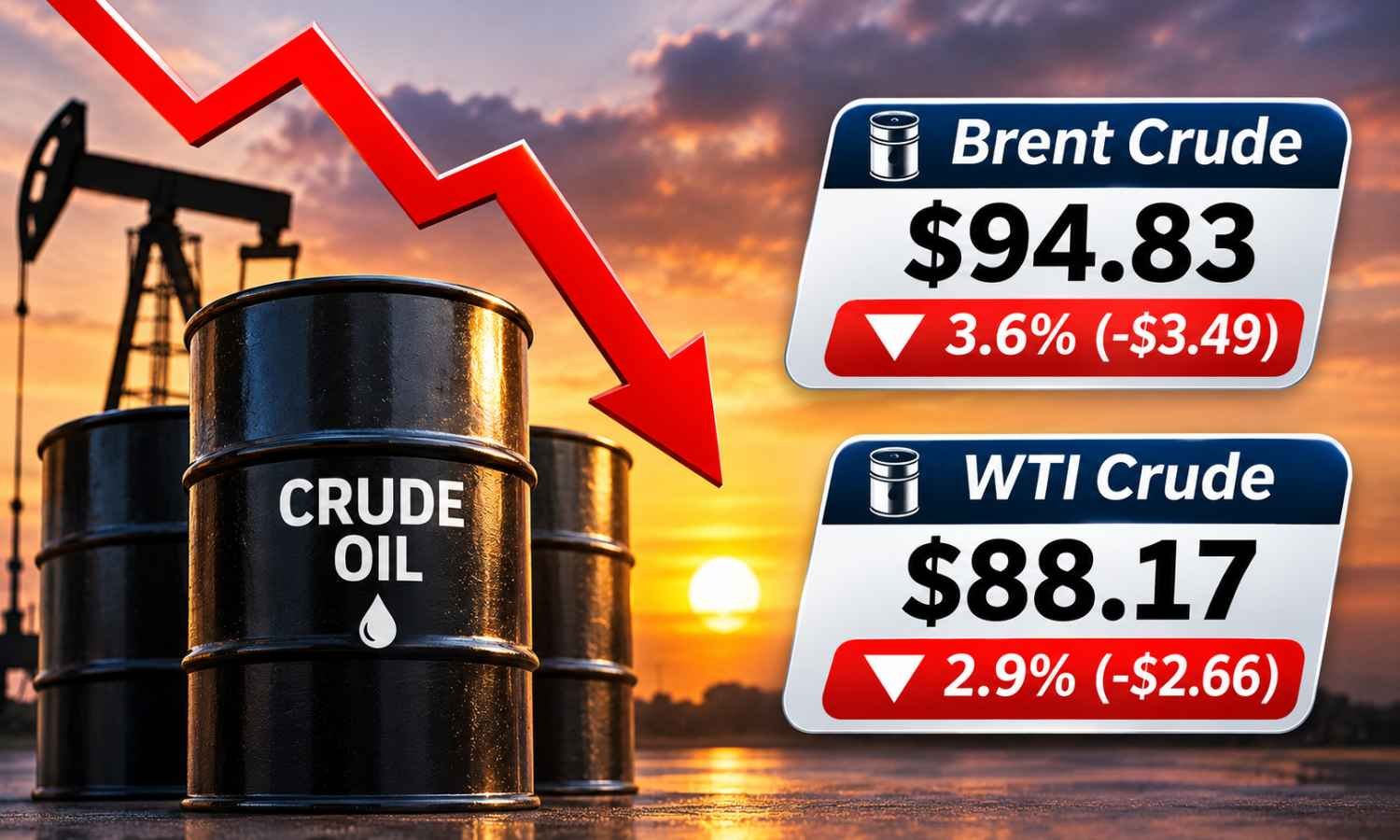
New Delhi: Global crude oil prices fell more than 3 per cent on Monday. President Donald Trump had indicated that further large-scale strikes on Iran looked unlikely if settlement talks advanced. Concerns over a growing supply surplus added to the decline. By 5.49 pm IST, Brent crude had dropped $3.49, or 3.6 per cent, to $94.83 a barrel. Similarly, US West Texas Intermediate (WTI) fell $2.66, or 2.9 per cent, to $88.17.
The losses extended the previous week’s steep fall. Last week, Brent lost roughly 16 per cent and hit $93.22, its lowest level in two months. That marked its sharpest weekly drop since the early days of the COVID-19 pandemic. After Trump’s Sunday remarks, traders cut the premium they had priced in for a long disruption of Gulf supplies.
The United States and Iran have remained in conflict since February. Military strikes, shipping restrictions and disputes over Iran’s nuclear programme have prevented a lasting settlement. Qatar continues to mediate. Yet wide gaps remain on sanctions, security guarantees and when Hormuz shipping can resume. Traders have mainly reacted to the lower chance of another major escalation, not to concrete progress in talks.
Supply glut adds to pressure on crude oil prices
Supply trends have also weighed on the market. A JPMorgan report last week said supply had moved above consumption. It cited recovering West Asian flows, higher output elsewhere and softer demand. The bank put the surplus at 1.1 million barrels per day in September. By October, the gap had widened to 1.4 million barrels per day. UBS analyst Giovanni Staunovo also noted weakness in the physical market, citing relatively strong flows from West Asia.
Security risks, however, have not gone away. Attacks on vessels in and around the Strait of Hormuz continue. On Sunday, the Houthi movement claimed responsibility for striking Saudi Aramco offices in Riyadh. In Russia, a Ukrainian drone strike reportedly started a fire at the Kirishi refinery on Monday. Even so, investors gave more weight to the chance of diplomatic de-escalation and better oil supply.
For India, a sustained fall in crude would cut the oil-import bill and ease pressure on the trade deficit. It would also help contain inflation. Moreover, lower input costs would benefit transport, aviation, chemicals and manufacturing. Any relief at the pump, however, will depend on domestic pricing decisions and taxes. The rupee’s exchange rate and the duration of the fall will also matter.
Analysts are now watching whether Brent can slide towards $93 a barrel. New Delhi-based market analyst Sugandha Sachdeva sees that level as near-term support. She cautioned that a geopolitical risk premium will likely remain in prices. In her view, it will fade only when diplomacy brings a steady return to normal shipping through Hormuz.
In the near term, crude prices will track US–Iran talks, shipping security and global supply. Monday’s fall has eased some immediate worry over energy costs. Still, the risk of renewed hostilities continues to hang over the market.
