

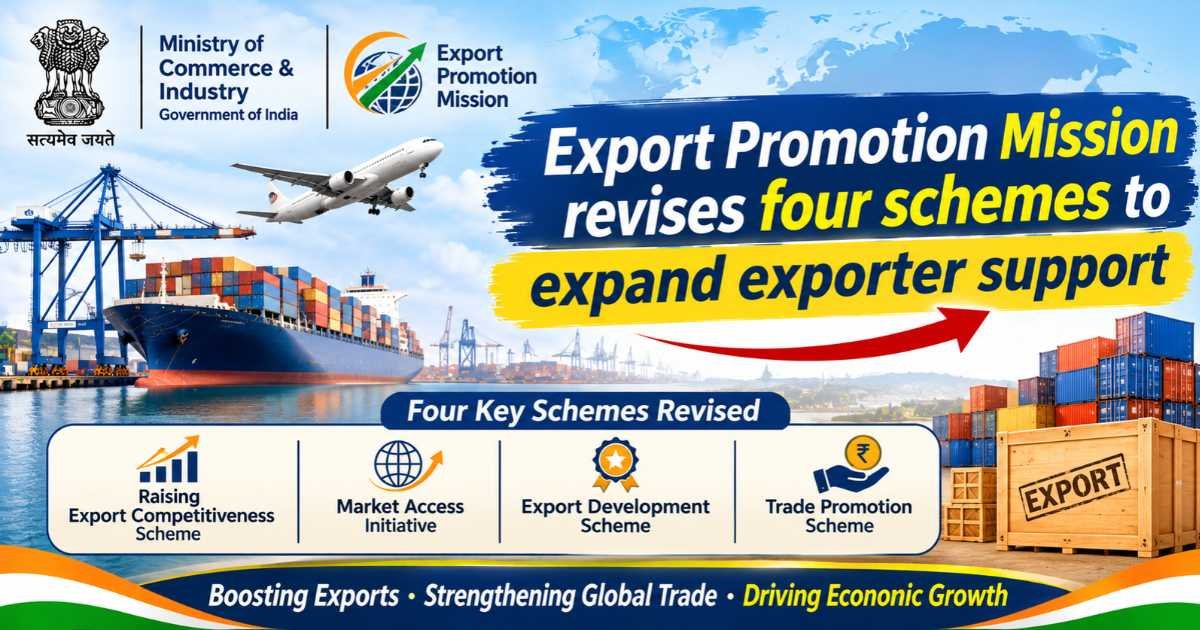
New Delhi: The Department of Commerce has amended four interventions under the Export Promotion Mission to expand support for Indian exporters. The changes took effect on 17 November 2026 under the Mission’s Niryat Disha sub-scheme. They cover market access, certification assistance and logistics support.
The revised interventions are Market Access Support (MAS), Trade Regulations, Accreditation and Compliance Enablement (TRACE), and Logistics Interventions for Freight and Transport (LIFT). The changes aim to widen participation in international trade and address challenges faced by exporters, particularly micro, small and medium enterprises (MSMEs).
Under MAS, exporters receive support for Buyer-Seller Meets, Reverse Buyer-Seller Meets, trade fairs, exhibitions and other market access activities. The revised guidelines raise the maximum eligible export turnover for airfare reimbursement from ₹75 lakh to ₹50 crore in the preceding year.
The reimbursement rate has also increased. Micro and Small Exporters can now receive up to 95 per cent of eligible airfare costs. Other eligible exporters can receive up to 80 per cent. Additionally, the mandatory membership period with Export Promotion Councils has been reduced from six months to three months.
Export Promotion Mission widens certification and logistics support
The TRACE intervention helps MSMEs meet international quality, safety and technical standards. It covers compliance and quality certifications, along with mandatory and voluntary conformity-assessment requirements. The amended guidelines expand the list of certificates eligible for reimbursement from 462 to 600. This change allows more businesses to access certification support for overseas markets.
The LIFT intervention addresses freight costs and transport gaps in areas with low export intensity. It aims to reduce logistical disadvantages faced by MSMEs because of their location. The revised guidelines expand coverage from 13 States and Union Territories to 34.
The eligible port categories now include Land Customs Stations and Integrated Check Posts. The intervention also adds waterways to the existing transport modes of road, rail and air. Meanwhile, air freight support now covers Jammu and Kashmir and Ladakh, in addition to the North Eastern Region.
The minimum distance requirement between origin and destination ports has also been reduced. Exporters can now qualify for support when the distance is at least 100 km, down from 200 km. Furthermore, the scheme covers all exportable merchandise, except products and export categories listed in the negative list.
The Union Cabinet approved the Export Promotion Mission on 12 November 2025. It carries an outlay of ₹25,060 crore for FY 2025-26 to FY 2030-31. The Mission aims to improve India’s export competitiveness through targeted financial and non-financial assistance. It gives particular attention to MSMEs, first-time exporters and under-represented regions.
The Mission operates through two integrated sub-schemes. Niryat Protsahan facilitates access to trade finance, while Niryat Disha supports market access and addresses non-financial barriers to exports. So far, authorities have operationalised 11 interventions under the two sub-schemes.
The latest amendments seek to strengthen exporters’ participation in international trade events. They also widen access to certification assistance and address freight challenges. The measures place particular emphasis on MSMEs in regions with lower export activity.
