

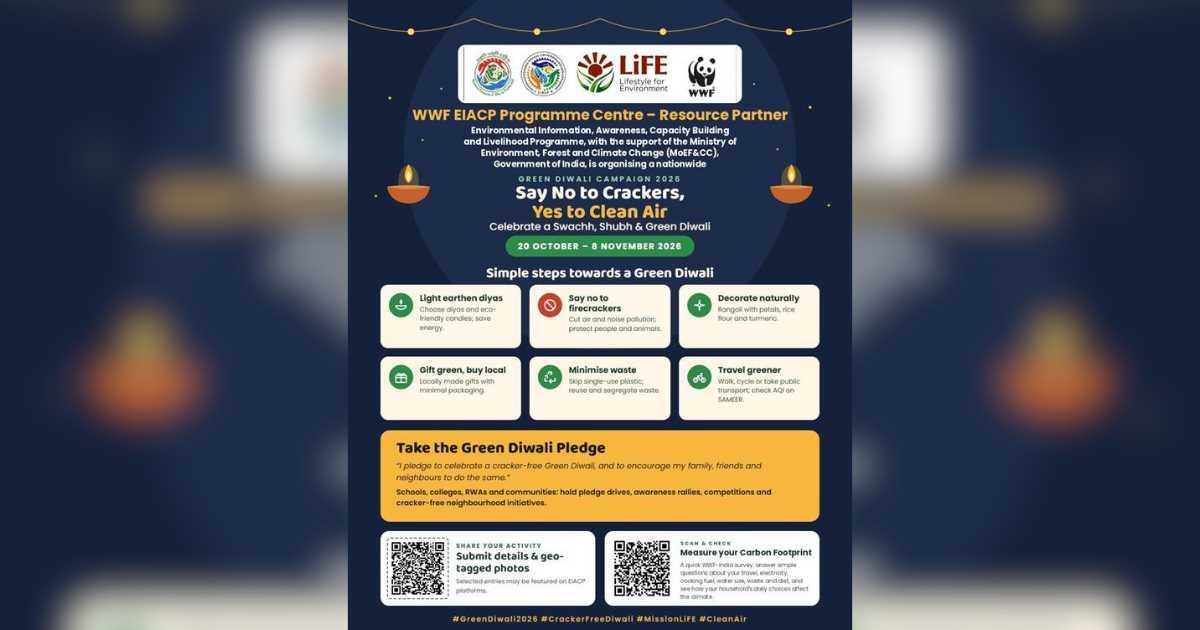
New Delhi: WWF-India’s Programme Centre – Resource Partner (PC-RP) has launched a nationwide Green Diwali Campaign, which runs from 20 October to 8 November 2026. The Union Ministry of Environment, Forest and Climate Change supports the centre. The campaign urges citizens to avoid firecrackers and celebrate a clean and green Diwali in line with Mission LiFE (Lifestyle for Environment).
The campaign will reach schools, colleges, educational institutions, resident welfare associations and local communities. It will place a special focus on the 130 cities covered under the National Clean Air Programme (NCAP).
WWF-India encourages citizens to take the Green Diwali Pledge. Under the pledge, they promise to avoid firecrackers and urge family and neighbours to do the same. They also commit to using diyas and energy-efficient lights, avoiding single-use plastic, segregating waste and choosing local products. Moreover, the campaign encourages educational institutions and community groups to organise pledge drives during assemblies, classes, rallies and community meetings.
Green Diwali Campaign: Carbon Footprint Survey and activity reports
WWF-India also encourages citizens to take its Carbon Footprint Survey. The survey helps people understand how their daily activities and consumption contribute to their environmental footprint. It also helps them identify more sustainable habits. The survey is available at https://wwfindiawebgis.in/Carbon_Footprint/Carbon_Footprint.html.
The organisers request schools, colleges, EIACP centres, community groups and individuals taking part in the Green Diwali Campaign to share details of their activities through an online form. The form is available at https://docs.google.com/forms/d/15hDbjbqZzeo68kNjAxeHQA_SMIQ7lUlPdvCIi-gvwdY/viewform.
Submissions should include the institution or organisation’s name and location, activity details and date, and the number of participants who took the pledge. They should also carry geo-tagged photographs and a brief report. EIACP may feature selected entries on its websites and social media platforms.
