
Indian Railways rolls out Trucks-on-Trains to shift freight from road to rail

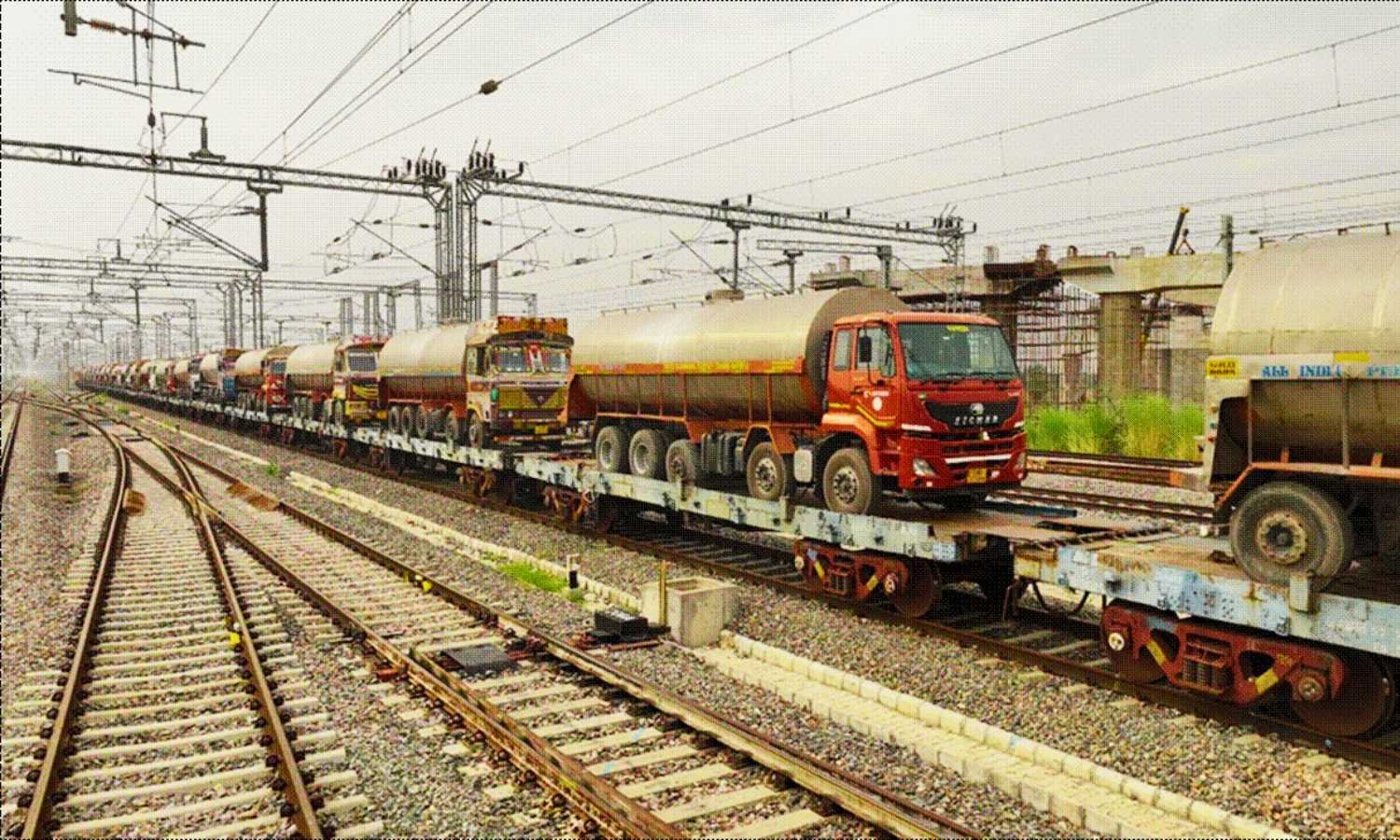
New Delhi: Indian Railways has rolled out the Trucks-on-Trains service on its Dedicated Freight Corridor to shift long-haul freight from road to rail, reduce logistics costs and cut emissions, officials said on Thursday.
The initiative, implemented through the Dedicated Freight Corridor Corporation of India Limited, allows loaded trucks to travel on specially designed flat wagons for the main haul. As a result, trucks avoid long highway journeys and use roads only for first- and last-mile movement.
Officials said the service combined the flexibility of road transport with the efficiency of electrified rail corridors. It aimed to ease highway congestion, lower diesel consumption and improve supply chain reliability as freight volumes rise with economic growth.
At present, Trucks-on-Trains operates between New Rewari and New Palanpur on the Western Dedicated Freight Corridor. The corridor spans about 636 kilometres and cuts transit time from nearly 30 hours by road to around 12 hours through the integrated road–rail model.
Dedicated Freight Corridor enables modal shift in freight movement
According to Indian Railways, the service has gained commercial traction in the current financial year. Between April and December 2025, Trucks-on-Trains handled 545 rakes, moved over 3 lakh tonnes of freight and generated revenue of ₹36.95 crore.
New Palanpur accounted for 273 rakes, carrying more than 2 lakh tonnes and earning ₹20.18 crore. Meanwhile, New Rewari handled 272 rakes, moved around 0.1004 million tonnes and generated ₹16.76 crore. Officials said dairy and FMCG cargo formed a major share of these movements.
The service follows a transparent pricing structure based on weight slabs. Charges range from ₹25,543 per wagon for trucks up to 25 tonnes to ₹32,000 for loads up to 58 tonnes, while empty trucks attract lower rates. Notably, milk tankers are exempt from GST to support the dairy sector.
Indian Railways said the service had already completed more than 1,955 trips since inception, moved over one million tonnes of freight and earned cumulative revenue exceeding ₹131 crore. Strong demand from sectors such as dairy, automobiles and food processing has reinforced confidence in the model.
Officials highlighted that the fully electrified Dedicated Freight Corridor helped reduce carbon dioxide emissions, fuel use and road dust pollution. On the Palanpur–Rewari stretch alone, the modal shift removes nearly 48,875 trucks from highways, saves about 88.81 lakh litres of diesel and avoids over 2.30 lakh tonnes of CO₂ emissions.
Looking ahead, DFCCIL plans to expand the service to additional corridors, introduce new wagon designs and add more terminals. Officials said Trucks-on-Trains formed a core part of India’s multimodal logistics strategy, aligning efficiency, sustainability and economic growth.
