

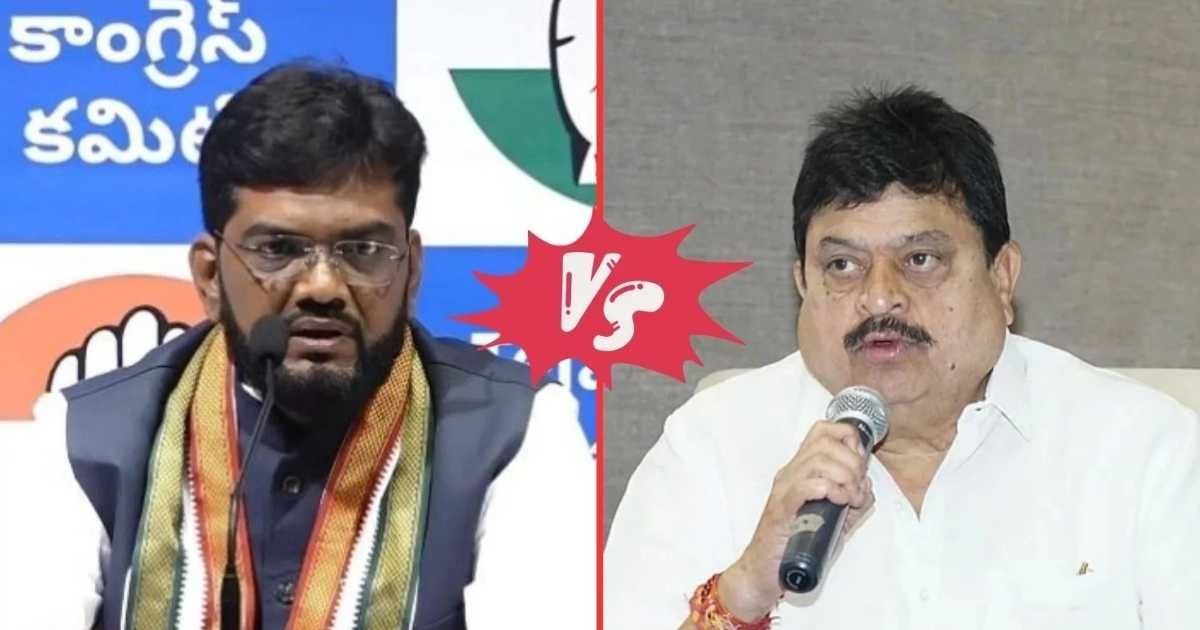
Hyderabad: Hyderabad DCC President Syed Khalid Saifullah challenged Telangana BJP President N. Ramchander Rao over his minority welfare claims on Monday.
Saifullah demanded documentary proof for Rao’s claim that minorities formed 22% to 37% of beneficiaries under Central welfare schemes.
He said government documents did not support those figures. Therefore, he asked Rao to withdraw the claim and apologise if he could not provide evidence.
The DCC president referred to Pradhan Mantri Mudra Yojana, Pradhan Mantri Jan Dhan Yojana and Pradhan Mantri Ujjwala Yojana.
According to Saifullah, official data showed a much lower minority share under Mudra. He said the share stood at about 8% to 14% across different years.
“Mr Ramchander Rao is the president of a national party’s Telangana unit. When he quotes figures concerning crores of citizens, he has a responsibility to produce evidence,” Saifullah said.
He added that Government of India documents did not support the figures presented by the BJP leader.
Saifullah cited the NITI Aayog impact assessment of Pradhan Mantri Mudra Yojana. The report was issued in November 2023.
He referred to Table 24 of the report. The table, according to Saifullah, showed minority shares of about 12%, 13%, 11%, 10%, 10%, 8% and 14% between 2015 and 2022.
The DCC chief also separated the number of accounts from the amount disbursed. He said the minority share of total Mudra lending did not exceed 12% during the cited period.
Saifullah also cited a Union Finance Ministry press release dated October 29, 2024. He said minority borrowers received ₹45,088 crore under Mudra during 2023-24.
He calculated that the amount represented about 8.5% of total lending under the scheme. An SBI research report, he added, placed the minority share at around 11%.
“Eight per cent, eleven per cent, fourteen per cent – where is the 22% to 37% that the BJP President is claiming?” Saifullah said.
The DCC president said these figures came from government institutions and documents. He then questioned the basis for Rao’s higher figures.
Saifullah also questioned the claims concerning Jan Dhan and Ujjwala. He said the Jan Dhan application did not seek an applicant’s religion.
Likewise, he said the Ujjwala application used categories such as General, SC, ST and OBC. According to him, those forms did not provide data to support a nationwide religion-wise beneficiary percentage.
Minority welfare claims raise questions over data sources
Saifullah asked the government to disclose the source and method used to calculate any nationwide religion-wise beneficiary percentages.
He also questioned how the BJP arrived at a precise figure such as 37%. In his view, the available application data did not explain such a calculation.
The DCC president referred to a similar figure cited by former Union Minority Affairs Minister Mukhtar Abbas Naqvi in the Lok Sabha in March 2022.
Saifullah said Naqvi had referred to a “study” while discussing the figure. He challenged the BJP to release that study publicly.
He sought the study’s title, author, methodology and underlying data. Moreover, he said journalists and researchers should be able to examine its findings.
“If this study exists, publish it. Let journalists, researchers and the people of Telangana examine it,” Saifullah said.
He argued that a political speech could not replace verifiable government data. The DCC president said claims involving large beneficiary numbers required clear evidence.
Saifullah also criticised the BJP over minority education schemes. He alleged that the party was presenting continued support despite the discontinuation of several major schemes.
He cited a Lok Sabha reply dated February 4, 2026. Union Minority Affairs Minister Kiren Rijiju had given the reply on the pre-matric, post-matric and merit-cum-means scholarship schemes.
The DCC president also referred to the discontinuation of the Maulana Azad National Fellowship, Padho Pardesh and Nai Udaan.
In addition, he highlighted an earlier reduction in the Ministry of Minority Affairs’ budget. Saifullah said the allocation had fallen from ₹5,020 crore to ₹3,097 crore.
“You cannot discontinue schemes and scholarships on one hand and then go before minorities and present the record as extraordinary generosity on the other,” Saifullah said.
He maintained that people deserved facts rather than selective statistics. Saifullah also said welfare claims should rely on figures that the public can verify.
The Hyderabad DCC president then directly challenged Ramchander Rao to release documentary evidence for the 22% to 37% claim.
“Mr Ramchander Rao, I am putting the Government of India’s own documents on the table. Now put yours on the table,” Saifullah said.
He demanded publication of the study and official data behind the claim. If Rao could not substantiate the figures, Saifullah asked him to withdraw them.
Saifullah further demanded an apology to Telangana’s minorities if the figures could not be supported.
The dispute centred on the source and interpretation of beneficiary data from Central welfare schemes. Saifullah maintained that the figures he cited did not support Rao’s claim.
At the same time, he questioned whether some schemes collected enough religion-wise information to support precise nationwide percentages.
The DCC president also brought minority education support into the wider debate. He cited discontinued scholarships and fellowships while questioning the BJP’s presentation of its welfare record.
Saifullah said the public should examine both the available government data and the evidence behind competing claims. He called for greater transparency when leaders cite beneficiary figures.
The minority welfare claims dispute therefore remained focused on the evidence behind the 22% to 37% figures. Saifullah said Rao should either publish the supporting material or withdraw the figures and apologise.
