

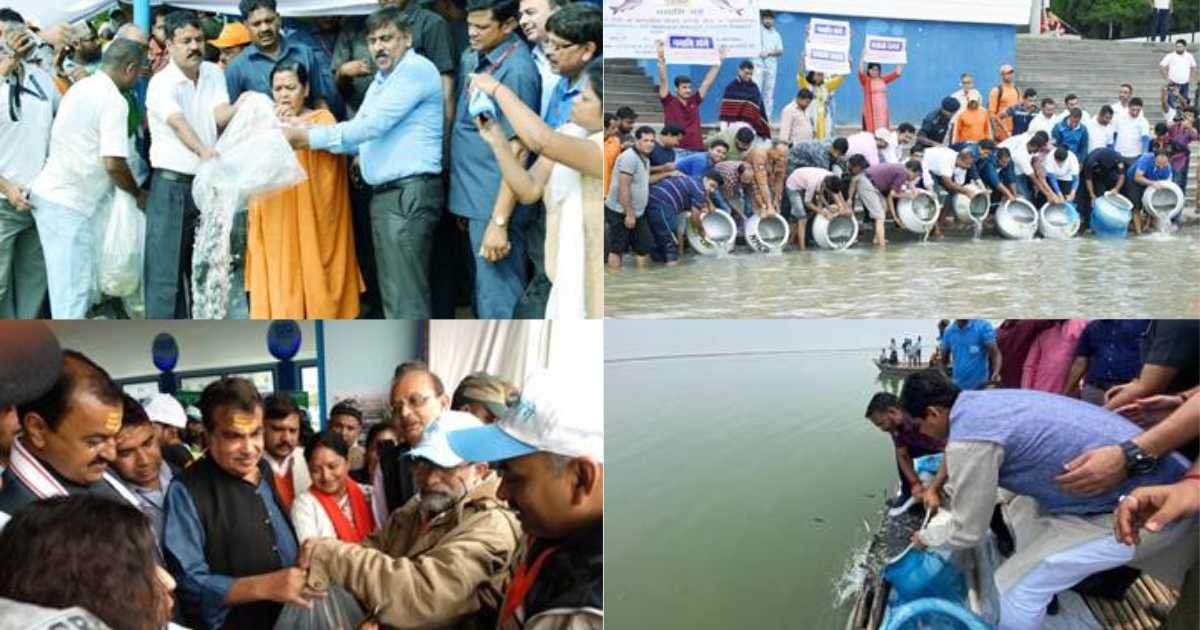
New Delhi: The Government of India said Namami Gange river ranching restored indigenous fish stocks in the River Ganga through 169 scientific interventions between 2017 and 2025.
Under the Namami Gange Programme, the ICAR–Central Inland Fisheries Research Institute released 205.5 lakh indigenous fish seeds across ecologically critical stretches of the Ganga and its tributaries. The initiative focused on conserving native species, protecting genetic integrity and strengthening sustainable riverine fisheries.
Officials said the institute used fingerlings and advanced fingerlings measuring 10–15 cm with an average weight of 100–120 grams. The team artificially bred the seed from wild brooders collected from the Ganga. It then reared them under controlled hatchery and nursery conditions before release.
The spatial strategy targeted areas where ecological value and fishing dependence intersect. West Bengal accounted for 68% of the 169 interventions. Bihar followed with 17%, while Uttar Pradesh had 9%. Jharkhand recorded 5%, and Uttarakhand accounted for 1%.
Namami Gange river ranching records measurable fish gains
The ministry reported measurable gains at key river centres. Prayagraj recorded a 24.7% rise in Indian Major Carp landings. Varanasi recorded a 41% increase. Officials attributed these gains to sustained Namami Gange river ranching and conservation measures.
In 2025, ICAR-CIFRI developed artificial breeding of hilsa using cryopreserved milt and brood females from the Hooghly estuary. The institute released 3.82 lakh Hilsa adults upstream of the Farakka barrage. It tagged 6,031 fish. It also released 54.91 lakh fertilised Hilsa eggs and 8.06 lakh spawn to support natural populations.
In a landmark first, the institute estimated annual fish catches in major rivers. It recorded 15,134 tonnes in the Mahanadi and 18,902 tonnes in the Krishna. India has now become the world’s top inland capture fish producer with 1.89 million tonnes annually, surpassing China.
ICAR-CIFRI also developed sustainable management protocols for four major estuaries and three brackishwater lakes. Reservoir productivity rose from 20 to 150 kg per hectare per year. Wetland productivity increased from 600 to 1,600 kg per hectare per year. These efforts led to national reservoir fisheries management policy guidelines in 2025.
Established in 1947 at Barrackpore, West Bengal, ICAR-CIFRI continues to advance ecosystem-based fisheries research. Officials said Namami Gange river ranching demonstrates that science-based interventions can restore depleted native fish stocks while supporting livelihoods and biodiversity.
