

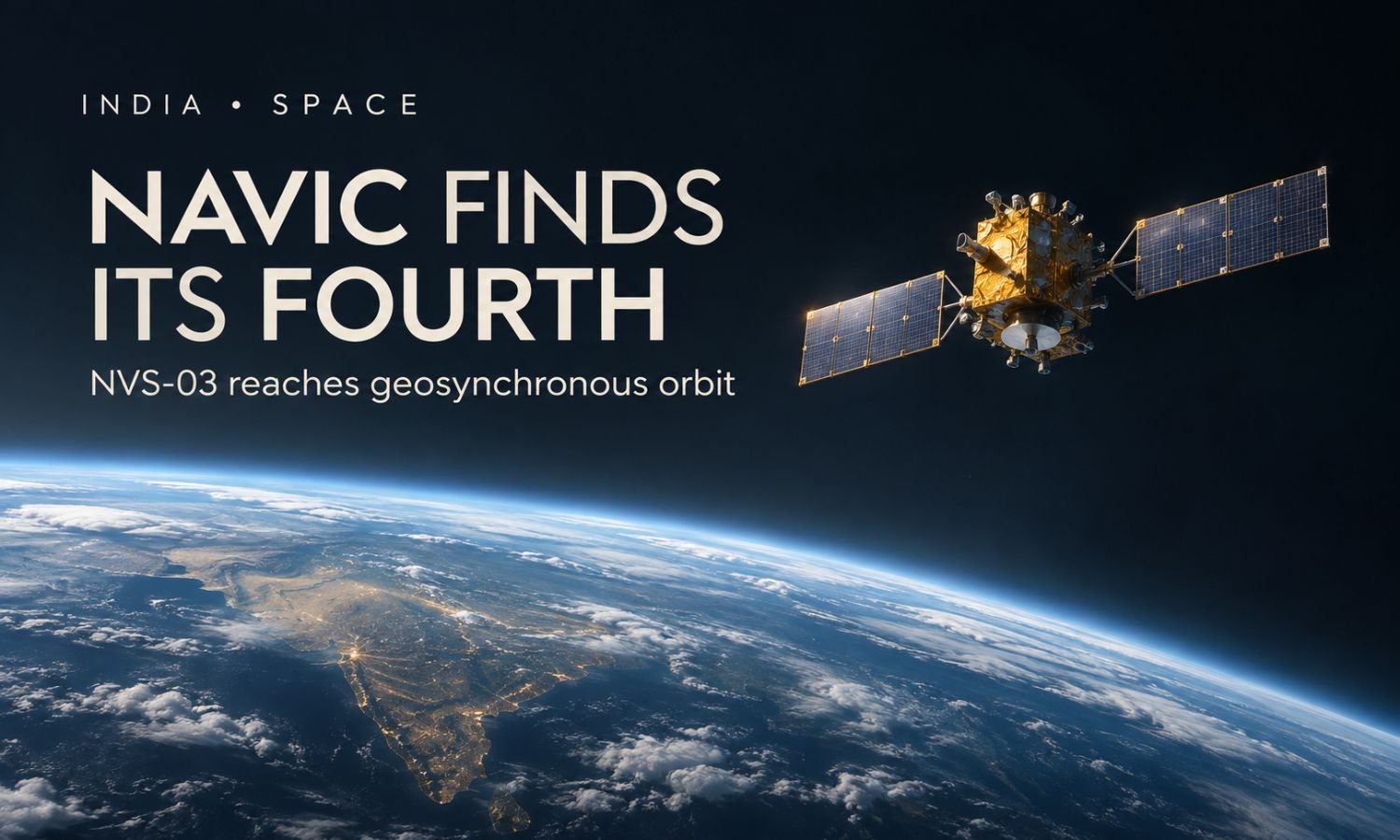
Sriharikota: Four NavIC satellites are working again after the Indian Space Research Organisation (ISRO) placed the NVS-03 navigation satellite in orbit, restoring the minimum needed for India’s own positioning service after a seven-month gap.
A GSLV-F18 rocket lifted off from Sriharikota around midnight on Friday with the 2,250-kg satellite. It was ISRO’s third launch of the year.
The rocket placed NVS-03 in a geosynchronous transfer orbit. The satellite’s onboard engines will raise it to its final orbit over about a week. “The solar panels of the satellite have been deployed and the spacecraft is in good health,” said D K Singh, Director of ISRO’s U R Rao Satellite Centre.
ISRO Chairman V Narayanan said the launch had restored the country’s Position, Navigation and Timing (PNT) services. He called NavIC a strategic national asset that gives India independent access to these services.
NavIC, short for Navigation with Indian Constellation, was earlier called the Indian Regional Navigation Satellite System (IRNSS). It covers India and an area of about 1,500 km around it.
A receiver needs signals from at least four satellites to work out latitude, longitude, altitude and time on its own. For months, NavIC had only three.
In July, the Centre acknowledged that the constellation could not provide standalone positioning because only IRNSS-1B, IRNSS-1I and NVS-01 were working. Timing services continued.
Four NavIC satellites leave little margin
The four working satellites are now IRNSS-1B, IRNSS-1I, NVS-01 and NVS-03. One failure would take the system below the minimum again.
IRNSS-1B has outlived its expected 10-year life and could stop working at any time. IRNSS-1I may last until about 2028. NVS-01, the first second-generation satellite, is expected to work for at least another decade.
The system was designed for seven satellites, three in geostationary orbit and four in geosynchronous orbit, so that service continues even if one or two go offline.
The programme has faced repeated setbacks. NVS-02, launched in January 2025, was left stuck in its initial orbit after its engines failed to raise it, and is of very limited use. At one stage, only four of the 11 satellites launched for the system were working.
NVS-03 carries an indigenous atomic clock along with procured atomic clocks. Faulty atomic clocks had earlier knocked out several first-generation satellites.
A more reliable system needs NVS-04, NVS-05 and NVS-06 to be launched in quick succession, along with backup satellites, to take the fleet to six or seven. No launch dates have been announced for them.
NavIC grew out of lessons from the 1999 Kargil War and was built at a cost of about $525 million.
During the outage, the armed forces and most civilian users relied on NavIC alongside GPS, Galileo and GLONASS. The government said this multi-system setup meant users faced no major disruption.
