

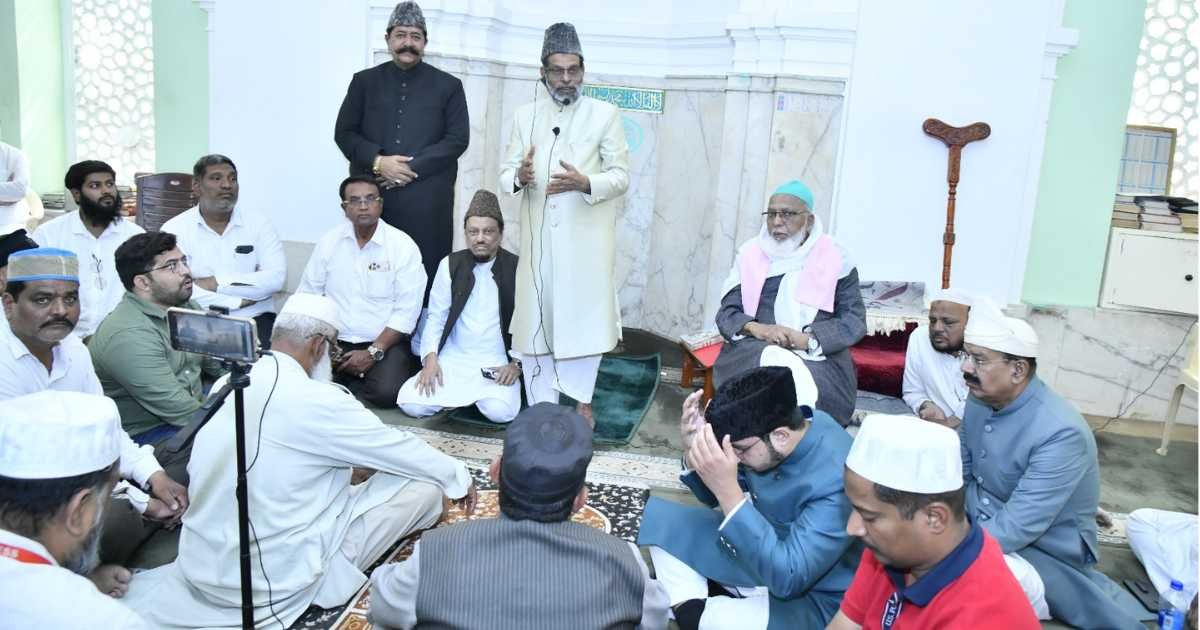
Hyderabad: Tahreek Muslim Shabban on Thursday sought a Nizam state award for contributions to education and healthcare. The organisation also urged the Telangana Government to include the Seventh Nizam’s public services in the educational syllabus.
The demands came at a public meeting at Masjid-e-Judi in King Koti. The organisation held the meeting in connection with the 1948 Police Action and to commemorate the legacy of the Nizam of Deccan.
Tahreek Muslim Shabban president Muhammad Mushtaq Malik addressed the gathering. He urged the Telangana Government to institute a state award in the Nizam’s name for outstanding contributions to education and healthcare.
Malik also sought syllabus inclusion of the Nizam’s public services and his contribution to Hindu-Muslim unity. In particular, he referred to Hyderabad’s Ganga-Jamuna Tehzeeb and called for its preservation for future generations.
The organisation has held its annual public meeting at Masjid-e-Judi on September 17 after Zuhr prayers. The event commemorates the legacy of Mir Osman Ali Khan, the Seventh Nizam of Hyderabad.
Mr. Abbas Ahmed Engineer, senior columnist and journalist, also addressed the gathering. Rahimullah Khan, former chairman of the Urdu Academy of united Andhra Pradesh, and Maulana Syed Ahmed Hussain Shuttari, chairman of the Sunni Ulama Board, also spoke.
The speakers paid tribute to Mir Osman Ali Khan’s public services and educational contributions. They highlighted institutions and development projects linked to his period of rule.
These included Osmania University, Osmania General Hospital and the High Court. They also cited Nizam’s Orthopaedic Hospital and the ENT Hospital at Koti.
The speakers recalled several irrigation and drinking water projects. Their references included Osmania Sagar, Nizam Sagar, Ali Sagar and Himayat Sagar.
They also cited the Nizam Sugar Factory and other industries while discussing Hyderabad’s industrial development. According to the speakers, these initiatives reflected contributions to public infrastructure and development.
Malik said the Seventh Nizam worked for public welfare and promoted education, healthcare and development. He also referred to the Nizam’s support for religious and charitable institutions.
Nizam state award demand focuses on public services
Malik said the Nizam supported Hindu temples and maths along with mosque construction and development. He described this approach as part of Hyderabad’s tradition of Hindu-Muslim coexistence.
He said the Nizam regarded Hindus and Muslims as the two eyes of the state. Therefore, he urged the government to recognise this legacy and preserve it for future generations.
Malik also criticised attempts to describe September 17 only as “Liberation Day”. Instead, he said people should remember the date as Hyderabad Merger Day.
He recalled Hyderabad State’s integration into the Indian Union following the events of 1948. Malik also said the Government of India appointed the Nizam as Rajpramukh of Hyderabad State after the integration.
According to Malik, the Nizam held that position for nearly three years. He further said authorities later reorganised the erstwhile Hyderabad State among Telangana, Maharashtra and Karnataka.
Malik referred to Aurangabad, Latur, Parbhani and Nanded as regions now in Maharashtra. He said Bidar, Raichur and Kalaburagi are now part of Karnataka.
He also welcomed former Chief Minister K. Chandrasekhar Rao’s recent speech in the Telangana Legislative Assembly. Malik appreciated Rao’s remarks concerning Hyderabad’s history and legacy.
He said the Nizam’s contributions to education and healthcare deserved recognition at state and national levels. Malik again urged the government to create a Nizam state award for outstanding contributions in these fields.
He also proposed opening the award to deserving individuals from across India. The demand remained a central part of the organisation’s appeal to the Telangana Government.
At the end of the programme, scholars, lawyers, ulema, teachers and representatives of various Muslim organisations paid respects at the Seventh Nizam’s grave.
The gathering performed Fatiha Khwani at the grave. Participants also adorned the grave as part of the programme.
