

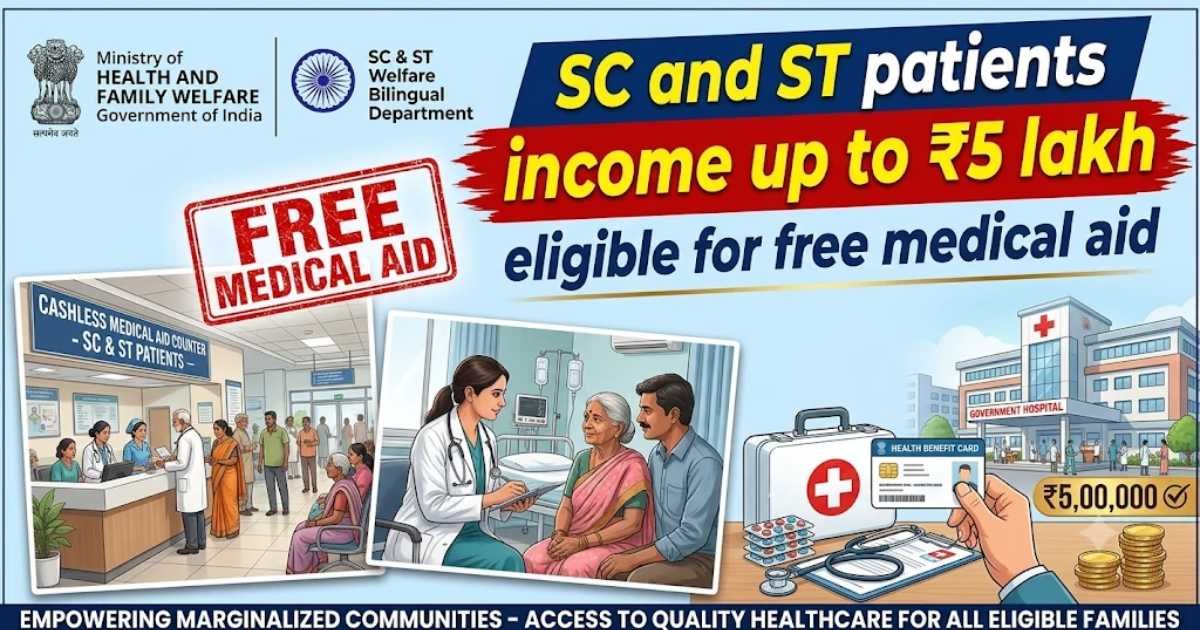
New Delhi: Scheduled Caste (SC) and Scheduled Tribe (ST) patients can seek financial assistance under the revised Dr. Ambedkar Medical Aid Scheme. Applicants must have an annual family income of up to ₹5 lakh. The scheme provides up to ₹3.50 lakh for serious and life-threatening diseases.
The Dr. Ambedkar Foundation (DAF), under the Ministry of Social Justice and Empowerment, implements the scheme. Director Vinesh Pachnanda said the revised provisions were notified on June 2, 2026. They aim to improve access to specialised healthcare and reduce treatment costs for vulnerable families.
Eligible patients can receive support for kidney, heart, liver and brain diseases. The scheme also covers cancer, organ transplantation, spinal surgery and other critical conditions. It pays 100% of the estimated treatment cost, subject to the prescribed limit. The Foundation transfers the approved amount directly to the hospital.
The assistance limits vary by treatment. Heart surgery attracts up to ₹1.50 lakh. Kidney surgery or dialysis can receive up to ₹3.50 lakh. Cancer surgery, chemotherapy or radiotherapy qualifies for up to ₹2.50 lakh. Brain surgery attracts up to ₹2 lakh.
Kidney or organ transplantation can receive up to ₹3.50 lakh. Spinal surgery qualifies for up to ₹1.50 lakh. Other life-threatening diseases can receive up to ₹2 lakh. Hospitals may receive the amount in one instalment before surgery. Payments can be made through RTGS, NEFT or Demand Draft.
Medical aid scheme extends support to eligible PM-JAY patients
The revised scheme allows patients with chronic ailments to seek a second renewal grant in the following financial year. This remains subject to the scheme’s provisions. It also covers PM-JAY beneficiaries with renal diseases or those requiring kidney or organ transplantation. Other PM-JAY beneficiaries cannot seek assistance under this scheme.
The Foundation works through recognised hospitals across India. These include AIIMS facilities and CGHS-approved hospitals. State Government medical college hospitals and State hospitals also qualify. The scheme covers institutions fully funded by Central or State governments.
Government hospitals at district headquarters and major towns may also participate. They must have facilities to treat serious diseases, including conditions requiring organ transplantation or spinal surgery.
Recognised institutions include Sanjay Gandhi Post Graduate Institute in Lucknow and Patna Medical College Hospital. The list also includes Jabalpur Hospital and Research Centre, and B. Barua Cancer Institute in Guwahati. Other institutions are Birla Heart Foundation in Kolkata, Kalinga Hospital in Bhubaneswar and Tata Cancer Research Institute in Mumbai. Nizam Institute of Medical Sciences in Hyderabad and Voluntary Health Services in Chennai are also covered.
In exceptional cases, the Foundation Chairman may approve treatment at other hospitals. Such cases will be considered on their individual merits.
The scheme generally does not accept reimbursement claims for treatment already completed. However, the Foundation may consider such claims on merit. The application must reach it at least 15 days before the scheduled surgery.
Hospitals must submit a Utilisation Certificate and final medical bills when patients are discharged. They must use the assistance within one month of receiving it. Any unused amount must be returned to the Foundation promptly. The deadline is one month after the patient’s discharge.
Application process and required documents
Eligible patients can apply through the prescribed form on the Dr. Ambedkar Foundation website. They may also submit an application on plain paper with the required details. Applicants must attach self-attested copies of their latest income certificate and caste certificate. They must also provide a ration card or Aadhaar card and a passport-size photograph.
The application must include an original Estimated Cost Certificate. The hospital’s Medical Superintendent must sign this document. It should state the estimated treatment cost and scheduled surgery date.
Kidney transplant applicants must provide additional documents. These include proof of the donor-beneficiary relationship and Form 14. The form must record the Authorisation Committee’s decision. Applicants must also provide relevant kidney donor details.
The hospital’s bank account number, account holder name and IFSC code are also required. These details will help the Foundation transfer assistance directly to the hospital.
Applicants must send the completed form and supporting documents to the Director, Dr. Ambedkar Foundation, 15 Janpath, New Delhi – 110001. The documents must reach the office at least 15 days before the scheduled surgery, dialysis or chemotherapy.
Applicants can find guidelines, eligibility details, recognised hospitals and forms on the Dr. Ambedkar Foundation website.
The scheme seeks to reduce financial barriers to specialised healthcare for disadvantaged families. It also aims to lower out-of-pocket spending and support timely treatment. The Ministry said the initiative advances equitable healthcare access and the vision of an inclusive Viksit Bharat@2047.
