
Sonia Gandhi’s ‘Belonging’: brisk sales, sharp words and a missing number
By Shaik Ahmed Ali

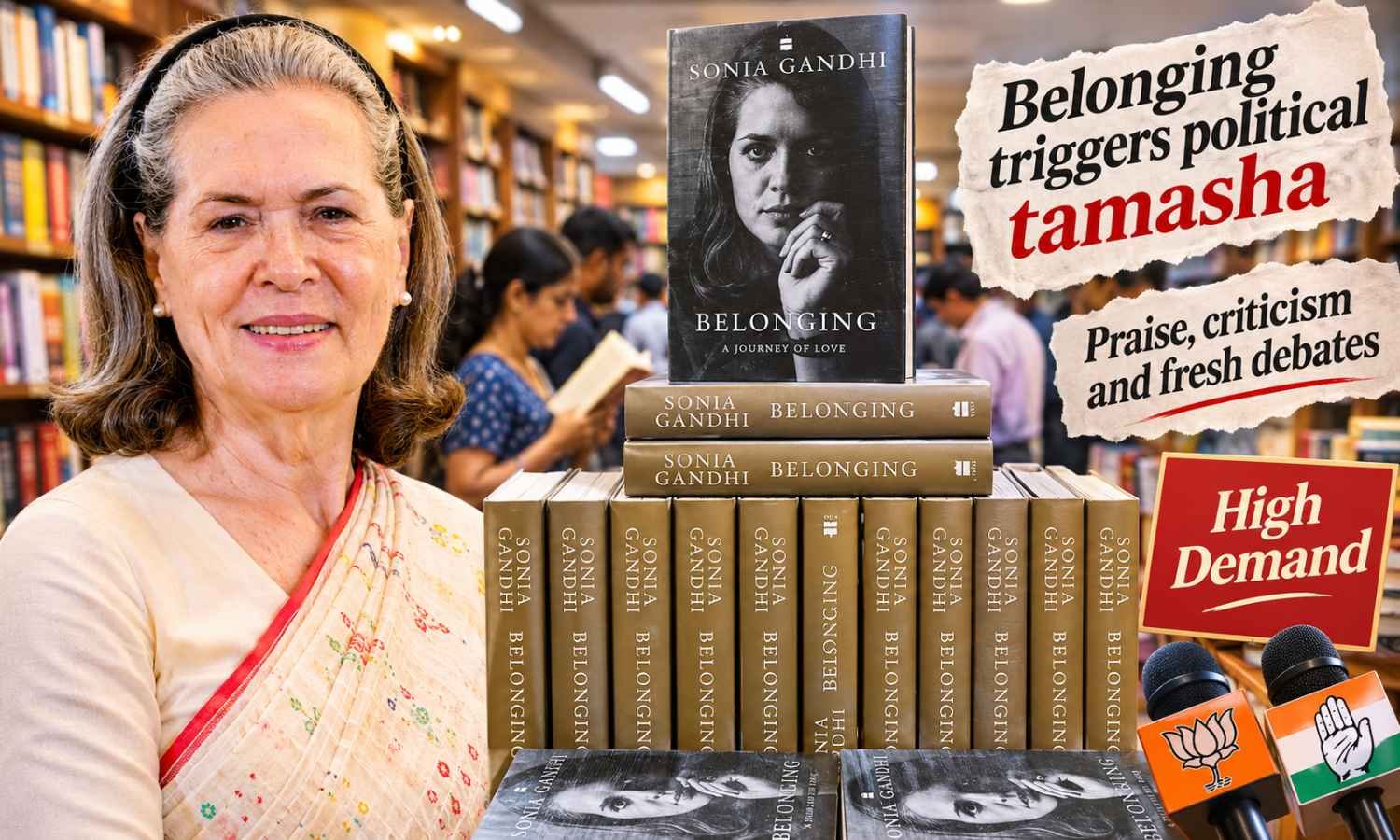
Hyderabad: UPA Chairperson Sonia Gandhi had predicted that her memoir would cause a “tamasha”. Less than a week after its release, her prediction has proved remarkably accurate. “Belonging: A Journey of Love” has attracted strong demand at bookstores, triggered arguments over India’s political history and prompted leaders to debate individual passages from its 544 pages. Even the speed at which a Congress spokesperson finished reading the book has become a political controversy.
Released on November 10, the memoir has generated interest beyond the conventional readership of political books. Congress leaders are celebrating Sonia Gandhi’s account of love, loss and public life, while BJP leaders are questioning her interpretation of controversial historical events. Regional parties have also entered the discussion, raising questions about developments they believe deserve greater attention. The result is an unusual publishing event in which commercial interest and political arguments have developed almost simultaneously.
What makes the response particularly interesting is the speed with which the book has entered political conversations. Sonia Gandhi spent years preparing her account of a life closely connected with some of India’s most significant events. Yet within days of publication, selected passages had become subjects of public disagreement. Politicians were discussing not only what she had written, but also what she had supposedly left out and how quickly others had read it.
Sonia Gandhi memoir Belonging sees strong demand
HarperCollins India released the memoir simultaneously across more than 100 cities and described the initial response as exceptional. The publisher reported queues at bookstores and record-breaking online orders, indicating considerable interest in a hardcover priced at Rs 1,299. Its promotional updates have shown the book being displayed and purchased at outlets across the country, while online retailers have offered discounts to attract buyers.
Such attention is noteworthy for a political autobiography, particularly one dealing with events that have been discussed extensively over several decades. However, the excitement has also produced an important unanswered question: how many copies have actually been sold? HarperCollins has not publicly disclosed a verified nationwide sales total, making it impossible to establish the memoir’s precise commercial performance or compare it reliably with earlier political bestsellers.
The distinction between printing, distribution and sales is important. A publisher may print a large number of copies, while distributors and retailers can place substantial orders in anticipation of demand. Neither figure necessarily represents purchases completed by readers. Without confirmed sell-through data, claims of record-breaking nationwide sales remain difficult to assess, even though the publisher’s statements point to an unusually strong opening.
The memoir had attracted attention even before reaching bookstores. Penguin Random House India, which was originally expected to publish the Indian edition, did not proceed with the project following disagreements during the editorial process. The publisher disputed suggestions that it had withdrawn simply because Sonia Gandhi refused proposed changes. HarperCollins subsequently acquired the Indian publishing rights, bringing the book to readers on the scheduled international release date.
The interest also reflects the author’s unusual position in Indian public life. Despite spending decades at the centre of national politics, Sonia Gandhi has generally maintained a guarded personal profile. Her memoir begins with her childhood in post-war Italy and moves to Cambridge, where she met Rajiv Gandhi in 1965. It follows their marriage, her arrival in India and her gradual adjustment to life within the Nehru-Gandhi family.
The assassinations of Indira Gandhi in 1984 and Rajiv Gandhi in 1991 form some of the most personal sections of the book. Sonia Gandhi also discusses her eventual entry into politics, her years leading the Congress and her decision not to accept the prime minister’s post following the United Progressive Alliance’s victory in 2004. These episodes have been narrated by politicians, journalists and biographers over the years, but the memoir presents her own recollections of them.
The publication has also reached listeners through an audiobook, with Sonia Gandhi reading the prologue herself and Sneha Mathan narrating the remaining chapters. The availability of both print and audio editions has widened the ways in which readers can engage with her account.
Political criticism adds to the publicity
Political reactions began almost immediately after the book’s release, with BJP national spokesperson C.R. Kesavan accusing Sonia Gandhi of attempting to soften the historical record of the Congress and the Nehru-Gandhi family. His criticism focused particularly on the memoir’s treatment of the Emergency imposed in 1975 and the anti-Sikh violence following Indira Gandhi’s assassination in 1984. Kesavan suggested that “Whitewashing” would have been a more appropriate title, while Congress leaders defended Sonia Gandhi’s right to present her personal experiences.
Rahul Gandhi, however, appeared amused by the criticism. Responding to a question during an Instagram interaction on November 13, he suggested that BJP leaders were unable to resist reading and commenting on his mother’s book. “The more you comment, the better it does,” he remarked, encouraging political opponents to continue their attacks. His observation raised an interesting possibility: repeated criticism might encourage curious readers to examine the disputed passages themselves. There is, however, no reliable evidence yet establishing a direct connection between the controversy and actual book sales.
The political debate took an unusual turn when Congress social media chairperson Supriya Shrinate announced that she had finished reading the memoir. Shrinate described it as deeply moving and praised Sonia Gandhi’s account of love, grief and resilience. The BJP responded by calculating that she had supposedly completed the 544-page book in just 27 hours and 45 minutes, based on the timing of her social-media posts. The party jokingly compared her reading speed to Chitti, the robot character from the film “Robo”.
Shrinate rejected the calculation, explaining that she had received an advance copy and deliberately posted the video showing its arrival later. The BJP’s calculation therefore rested on an incorrect assumption about when she began reading. What started as a response to a political autobiography had turned into an argument over the reading habits of someone discussing it, illustrating how far the controversy had moved beyond the book’s actual contents.
The contrasting responses also show how different political groups are approaching the memoir. Congress leaders have largely focused on Sonia Gandhi’s personal sacrifices, her relationship with India and the difficulties she faced after Rajiv Gandhi’s assassination. BJP leaders have concentrated on historical accountability and her interpretation of decisions associated with Congress governments. In Telangana, former BRS MP B. Vinod Kumar has questioned the alleged absence of the statehood movement from the book, despite acknowledging Sonia Gandhi’s role in the political decisions leading to the formation of the state in 2014.
These reactions do not necessarily establish that every politician commenting has read the entire memoir. A statement about an individual passage may reflect interest in a particular political issue rather than an assessment of the complete work. Nevertheless, the rapid succession of responses has helped keep the book in public discussion, with different aspects of Sonia Gandhi’s life attracting attention from different audiences.
Sonia Gandhi had anticipated this reaction in an October 27 social-media message, observing that others had spent decades telling her story and that it was finally her turn. She has described the memoir as primarily personal rather than a comprehensive political history. Yet her private experiences have been so closely connected with major national events that separating the personal from the political was always likely to be difficult.
There’s bound to be some tamasha when this book comes out. After all, others have spent decades telling my “story”, now it’s my turn. https://t.co/jDy5vBI8ey
— Sonia Gandhi (@SoniaGandhi) October 27, 2026
Whether “Belonging” maintains its opening momentum will become clearer in the coming weeks. Verified sales figures, additional print runs and demand for subsequent editions will provide a more dependable measure of its commercial success. For now, the memoir has achieved something unusual for a political autobiography: it is being bought, discussed and challenged almost simultaneously.
Sonia Gandhi set out to tell her own story after decades of public scrutiny. Within days, politicians across party lines had begun responding with their versions of it. The actual sales record remains to be established, but the debate surrounding the book is already unmistakable.
