

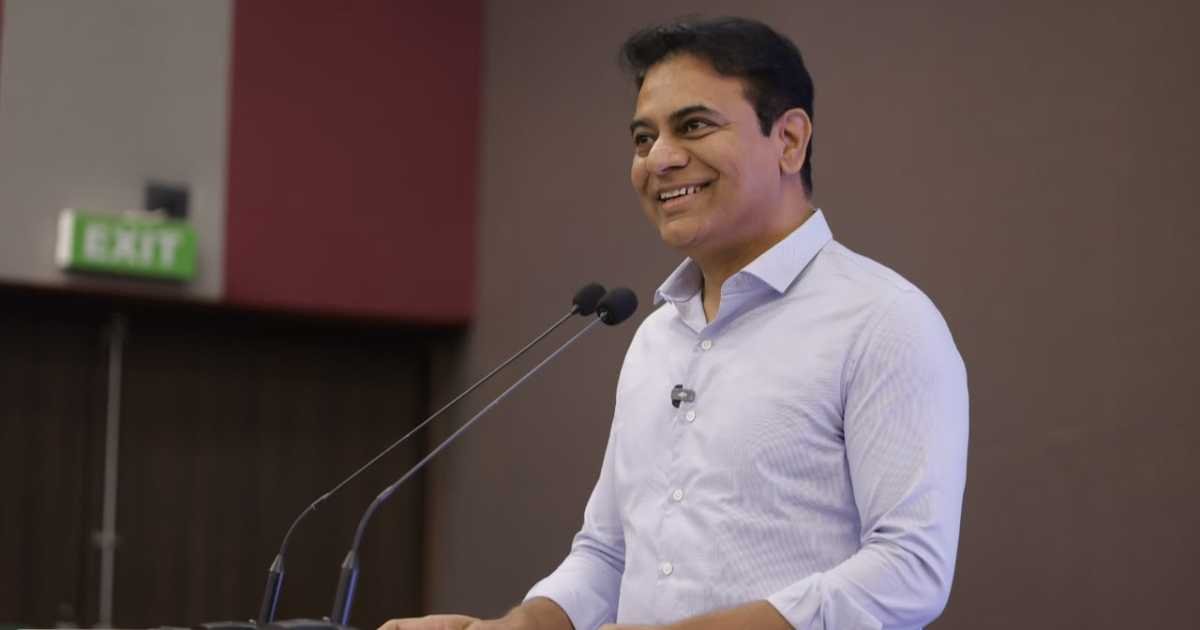
Hyderabad: BRS working president K.T. Rama Rao called for long-term urban governance solutions to address growing challenges in Indian cities.
Rama Rao made the remarks at “Sheheron pe Charcha”, a cross-party summit organised by Janaagraha at the India Habitat Centre in New Delhi. The discussion focused on measures to improve urban liveability.
The former Telangana minister argued against what he described as “knee-jerk reactions” to urban challenges. Instead, he sought sustained policy interventions to improve governance and living conditions in growing cities.
The panel included JMM MP Mahua Majhi, YSRCP MP S. Niranjan Reddy and Janaagraha CEO Srikanth Viswanathan. The event brought legislators from different political parties together to discuss how Indian cities can improve governance.
Rama Rao highlighted decentralisation measures undertaken during the previous BRS government in Telangana. He cited the establishment of medical colleges at district headquarters as one such initiative.
He also pointed to the expansion of IT Towers into Tier-II cities. According to Rama Rao, these measures helped spread economic opportunities beyond Hyderabad and reduce pressure on the state capital.
The BRS leader also discussed public transport and infrastructure as key areas of urban governance. He said expanded high-speed rail networks could significantly reduce pressure on major metropolitan cities over the next decade.
In addition, Rama Rao identified access to capital as a major challenge for municipal authorities. He called for innovative financial models to strengthen the ability of urban local bodies to meet infrastructure and service needs.
He also advocated inclusive governance models for cities facing growing municipal demands. His remarks linked urban planning with decentralisation, transportation, financing and administrative reforms.
Urban governance needs stronger local decision-making
Rama Rao said cities need governance structures that can respond to changing demands. He linked this approach to the wider need for stronger local institutions and better coordination.
The discussion also covered the pressures created by rapid urbanisation. Recent analysis of India’s urban governance highlights limited municipal powers and finances as continuing challenges for city governments.
Rama Rao also referred to the “Bharat AI Experiential Center” hosted at the summit venue. He said the visit provided an opportunity to examine artificial intelligence applications developed for public service delivery and urban administration.
Meanwhile, the broader panel discussion brought together representatives from different political parties to examine urban governance challenges. The session was moderated by Janaagraha CEO Srikanth Viswanathan.
The discussion placed emphasis on the need for sustained policy measures rather than short-term responses to urban problems. It also highlighted transport, municipal finance, decentralisation and service delivery as key areas for city development.
Rama Rao’s remarks focused on strengthening governance as Indian cities expand. He called for policies that can address infrastructure needs while improving the quality of urban life.
He also stressed the importance of giving cities greater capacity to manage growing demands. Such measures, he said, could help cities respond more effectively to changes in population, infrastructure and economic activity.
