

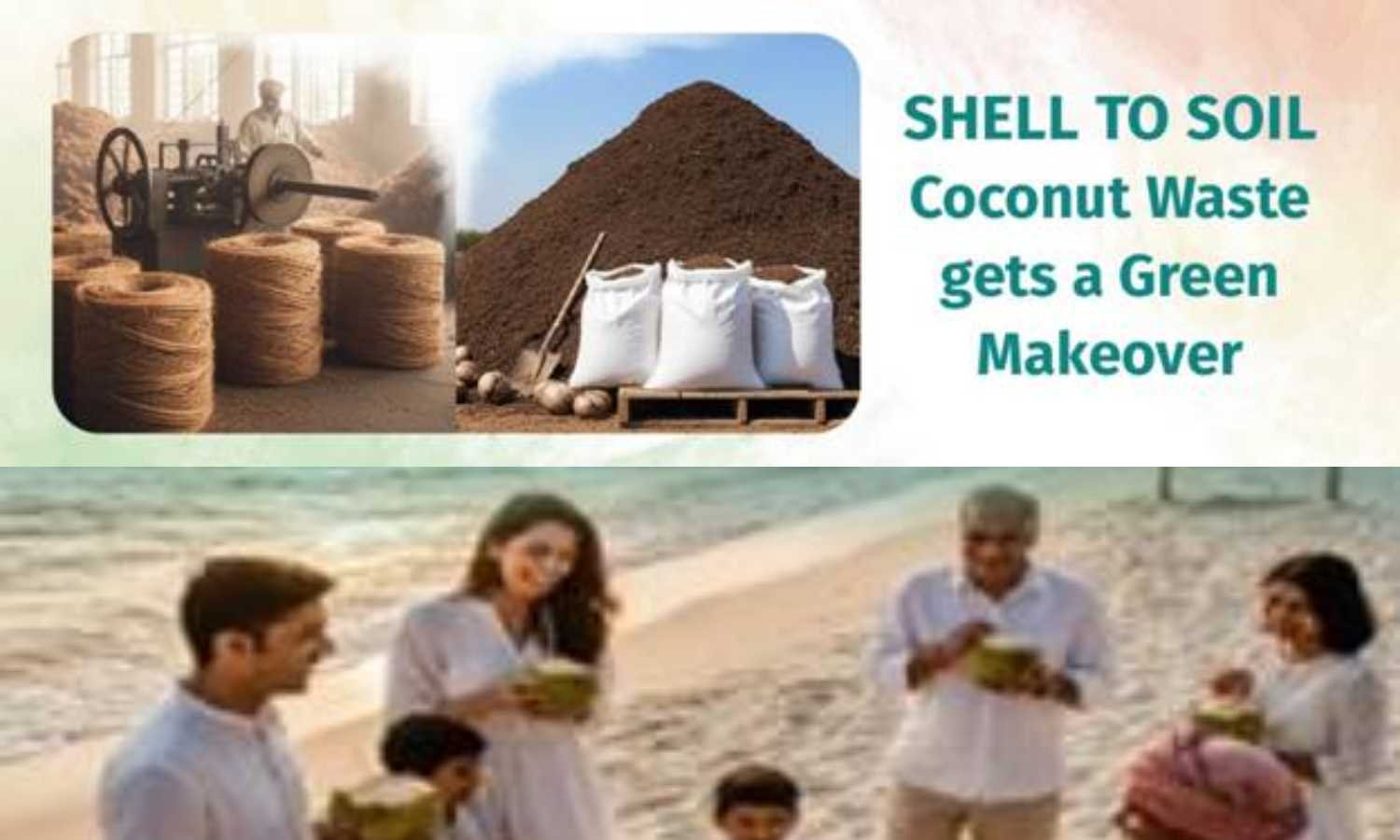
New Delhi: Urban local bodies across India expanded coconut waste recycling under the Swachh Bharat Mission–Urban, converting temple and street waste into coir, compost and steady livelihoods, the Ministry of Housing and Urban Affairs said in its year-end review.
Cities with high coconut consumption once sent large volumes of husks to landfills. However, under SBM-U 2.0, municipalities now segregate and process this waste through material recovery facilities and dedicated processing units. Officials said coconut husk forms 3–5% of urban wet waste nationally and rises to 6–8% in coastal cities.
India’s growing coconut economy has supported this shift. Official data showed coconut production crossed 21,000 million units in 2023–24 and 2024–25, led by Kerala, Tamil Nadu, Karnataka and Andhra Pradesh. Meanwhile, the global coir market reached about USD 1.45 billion in 2025, with India contributing over 40% of global production.
Several religious centres adopted structured recycling systems. Cities such as Puri, Varanasi and Tirupati established specialised facilities to process temple-generated coconut waste. As a result, civic bodies reduced drain blockages and diverted organic waste from landfills.
Government schemes strengthened the waste-to-wealth model. Under SBM-U 2.0, urban local bodies and entrepreneurs received 25–50% central financial assistance to set up processing units. In addition, the Coir Udyami Yojana offered a 40% subsidy for micro and small enterprises. The GOBARdhan scheme also supported bio-CNG and compost production from coconut residues.

Coconut waste recycling drives jobs and circular economy in cities
Urban initiatives created both environmental and economic gains through coconut waste recycling. The coir sector now employs about 7.5 lakh people, nearly 80% of whom are women working through self-help groups. Across the country, more than 15,000 coir units operate, with Tamil Nadu accounting for 7,766 units alone.
Bhubaneswar’s Palsuni processing plant converted temple waste into revenue and jobs. The facility collected 5,000–6,000 coconuts daily from 189 vendors. It produced over 7,500 kg of coir fibre and ropes, along with 48 metric tonnes of cocopeat-based compost. Officials said the unit generated ₹7–9 lakh each month while providing income to SHG members and Safaimitras.
In Kerala, the Kunnamkulam green de-fibering unit processed coconut husks into odour-free compost using aerobic systems. Farmers earned ₹1.25 per husk and delivered waste directly to the unit. The facility also sold coir fibre and developed bio-pots from short fibres, supporting local green jobs.
Greater Chennai adopted a public-private partnership model for coconut waste recycling. Since December 2021, the city received nearly 1.5 lakh metric tonnes of coconut waste and processed over 1.15 lakh metric tonnes. The units at Kodungaiyur and Perungudi operated at full capacity and supplied coir and compost to nurseries, tyre firms and forest departments.
Indore integrated coconut waste recycling with its bio-CNG infrastructure. A dedicated unit beside a 550 TPD bio-CNG plant processed 20 tonnes daily. The dry line produced cocopeat, while the wet line extracted coir fibre. Officials said the unit earned about ₹20,000 per day and employed 15 workers.
Patna adopted a zero-cost processing model at its Danapur facility. The unit handled 10 tonnes per day and converted husks into coir fibre, ropes, cocopeat and organic compost. The city said the initiative diverted waste from landfills and supported urban farming and rooftop gardens.
The ministry said coconut waste recycling under SBM-U showed how policy support, local innovation and community participation can convert organic waste into economic value while strengthening India’s circular economy.
