

New Delhi: Researchers have developed a single-piece dental implant that combines titanium alloy and zirconia to reduce surgical complexity. The new design also aims to improve durability, interface stability and biocompatibility.
Scientists at the International Advanced Research Centre for Powder Metallurgy and New Materials (ARCI) developed the implant. ARCI is an autonomous institute under the Department of Science and Technology (DST).
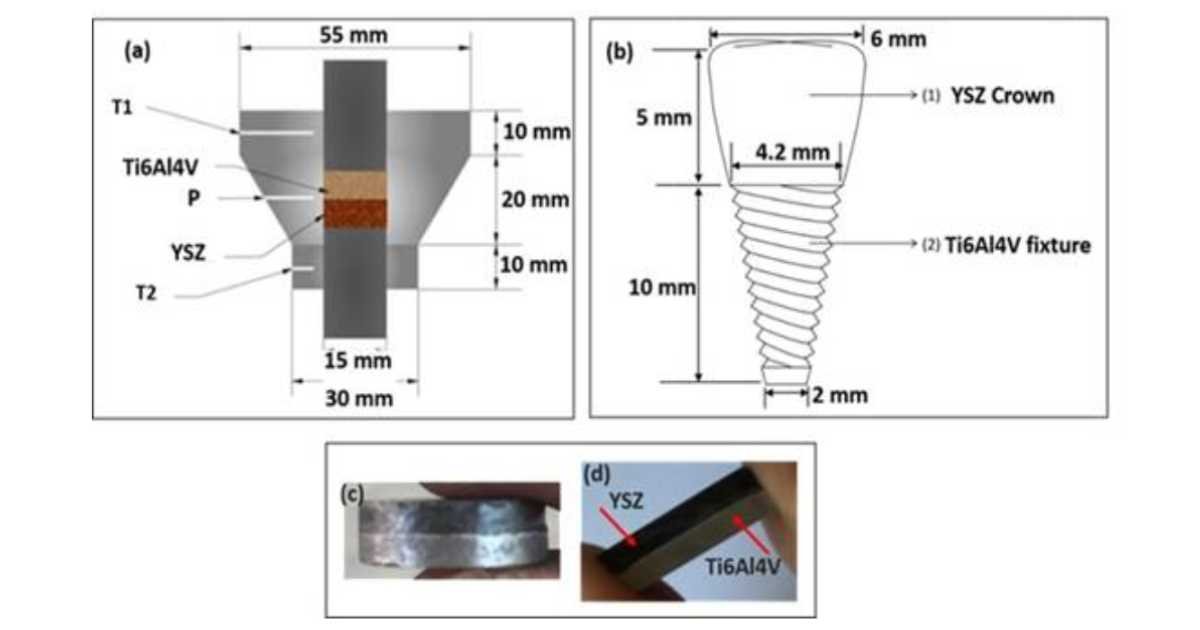
The researchers integrated titanium alloy Ti6Al4V with yttria-stabilized zirconia (YSZ) into one structure. This approach addressed several limitations linked to conventional multi-part dental implants.
Traditional implants use three main components. A fixture sits inside the jawbone, while an abutment connects it to the crown. The crown then forms the visible tooth structure.
However, movement can occur at the abutment interface. Such micromovements can affect osseointegration and may eventually loosen the implant.
Conventional systems can also require two or three surgical procedures. Therefore, patients may face greater discomfort and added clinical complexity.
The researchers also noted limitations in commonly used materials. Ti6Al4V offers strength and biocompatibility, but it can face corrosion and gum recession in the moist oral environment.
Zirconia offers good appearance and corrosion resistance. However, hydrolysis can affect its long-term stability.
Single-piece dental implant uses two materials in one structure
The new single-piece dental implant assigns different roles to its two materials. Ti6Al4V acts as the load-bearing fixture and supports integration with the jawbone.
Meanwhile, YSZ forms the crown region. It provides wear resistance and an appearance suited to dental applications.
The team fabricated the structure through Spark Plasma Sintering (SPS), an advanced powder metallurgy process. A specially designed tapered graphite die helped control temperature during sintering.
The method allowed the researchers to densify both materials in one processing step. The two materials have widely different sintering temperatures, making this integration technically challenging.
The process achieved 99.5% material density. It produced a strong bi-layered structure without visible defects.
After sintering, researchers used a 5-axis CNC machine to create the threaded implant shape. They observed some difficulties when moving the cutting tool across curved surfaces.
The team is now working on process optimisation to address those machining challenges. The researchers reported that the overall fabrication method remained reproducible and suitable for scale-up.
Tests also confirmed a clear and well-bonded interface between the two materials. Researchers found no cracks, delamination, pores or secondary phases at the interface.
The analysis showed fine YSZ grains measuring about 0.3 micrometres. Ti6Al4V grains near the interface measured about 0.3 to 1 micrometre.
The researchers also found no noticeable elemental diffusion across the interface. This indicated a stable transition zone between the ceramic and metal components.
Mechanical tests further showed strong performance. The bi-layered structure reached hardness values of up to 1,350 HV.
It also recorded compressive strength of about 1,550 MPa. Its flexural strength reached about 310 MPa.
These values were comparable with, or higher than, those of commercial implant materials. In addition, biological tests showed non-cytotoxic behaviour and strong biocompatibility.
Researchers used L929 mouse fibroblast cells for MTT testing. The test measures cellular metabolic activity.
The cells showed more than 90% metabolic activity across all tested concentrations. The results exceeded the minimum threshold used for biomaterials.
Hemolysis tests also showed negligible damage to red blood cells. This supported the material’s suitability for dental applications.
The research team said the integrated structure combined mechanical strength, corrosion resistance, aesthetic performance and biological safety. As a result, the design can reduce the need for multiple surgical interventions.
The approach could also support the development of affordable, high-performance dental implants in India. It further strengthens domestic biomedical device research and manufacturing capabilities.
The researchers presented the work in Materials Letters, published through ScienceDirect. The study was associated with the DOI 10.1016/j.matlet.2023.134403.
The reported biological evaluation involved laboratory testing. Further clinical assessment would be needed before drawing conclusions about performance in patients.
