

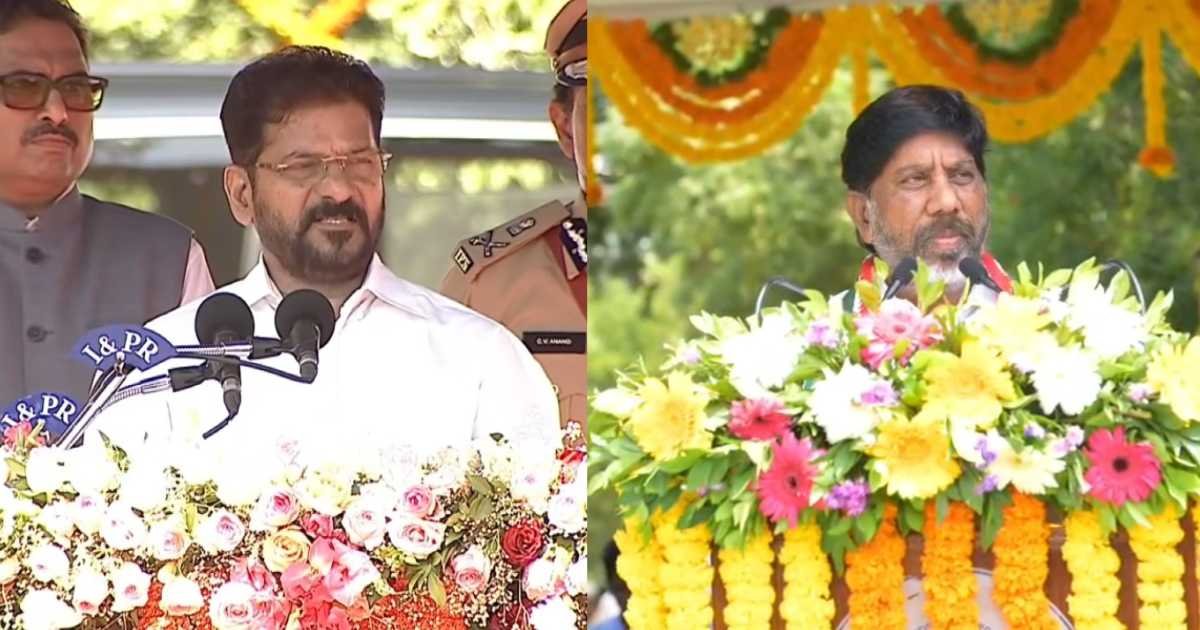
Hyderabad: Chief Minister A. Revanth Reddy outlined Telangana’s welfare and development agenda at Praja Palana Day celebrations on September 17. He linked the state’s past struggles with his government’s plans for social justice, economic growth and infrastructure. He also presented Telangana Rising 2047 as a long-term development vision.
The Chief Minister recalled September 17, 1948, when the Hyderabad State joined the Indian Union. He said the day also represented the people’s role in shaping governance. Therefore, his government observed it as Praja Palana Day, with the focus on people-centred administration.
Reddy highlighted Telangana’s economic progress and said per capita income had reached ₹4,18,931. He also detailed welfare spending across agriculture, housing, pensions, education and healthcare. According to him, the government had linked these measures with broader economic development.
Farm support and land reforms
The government waived ₹20,616 crore in farm loans for 25.35 lakh families, Reddy said. It also provided more than ₹36,000 crore under Rythu Bharosa. Farmers received a ₹500 bonus on eligible crops, while agriculture-related spending reached ₹1.72 lakh crore in 32 months.
Reddy also referred to Bhu Bharati, BhuDhaar and BhuMithra as steps to improve land records. The government issued 5.94 lakh new passbooks, he said. These measures aimed to simplify land ownership records and reduce disputes.
The Chief Minister also spoke about irrigation projects and the state’s efforts to secure its share of Krishna waters. He cited the Palamuru-Rangareddy, Sitarama and SLBC projects. He said the government had continued its legal fight over water rights.
Women’s welfare formed another major part of the address. Reddy said more than one crore women had benefited from government programmes. The Mahalakshmi scheme, he said, supported women through free travel and other measures.
He said women’s self-help groups had generated savings of ₹12,385 crore. The government also provided ₹60,487 crore in bank linkages to these groups. It additionally gave ₹1,900 crore in interest support.
The Gruha Jyothi scheme benefited 53 lakh households, while 43 lakh families received LPG cylinders at ₹500, according to Reddy. He also cited ₹4,709 crore spent under Kalyana Lakshmi and Shaadi Mubarak for 1.68 lakh beneficiaries.
The government planned women’s marts and petrol pumps as additional livelihood opportunities. Reddy also referred to women’s participation in RTC bus operations. He presented these measures as part of a wider effort to strengthen women’s economic role.
Food security, housing and social justice
The government supplied food through the public distribution system to 3.42 crore people, Reddy said. It also planned 15 lakh smart ration cards. The Chief Minister said the measures would strengthen access to essential food support.
The state provided pensions to 43 lakh beneficiaries, with spending reaching ₹31,000 crore. Reddy said the government had also approved pensions for another 2.25 lakh people. The move expanded support for vulnerable sections.
Housing remained another key part of the government’s welfare programme. Reddy said the government had taken up 4.5 lakh Indiramma houses at a cost of ₹22,500 crore. Each eligible household received ₹5 lakh for construction.
The second phase covered another 2.5 lakh houses, he said. In Hyderabad, the government planned one lakh houses along with Indiramma Towers. Reddy said these projects would address housing needs among eligible families.
The Chief Minister also highlighted the caste survey and measures linked to social justice. He said the government had sent bills seeking 42% reservation for Backward Classes to the President. He also referred to legislation on Scheduled Caste classification.
The state observed February 4 as Social Justice Day, Reddy said. He presented the decision as part of the government’s focus on representation and equal opportunities.
Praja Palana Day puts education and health at centre
Reddy said the government was building Young India schools on sites measuring 20 to 25 acres. The schools would include pre-primary education and operate as Telangana Public Schools. He said the government had also planned better facilities and learning support.
The state allocated ₹927 crore for breakfast and milk programmes in schools, according to the Chief Minister. It also extended the midday meal programme up to Class 12. Around 11 lakh students received scholarships and fee reimbursement.
Reddy said Telangana had improved its position in the national PGI education index from 28th to 18th. He also referred to plans for overseas university campuses. Northeastern University and the University of London were among the institutions mentioned in the address.
Healthcare also featured prominently in the speech. Reddy said the government increased the Aarogyasri coverage limit from ₹5 lakh to ₹10 lakh. The Chief Minister’s Relief Fund supported 5.19 lakh people with ₹2,526 crore.
The government allocated ₹2,700 crore for Osmania General Hospital, he said. It also planned TIMS facilities at Sanathnagar, Alwal and LB Nagar. Warangal would receive a 2,000-bed hospital, according to the Chief Minister.
Employment formed another part of the development agenda. Reddy said the government had filled more than 72,000 government posts. It also conducted recruitment examinations covering Group I to Group IV posts.
The government established a Skills University and planned to upgrade ITIs into Advanced Training Centres. New polytechnic courses would also support technical education. Reddy said these measures would connect education with employment opportunities.
Infrastructure and urban development
The Chief Minister outlined major transport projects across Telangana. Metro Phase II would cover 122.9 km at an estimated cost of ₹38,595 crore. The government also planned airports at Adilabad and Mamnoor.
Reddy referred to the Musi River project covering a 55-km stretch. He also highlighted TG Safe and EAGLE as measures linked to urban safety and enforcement. The speech connected these projects with the government’s broader urban development plans.
The government allocated ₹13,000 crore to Roads and Buildings works, according to Reddy. Panchayat Raj works received ₹6,294 crore. He also spoke about planning for El Niño conditions, drought risks, rising power demand and future drinking water needs.
The Chief Minister said Telangana needed stronger systems to manage water and electricity requirements. He also referred to VBG-RAM-G and work opportunities as part of the state’s development strategy.
Telangana Rising 2047 vision
Reddy placed the government’s long-term plans under the Telangana Rising 2047 vision. He set a target of building a $3 trillion economy and raising Telangana’s share of the national economy to 10%.
Future City formed a major part of that vision. The government planned the project across 30,000 acres as a net-zero smart city. Reddy said the project would support new industries, technology and modern urban infrastructure.
The government also planned the December Invest Telangana Global Summit. Reddy cited major investment proposals, including a ₹70,000 crore artificial intelligence data centre by TCS. He also referred to Amazon’s proposed ₹1 lakh crore data centre.
The state planned special zones for emerging industries, the Chief Minister said. He also listed the Regional Ring Road, greenfield highways, dry ports and industrial corridors among major infrastructure priorities.
Reddy said Telangana faced challenges from climate conditions, rising demand and rapid urbanisation. He called for coordinated planning to protect agriculture, strengthen infrastructure and secure essential services.
The Chief Minister concluded the Praja Palana Day address by calling for collective work towards Telangana’s future. He linked the government’s welfare programmes with its longer-term economic and social goals.
