
INS Mahendragiri commissioned into Indian Navy with 75% indigenous content

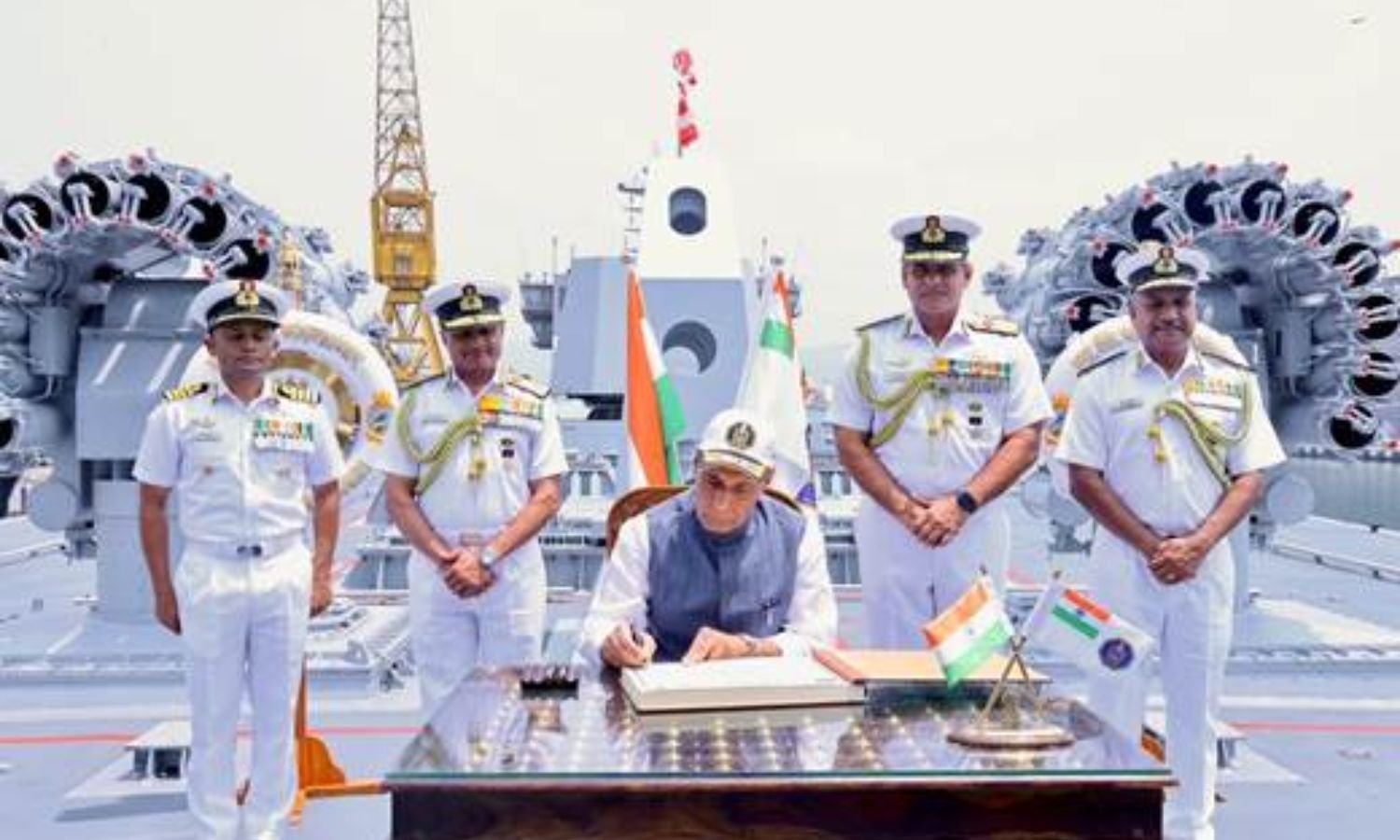
New Delhi: Defence Minister Rajnath Singh commissioned INS Mahendragiri into the Indian Navy’s Eastern Fleet at Visakhapatnam on Saturday. He described the frontline stealth frigate as a symbol of India’s growing self-reliance in defence manufacturing. He said the warship reflects the country’s commitment to building a technologically advanced and combat-ready Navy.
The INS Mahendragiri commissioned ceremony marked the induction of the sixth Project 17A stealth frigate into the Navy in just one and a half years. Rajnath Singh said the warship showcased India’s expanding design capability, manufacturing excellence and the strength of its domestic naval industrial ecosystem.
Designed by the Indian Navy’s Warship Design Bureau and built by Mazagon Dock Shipbuilders Limited in Mumbai, the frigate can perform fleet air defence, anti-surface warfare, anti-submarine warfare, maritime interdiction, surveillance and humanitarian assistance and disaster relief missions.
The 6,670-tonne warship has more than 75% indigenous content. It can reach speeds of up to 28 knots. The vessel features advanced stealth technology, modern sensors, network-centric combat systems, supersonic surface-to-surface missiles, medium-range surface-to-air missiles, anti-submarine warfare systems and an embarked multi-role helicopter.
INS Mahendragiri strengthens India’s maritime capability
Rajnath Singh said the frigate can carry the BrahMos surface-to-surface missile and advanced radar systems. These systems can detect and neutralise aerial threats over long distances. He added that the vessel also carries indigenous rocket launchers, torpedo launchers, an Integrated Anti-Submarine Defence System, an electronic warfare suite and a Close-In Weapon System. Together, these systems make it a formidable naval platform.
The Defence Minister said future conflicts will increasingly involve artificial intelligence, drones, cyber warfare, hypersonic weapons, space-based capabilities and unmanned systems. However, he stressed that conventional military strength will remain the foundation of national defence. He said Operation Sindoor demonstrated the successful integration of modern technology with conventional military capabilities.
Maritime security and indigenous shipbuilding
Highlighting India’s maritime strategy, Rajnath Singh said maritime security and economic security are closely connected. He reaffirmed the government’s commitment to the SAGAR vision. He also said the Indian Navy has earned recognition as a First Responder and Preferred Security Partner in the Indo-Pacific through humanitarian missions, anti-piracy operations and evacuation efforts.
The Defence Minister also referred to Operation Urja Suraksha. Under the operation, the Navy safely escorted 18 merchant vessels carrying essential cargo worth more than Rs 9,000 crore during the West Asia conflict. He said INS Mahendragiri will strengthen India’s eastern seaboard, extend its blue-water reach and reinforce its presence across the Indian Ocean Region.
He added that indigenous warship construction supports employment, innovation and industrial growth. Sectors including steel, electronics, propulsion systems, software and precision engineering benefit from these efforts. He said initiatives such as Maritime India Vision 2030, the Maritime Development Fund, the Shipbuilding Financial Assistance Scheme and the Shipbuilding Development Scheme will further strengthen India’s shipbuilding ecosystem.
Navy Chief highlights Project 17A achievements
Chief of the Naval Staff Admiral Krishna Swaminathan said INS Mahendragiri represents India’s growing maritime capability and technological self-reliance. He said the induction of the sixth Project 17A frigate significantly enhances the Navy’s operational capability. He also reaffirmed that the force remains combat-ready, credible and future-ready.
The Navy Chief highlighted several milestones achieved under the project. The time between launch and delivery fell from 63 months to 31 months, a reduction of about 50%. Overall construction time dropped from 95 months to 75 months. Engineers also completed all technical analyses during a single sea trial instead of the usual five to seven trials. He credited the achievement to close cooperation between the Navy, Mazagon Dock Shipbuilders Limited, Indian manufacturers, MSMEs, trial agencies and the ship’s crew.
