

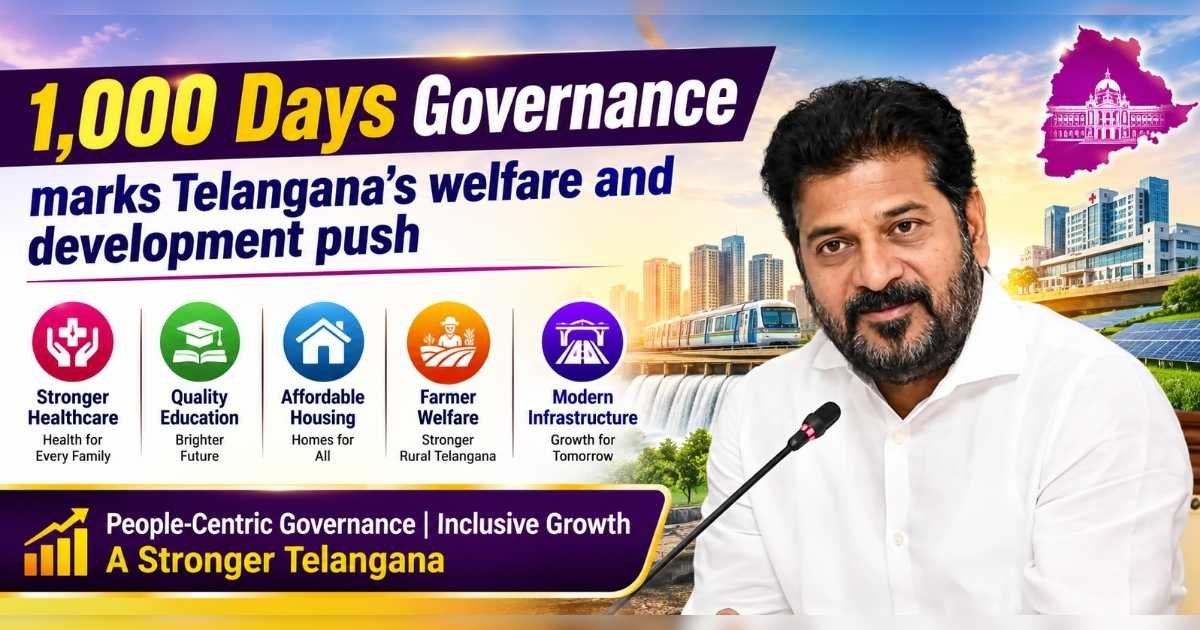
Hyderabad: Telangana Chief Minister A Revanth Reddy’s 1000 days governance milestone highlighted welfare, social justice, jobs, investment and infrastructure. The government said it had reshaped administration while focusing on farmers, women and youth.
The People’s Government completed 1,000 days on September 1. It presented the milestone as a period of administrative change and people-focused development.
The government said Telangana’s per capita income reached ₹4,18,931 in 2025-26. That figure was about 91% higher than the national per capita income.
It also said the state attracted major investments across several sectors. These investments supported employment, infrastructure and technology development.
The government credited farmers, women, youth, workers, employees, officials, entrepreneurs and the public for the state’s progress.
Agriculture remained a major focus. The government waived farm loans up to ₹2 lakh. The scheme benefited more than 25 lakh farming families.
The government also provided more than ₹36,000 crore through the Rythu Bharosa scheme. In one phase, nearly ₹9,000 crore reached farmers within nine days.
Farmers received a ₹500-per-quintal bonus for fine-variety paddy. The government also continued free electricity for agriculture and farmer insurance.
The state spent about ₹1.68 lakh crore on agriculture and farmer welfare during the first 32 months of its tenure.
Telangana also said it had surpassed Punjab in paddy cultivation and production. It procured 81.12 lakh metric tonnes of grain during the latest Yasangi season.
The government continued its efforts to secure Telangana’s share of Krishna and Godavari waters. It also thanked farmers for cooperating during challenges such as the urea shortage.
Women’s welfare formed another major part of the government’s programme. Under the Mahalakshmi scheme, women received free travel on RTC buses.
The government said women had taken more than 335 crore free trips. It estimated their travel savings at nearly ₹11,000 crore.
Under Gruha Jyothi, more than 53 lakh families received free electricity up to 200 units. Another 43 lakh families received domestic LPG cylinders for ₹500.
Women’s groups received bank-linked loans worth ₹60,487 crore. The government also provided an interest subsidy of ₹1,900 crore.
It created new business opportunities for women’s groups. These included school uniform and saree stitching, petrol bunk operations and RTC bus services.
The government set a goal of helping 10 million women become crorepatis through economic opportunities and support.
Food security also received attention during the 1000 days governance period. The government said it had issued more than 15 lakh new ration cards.
The Public Distribution System provided food security to about 3.38 crore people. The state also introduced fine rice for ration cardholders.
Smart ration cards were introduced to improve transparency and access within the distribution system.
The government sanctioned new social security pensions for 2.25 lakh people. Overall, more than 43 lakh elderly people, widows, persons with disabilities and other eligible beneficiaries received pensions.
Housing remained another key welfare area. The government said it had constructed 4.50 lakh Indiramma houses during the first phase.
Eligible families received financial assistance of ₹5 lakh for house construction. The government gave special priority to tribal communities, including the Chenchu tribe, and extremely backward families.
It also planned 1 lakh Indiramma housing units in multi-storey towers within Hyderabad’s urban limits.
1000 days governance and social justice measures
The government conducted a state-wide survey covering social, economic, educational, employment, political and caste-related aspects.
The survey aimed to assess the socio-economic status of different communities. The government described the exercise as a basis for policy and social justice measures.
Following the Supreme Court verdict, Telangana became the first state to implement SC sub-categorisation. It classified 59 SC sub-castes into three groups.
The Legislative Assembly also approved bills providing 42% reservation for BCs in education, employment and politics.
The government revised minimum wages that had remained pending for 12 years. It said the move would benefit 1.11 crore workers.
It also introduced legislation for gig workers. The law provided legal recognition, a welfare board and social security measures for workers in the sector.
Education reforms formed another major component of the government’s agenda. Telangana improved from 28th to 18th position in the Performance Grading Index announced by the Central Government.
The government sanctioned 105 Young India Integrated Residential Schools. It planned to establish such schools in every constituency.
Pre-primary classes were introduced in government schools. The government also gave public education a new identity through Telangana Public Schools.
More than 22 lakh students from pre-primary to Intermediate levels received breakfast, milk and nutritious food. The government allocated ₹720 crore for the programme.
Diet charges in welfare hostels rose by 40%. Cosmetic charges increased by 212%.
The government recruited 10,006 teachers through Mega DSC. It also provided scholarships and fee reimbursements to about 11 lakh students.
Osmania University received an allocation of ₹1,000 crore.
Youth employment remained another priority. The government said it made more than 72,000 government job appointments within its first 1,000 days.
The recruitment drives covered Group-1 posts and DSC appointments. The government also issued notifications for another 456 posts through TGPSC.
The Police Recruitment Board received a notification for 7,437 posts.
Young India Skills University trained 1,190 people. Of them, 838 secured jobs with prominent organisations.
The government upgraded 65 government ITIs and 57 polytechnic colleges into Advanced Technology Centres.
It also planned a new direction for sports through the Young India Physical Education and Sports University and the Gachibowli Sports District.
Healthcare expansion formed another major part of the programme. The government increased Rajiv Aarogyasri coverage from ₹5 lakh to ₹10 lakh.
It planned a new 2,000-bed Osmania Hospital at Goshamahal. The project was estimated to cost ₹2,700 crore.
Three TIMS super-speciality hospitals were planned in Sanathnagar, Alwal and LB Nagar. The state also added nine new government medical colleges, while construction continued on another 17.
NIMS reached the milestone of 2,000 kidney transplant surgeries.
The Chief Minister’s Relief Fund provided ₹2,526.12 crore to 5,18,186 people between December 7, 2023, and August 12, 2026.
Of this, ₹1,635.34 crore supported medical reimbursement for 4,78,789 poor patients. Letters of Credit worth ₹798.41 crore covered 39,712 people.
The government also intensified action against food adulteration. It increased inspections and sample testing and took legal action against violations.
It established TG Safe to tackle food adulteration and drug-related threats. The system brought food and drug control under a strengthened framework.
The government said the system included dedicated legal, laboratory and enforcement wings. It also conducted raids against those accused of risking public health.
The state launched a special anti-drug campaign through the Eagle system. It also introduced specialised policing for cybercrime and the safety of women and children.
Schools, colleges and universities were directed to establish anti-drug and safety committees. Institutions were also required to appoint campus coordinators and spotters.
These personnel would report suspicious behavioural changes among students to the Education Department and police.
The government said educational institutions that neglected student safety could face suspension of recognition.
Road and traffic safety also received a dedicated focus. The state planned a TG Traffic Management and Road Safety Bureau.
The proposed bureau would address urban traffic challenges and reduce accidents on highways and the Outer Ring Road.
It would receive dedicated funds and modern facilities. Its responsibilities would include urban traffic management, highway patrolling and accident prevention.
The government also sought to take grievance redress closer to residents. It planned to extend Praja Vani to MPDO offices at the mandal level.
Under the expanded system, mandal-level officials would remain available at one location every Monday. Residents could submit petitions and seek local solutions.
The government said this would reduce the need for people to travel to district or state offices for minor issues.
An online Praja Vani portal was also planned. It would allow residents to submit petitions from anywhere in Telangana.
A dedicated dashboard would track grievance resolution. The Chief Minister and Chief Minister’s Office would monitor progress.
As part of the 99-day Praja Palana–Pragathi plan, the government conducted 12,758 Gram Sabhas and 3,175 Ward Sabhas.
Land administration also underwent changes. The government introduced the Bhu-Bharati Act, Bhu-Dhar and AI-based Bhu-Mitra services.
It issued 3.76 lakh new pattadar passbooks.
The government said fiscal discipline helped it pay salaries to government, contract and outsourcing employees on the first day of every month.
It also cleared ₹600 crore in dues to retired employees within 100 days. The government introduced the Employee Health Scheme for employees and pensioners.
Digital governance expanded across the administration. The government said e-Office had reached 100% implementation across all 36 Secretariat departments.
It also established what it described as the country’s first fully digital cabinet. More than 581 government services were made available through WhatsApp.
The government created special enforcement wings within the Vigilance and Civil Supplies departments to reduce revenue leakages.
It took measures against revenue losses and tax evasion involving Civil Supplies, Mines and Minerals and GST.
The stated objective was to increase state revenue and use additional resources for welfare and development.
Infrastructure expansion formed a major part of the government’s longer-term development plan. Work was progressing on the Regional Ring Road around Hyderabad.
The RRR would span about 360 kilometres. Plans were also finalised for 6,092 kilometres of HAM roads across Telangana.
The government planned a 122.9-kilometre expansion of Hyderabad Metro across seven corridors under Phase II.
It also planned the development of Mamnoor Airport and the Adilabad airstrip.
The Musi rejuvenation project included development of a 55-kilometre stretch. The government also planned 39 new sewage treatment plants.
Another proposal involved diverting 2.5 TMC of fresh water from the Godavari to the Musi.
Investment promotion remained central to the government’s economic strategy. Telangana secured a top position in key areas under the Business Reforms Action Plan.
TG-iPASS helped attract investments worth ₹1.29 lakh crore, according to the government.
Investment agreements worth ₹5.75 lakh crore were signed at the Telangana Rising Global Summit–2025.
Investments worth ₹92,281 crore were planned on TSIIC lands. The government said these projects could create more than 78,000 jobs.
The Next-Gen Life Sciences Policy targeted ₹73,360 crore in investments and 3.5 lakh employment opportunities.
The government also highlighted Telangana’s growth in IT, artificial intelligence and Global Capability Centres.
IT exports were projected at ₹3.97 lakh crore for 2025-26. The sector was also projected to support 12.14 lakh direct IT jobs.
Hyderabad had more than 355 Global Capability Centres. The government said 40 new centres selected Hyderabad in 2026 alone.
Telangana also positioned itself as a growing destination for data centres, cloud computing and artificial intelligence.
Amazon announced an additional $7 billion investment in Telangana, according to the government.
The state also planned TG-DEX, described as the country’s first state-level AI data exchange.
Tourism and cultural identity formed another part of the government’s development agenda. Telangana introduced its first comprehensive tourism policy in 2025 since state formation.
The government said it secured ₹23,174 crore in investments during the first year. That figure exceeded its five-year target of ₹15,000 crore.
Telangana also ranked first nationally in establishing Yuva Tourism Clubs.
The state formally recognised Jaya Jayahe Telangana as the state song. It also unveiled Telangana Thalli statues.
A special committee was formed to identify and recognise Telangana movement activists.
The government presented these initiatives as part of a broader development plan extending beyond the first 1,000 days.
Under Telangana Rising–2047, it set a goal of building a $1 trillion economy by 2034. It also targeted a $3 trillion economy by 2047.
The plan seeks balanced development across Hyderabad and rural Telangana. It includes CURE, PURE and RARE development corridors.
The government also proposed Bharat Future City as the country’s first net-zero smart city.
Other long-term projects include an AI City, data centres, the Regional Ring Road, Metro Phase-II and the Musi rejuvenation project.
The Young India Skills University and Sports University also form part of the future development strategy.
The government said its next phase would build on welfare, development and social justice achieved during its first 1,000 days. It presented the 1000 days governance milestone as a foundation for its Telangana Rising–2047 vision.
