

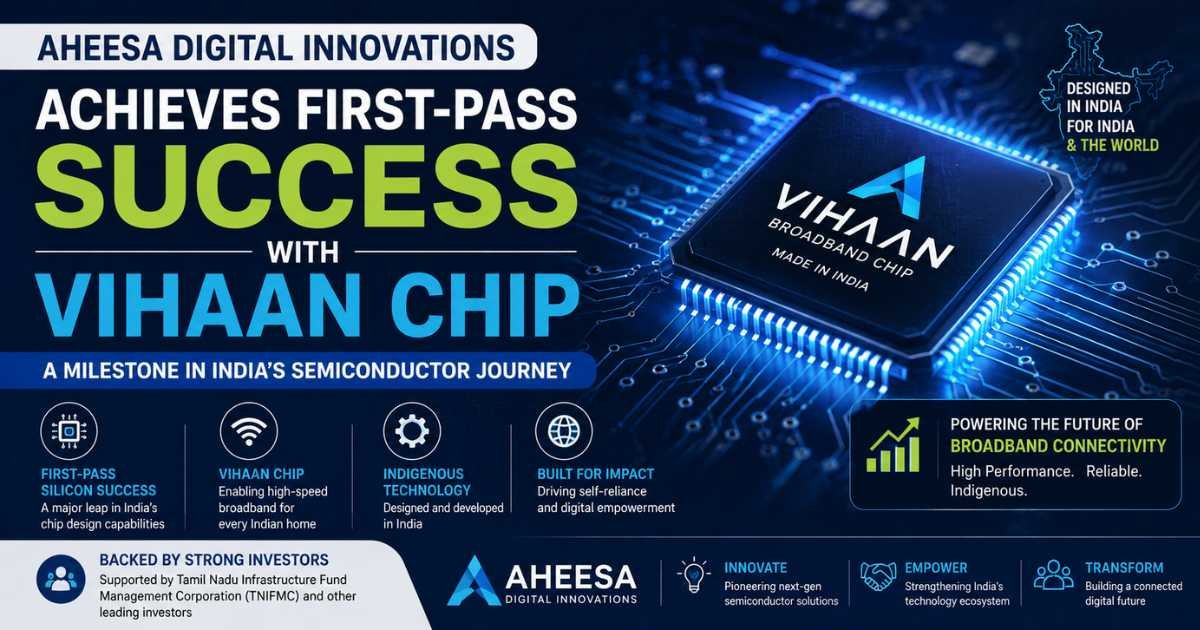
New Delhi: Chennai-based Aheesa Digital Innovations has achieved first-pass silicon success with its VIHAAN chip, a broadband networking System-on-Chip built using the indigenous VEGA microprocessor.
The DLI Scheme-backed fabless semiconductor startup designed VIHAAN for fibre broadband applications. The chip achieved first-pass silicon success on Independence Day this year after completing its design tape-out on Republic Day.
Aheesa will now move VIHAAN towards production tape-out, which it targets for 2027. The company aims to use the chip to support fibre broadband connectivity in Indian homes.
The achievement comes as India expands optical fibre, 5G and broadband-based digital services. As a result, demand is growing for semiconductor solutions designed and developed within the country.
Aheesa has also attracted funding from the Tamil Nadu Infrastructure Fund Management Corporation (TNIFMC) and other private investors. Earlier this year, the company raised about ₹40 crore through the Tamil Nadu Emerging Sector Seed Fund and other investors.
VIHAAN chip adds momentum to India’s semiconductor ecosystem
The latest milestone reflects wider progress under the government’s Design Linked Incentive (DLI) Scheme. The scheme supports Indian startups developing chips for strategic and commercial applications.
These applications include satellite communications, drones, surveillance systems, defence and aerospace, automotive systems, IoT devices, AI systems, telecom equipment and smart meters.
The government has also made advanced chip-design tools available to 455 organisations. This includes 350 academic institutions and 105 startups, helping students, researchers and companies develop semiconductor designs.
Companies supported under the DLI Scheme have raised more than US$100 million in venture capital funding. They have also achieved more than 30 chip design tape-outs across different foundries.
Meanwhile, the Chips to Startup programme has supported 245 chip designs taped out by 71 academic institutions. The programme aims to help build India’s future semiconductor workforce.
Other DLI-supported companies have also reported major milestones. Vervesemi Microelectronics achieved first-pass silicon success with a BLDC motor controller chip. Netrasemi tested a 12nm Vision SoC with integrated video analytics acceleration.
Similarly, OptoML received its 12nm compute-in-memory SoC for faster and more power-efficient AI processing. Mindgrove Technologies partnered with PRAMA India to explore Vision SoC use in CCTV cameras.
IndieSemiC also secured global certification for its Bluetooth BLE 6 chip module.
The government said its semiconductor programmes aim to build the entire value chain. This includes chip design, manufacturing, advanced packaging, equipment, materials, research and development, and skilled manpower.
In July 2026, the government approved Semicon 2.0 with an outlay of ₹1,27,500 crore. The programme seeks to strengthen India’s position as a globally competitive semiconductor ecosystem.
Aheesa’s progress shows how Indian chip designs are moving from development to silicon validation and customer-ready products. As the ecosystem grows, more Indian-designed chips could enter volume manufacturing and global markets.
