

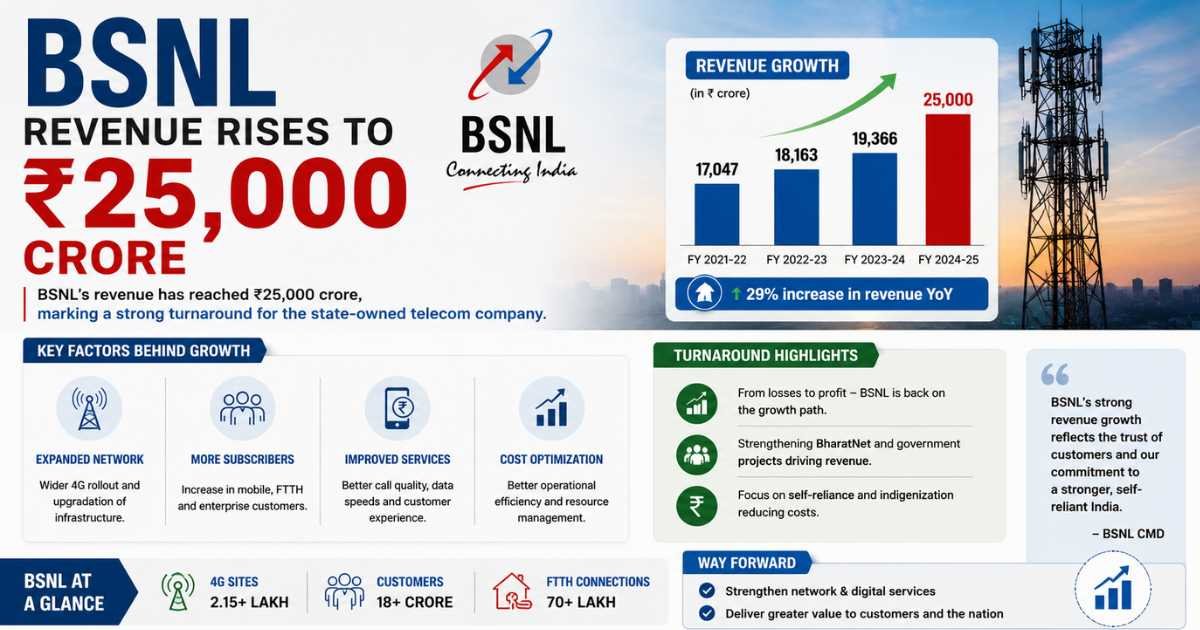
New Delhi: Union Minister of State for Communications Dr. Chandra Sekhar Pemmasani said BSNL revenue increased from ₹21,000 crore to ₹25,000 crore in two years, reflecting strong growth in the public sector telecom company.
In an interview with DD India, the minister said BSNL achieved a financial turnaround through infrastructure upgrades, operational reforms and indigenous technology deployment.
He said EBITDA increased sharply from ₹50 crore to nearly ₹7,000 crore during the period. According to him, the company improved operational efficiency and moved closer to profitability.
Dr. Pemmasani said the government focused on fixing outdated infrastructure, improving tower conditions and strengthening work culture within BSNL.
He said tower uptime in states such as Andhra Pradesh earlier remained around 75 per cent. However, BSNL later increased the target to 95 per cent after replacing 50,000 batteries and upgrading power systems.
The minister also highlighted the rollout of indigenous 4G technology across the country. He said BSNL launched indigenous 4G services on 100,000 towers within one year.
According to him, India became the fifth country in the world to develop deep indigenous 4G technology.
Indigenous 4G expansion strengthens BSNL revenue growth
Dr. Pemmasani said BSNL introduced low-cost SIM cards through India Post offices to rebuild public confidence and expand rural connectivity.
He added that postal workers were creating awareness about BSNL services in villages where private telecom coverage remained weak.
The minister said nearly 35,000 villages earlier lacked proper telecom connectivity because of difficult terrain and left-wing extremism. He stated that BSNL already installed around 25,000 towers in such areas, while another 10,000 towers remained under progress.
He said improved communication networks in remote regions helped residents contact authorities quickly and supported efforts to reduce extremism.
Dr. Pemmasani also referred to the BharatNet project aimed at providing fibre connectivity to every Gram Panchayat. He said the government planned investments of nearly ₹1.40 lakh crore under the programme.
According to him, the first phase targeted broadband connectivity for 1.5 crore rural households.
The minister said communication infrastructure remained central to the vision of Viksit Bharat by 2047. He added that BSNL’s long-term goal was to become trustworthy, proud and profitable.
