
Jitendra Singh urges industry to speed up commercialisation of Indian innovation

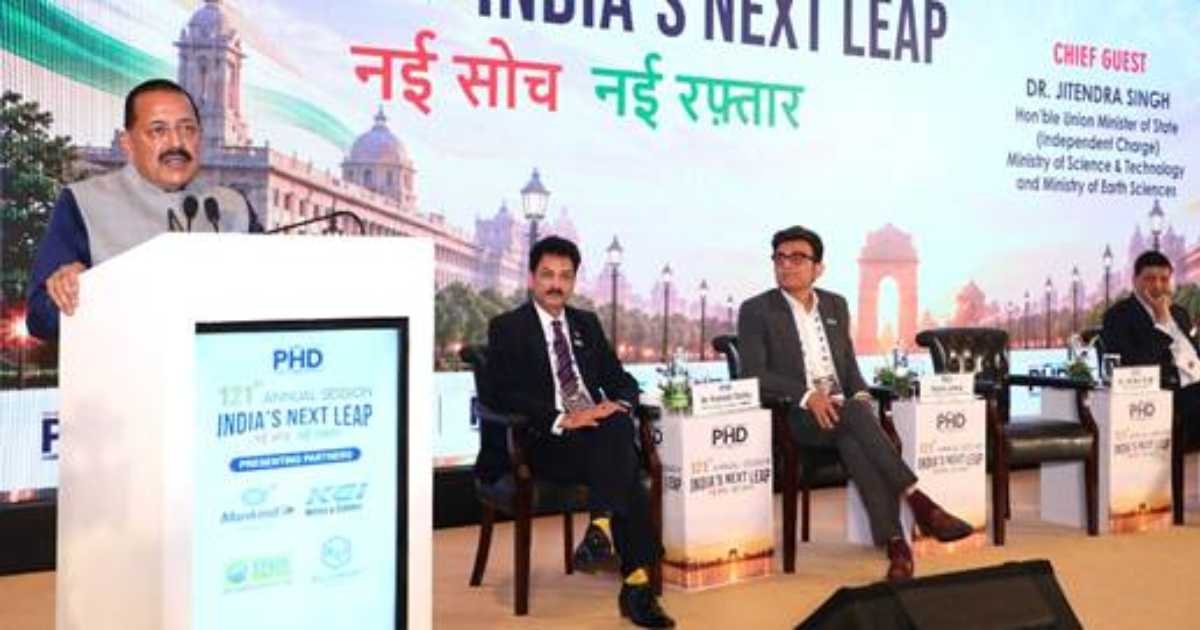
New Delhi: Dr Jitendra Singh on Saturday urged industry to accelerate the commercialisation of Indian innovation. He said companies must also scale up India’s technological capabilities to meet the national objectives set for 2047. These steps would strengthen the country’s strategic sovereignty, he said. Singh is Union Minister of State (Independent Charge) for Science & Technology and Earth Sciences. He is also Minister of State in the Prime Minister’s Office, Personnel, Public Grievances and Pensions, Department of Atomic Energy and Department of Space.
Singh addressed the 121st Annual Session of the PHD Chamber of Commerce and Industry (PHDCCI) in New Delhi. The session brought together industry leaders, entrepreneurs and other stakeholders. They discussed India’s growth and innovation priorities. The Minister stressed the need to unite Government, industry, academia, research institutions and start-ups. Together, they should convert scientific capabilities into indigenous technologies, commercially viable enterprises and globally competitive solutions.
He said India’s next phase of technological growth must move beyond adopting technologies developed elsewhere. It must create indigenous solutions with global relevance. The expansion of the space ecosystem after policy reforms shows the opportunities that follow. Greater private-sector participation in strategic technology areas points the same way. Scientific capabilities, he said, thrive when an enabling policy environment and entrepreneurial initiative support them.
Commercialisation of Indian innovation: quantum and bioeconomy milestones
Singh cited progress under the National Quantum Mission. India had set an eight-year target of 2,000 kilometres of quantum-secure communication. It achieved the 1,000-kilometre milestone in three years, according to his address. He stressed the strategic and security significance of quantum communication. He also underlined the importance of building domestic capabilities in frontier technologies.
The Minister also referred to the growth of India’s bioeconomy. It has risen from around US$10 billion in 2014 to approximately US$196 billion. India aims to reach US$300 billion by 2030. He cited the expansion of the biotechnology start-up ecosystem as evidence of emerging opportunities in life sciences and advanced research. These developments, he said, show how scientific innovation can create new enterprises, strengthen domestic capabilities and generate economic value.
Industry role in research and innovation
Singh stressed that industry engagement should begin at the start of research projects. Scientists could then understand market requirements and identify technological needs. They could also develop solutions with a clear path to commercial deployment. Industry bodies such as PHDCCI can connect researchers with businesses, he said. They can also facilitate investment and build partnerships that carry innovations from laboratories to prototypes and market-ready products.
He referred to the Government’s Research, Development and Innovation (RDI) initiative. Greater private-sector participation in research and development is essential, he said, to speed up the translation of discoveries into commercial applications. He encouraged industry to take part more actively in research-led innovation. Such participation would help build an ecosystem where scientific excellence leads to sustainable enterprises and globally competitive products.
Energy, self-reliance and the road to 2047
The Minister also stressed the importance of indigenous technologies and reliable energy supplies. They are vital for India’s ambitions in artificial intelligence, data infrastructure and advanced manufacturing. Domestic capabilities in strategic and emerging technologies, he said, would be essential to technological self-reliance and strategic sovereignty. Deeper collaboration between industry and scientific institutions would also play a key role.
Singh said India’s next leap would depend on combining new thinking with faster execution. It would also depend on the ability to scale successful innovations. Stronger partnerships among Government, industry, academia and start-ups would help accelerate the commercialisation of Indian innovation, he said. They would also expand the country’s innovation base and build the capabilities needed to realise India’s ambitions for 2047.
