
Delhi road tunnel project approved to connect Dwarka Expressway with Vasant Kunj

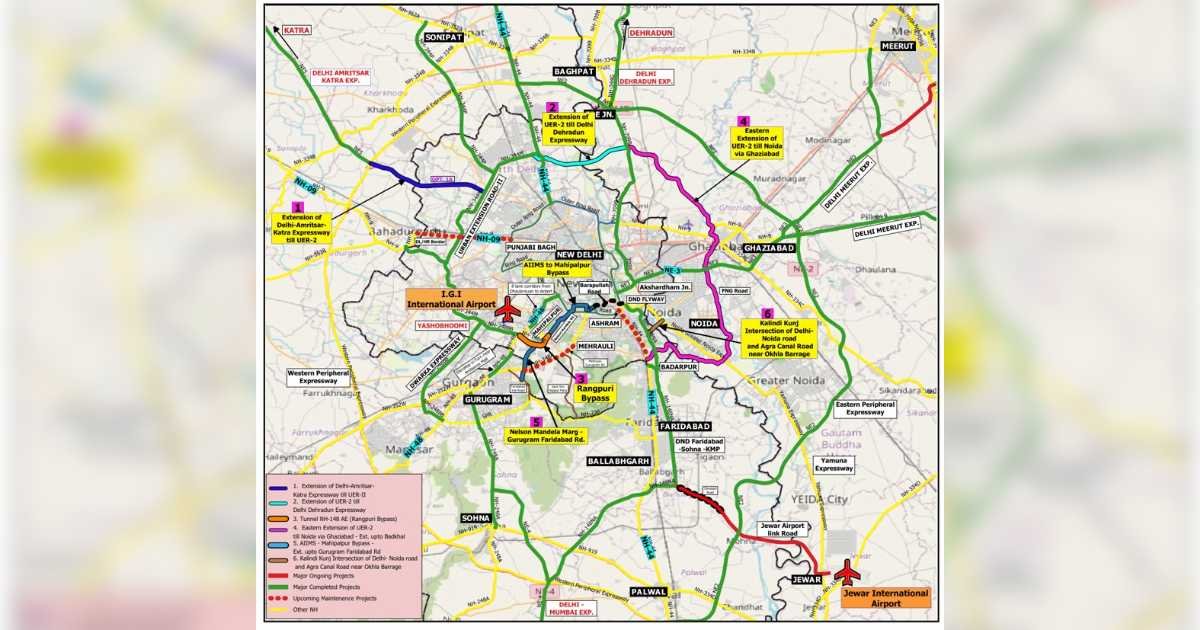
New Delhi: The Union Cabinet has approved the Delhi road tunnel project worth ₹6,969.67 crore to build a six-lane tunnel connecting Dwarka Expressway with Nelson Mandela Marg at Vasant Kunj, aiming to improve connectivity between West and South Delhi while reducing traffic congestion.
The Cabinet Committee on Economic Affairs, chaired by Prime Minister Narendra Modi, cleared the 8.1-km project under the National Highways (Original) Scheme on the Hybrid Annuity Mode (HAM). The project will connect Urban Extension Road-2 (UER-2), Dwarka Expressway, Indira Gandhi International Airport, Gurugram and West Delhi with South Delhi through a faster and more efficient corridor.
The project includes a 3.14-km underground twin-tube tunnel built using Tunnel Boring Machine (TBM) technology. The tunnel will pass beneath the Southern Ridge Forest for nearly 1.98 km, helping preserve the ecologically sensitive area while minimising disruption on the surface.
In addition, the project includes a 1.8-km elevated corridor along Nelson Mandela Marg, an additional flyover from Chhatarpur towards Mahipalpur and an elevated U-turn to ease traffic movement at one of the city’s busiest intersections.
Delhi road tunnel to ease congestion and improve connectivity
The main carriageway will extend for 6.3 km. Including tunnel approaches, elevated sections and at-grade roads, the total project length will be 8.1 km. The new corridor will also integrate with the proposed AIIMS–Mahipalpur elevated road and the Barapullah elevated corridor, strengthening connectivity between West, South and East Delhi, Ghaziabad and Noida.
According to the government, the upgraded corridor will reduce travel time, improve traffic flow and support faster movement of commuters travelling between Gurugram, Dwarka, IGI Airport and South Delhi.
The government also said the infrastructure project will generate substantial employment during construction. It estimates around 7.54 lakh person-days of direct employment and nearly 9.80 lakh person-days of indirect employment, besides creating additional economic opportunities in surrounding areas.
The project forms part of the Centre’s broader strategy to modernise urban transport infrastructure and improve connectivity in the National Capital Region through high-capacity road networks.
