

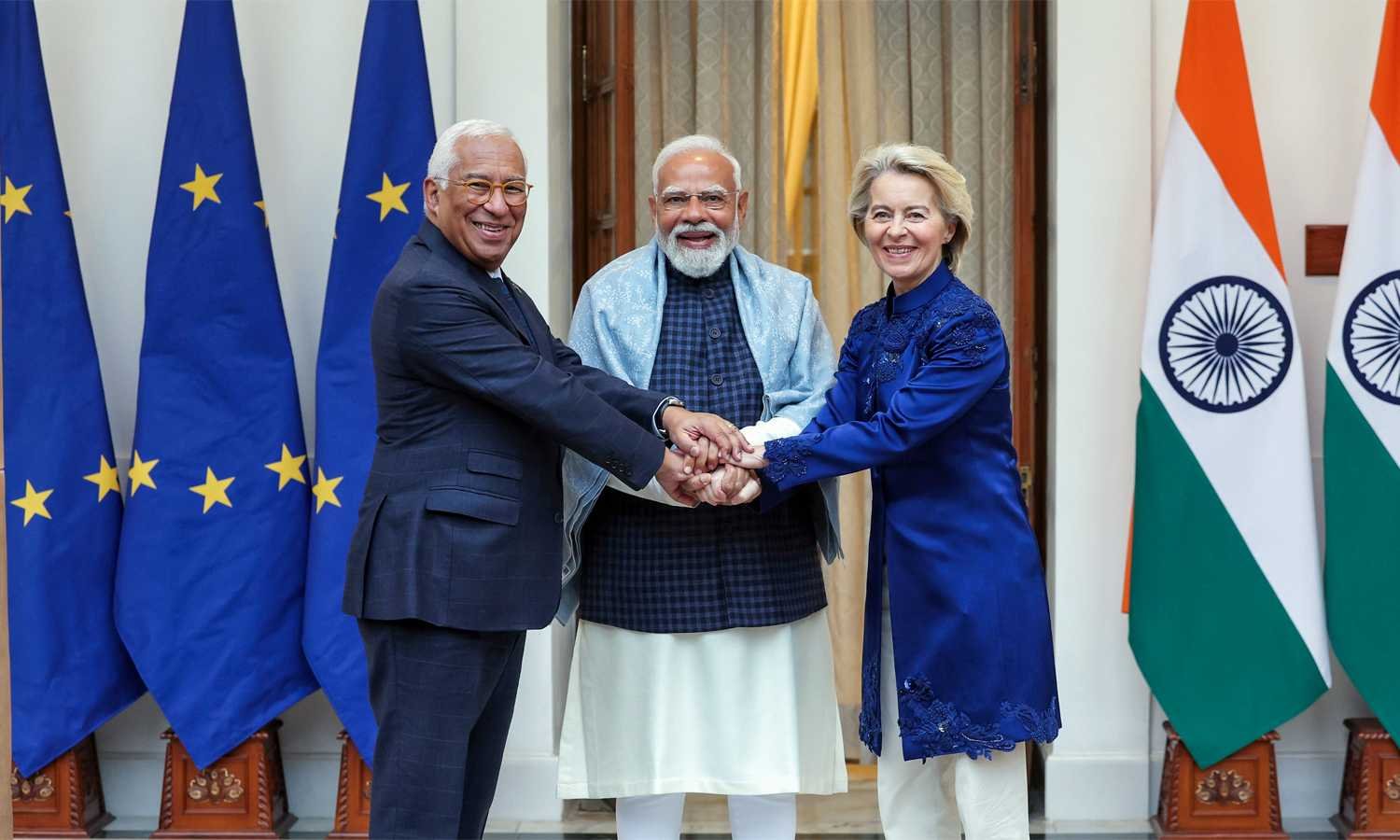
New Delhi: Prime Minister Narendra Modi and European Commission President Ursula von der Leyen announced the conclusion of the India–EU FTA at the 16th India–EU Summit, marking a major breakthrough in India’s global trade engagement.
The announcement came during the visit of senior European leaders to India. Officials said the India–EU FTA positioned both sides as trusted partners committed to open markets, predictability, and inclusive growth. The agreement followed sustained negotiations after talks were relaunched in 2022.
India and the European Union rank as the world’s 4th and 2nd largest economies. Together, they account for about 25% of global GDP and nearly one-third of global trade. Officials said the integration of the two economies would create unprecedented trade and investment opportunities.
In 2024–25, India’s goods trade with the EU stood at INR 11.5 lakh crore. Exports accounted for INR 6.4 lakh crore, while imports stood at INR 5.1 lakh crore. Trade in services reached INR 7.2 lakh crore during the same period.
Union Commerce and Industry Minister Piyush Goyal said the India–EU FTA represented a defining achievement in India’s economic engagement. He said the agreement secured preferential market access for over 99% of Indian exports by value. He added that the pact supported Make in India and unlocked high-value opportunities in services and mobility.
India–EU FTA opens markets, safeguards sensitive sectors
Officials said the India–EU FTA would give a decisive boost to labour-intensive sectors such as textiles, apparel, leather, marine products, gems and jewellery, and handicrafts. Tariffs of up to 10% on nearly USD 33 billion worth of exports will fall to zero when the agreement comes into force.
The agreement also includes calibrated auto liberalisation. Officials said the approach balanced market access with domestic manufacturing priorities. It will allow greater EU auto access in higher segments while opening export opportunities for India-made vehicles.
India’s agricultural and processed food exports will also gain improved access. Products such as tea, coffee, spices, fruits, vegetables, and processed foods will become more competitive. At the same time, India protected sensitive sectors, including dairy, cereals, poultry, and select produce, with no market access commitments.
The pact delivers ambitious commitments in services, including IT, professional services, education, finance, tourism, and construction. Officials said the agreement ensured predictable market access across 144 EU subsectors for Indian firms.
On mobility, the India–EU FTA provides a structured framework for professionals, business visitors, and intra-corporate transferees. It also includes entry and work rights for dependents. The EU extended commitments in several sectors of interest to India, including research, education, and digital services.
The agreement also addresses non-tariff barriers through regulatory cooperation and streamlined customs and SPS procedures. CBAM-related provisions provide assurances on dialogue, technical cooperation, and support to address carbon compliance.
Officials said the India–EU FTA would expand trade, strengthen global value chain integration, and boost employment for MSMEs, women, youth, artisans, and professionals. They added that the agreement aligned with India’s Viksit Bharat 2047 vision and laid the foundation for inclusive and future-ready growth.
