

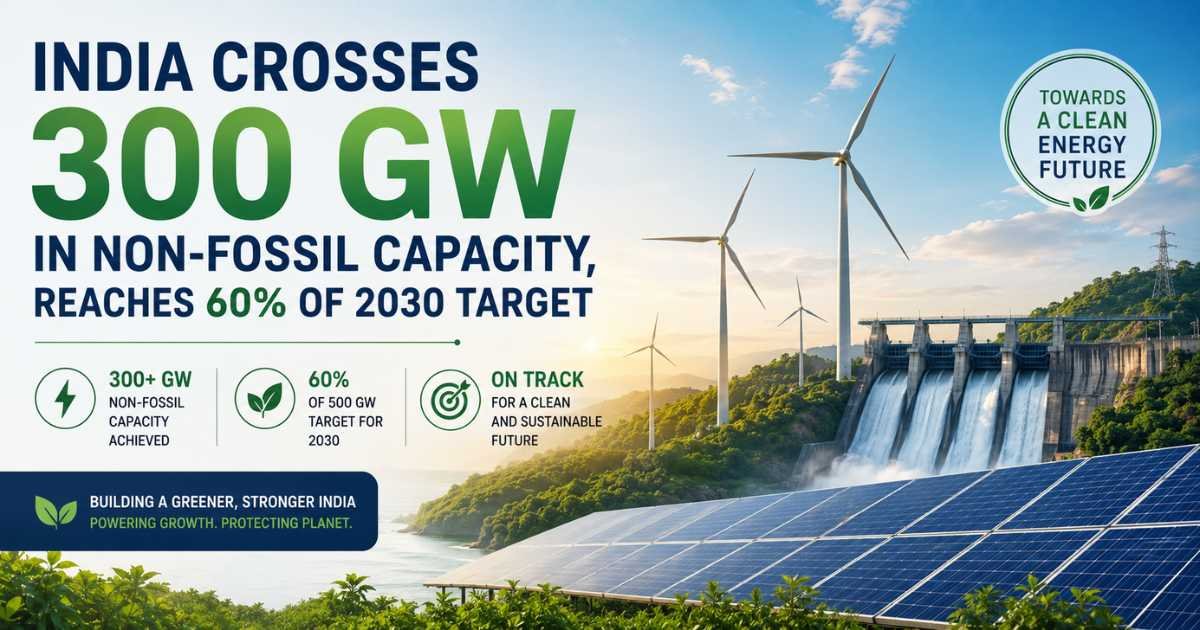
New Delhi: India crossed 300 GW of non-fossil capacity as of July 31, 2026, marking major progress toward its 500 GW target for 2030. The country reached 300.50 GW of installed electricity generation capacity from non-fossil sources.
This figure represents more than 60% of India’s 500 GW target for 2030. Moreover, non-fossil sources now account for over 54% of the country’s total installed electricity capacity, which stands at around 552 GW.
Solar power led the expansion, reaching 164.59 GW as of July 31. India had only 2.8 GW of solar capacity in 2014. Meanwhile, wind power reached 58.14 GW, compared with 21 GW in 2014.
Large and small hydropower contributed 57.24 GW, while bio-power added 11.75 GW. Nuclear power accounted for another 8.78 GW. Together, these sources took the country’s total to 300.50 GW.
Solar and wind drive India’s clean energy growth
During 2025-26, India added a record 55.29 GW of electricity capacity from non-fossil sources. Solar power accounted for 44.6 GW of the addition, while wind power contributed 6 GW.
The rise in installed capacity has also lifted renewable energy generation. Generation increased from 190.96 billion units in 2014-15 to 477.79 billion units in 2025-26.
At the same time, India has expanded domestic manufacturing to support the clean energy transition. The government has used the Production Linked Incentive scheme to promote high-efficiency solar module manufacturing.
Consequently, capacity listed under the Approved List of Models and Manufacturers for Solar PV modules crossed 200 GW. The figure stood at only 2.3 GW in 2014.
The clean energy transition is also supporting India’s energy independence, industrial competitiveness and economic resilience. In addition, the Ministry of New and Renewable Energy is advancing industrial decarbonisation through the National Green Hydrogen Mission.
The mission aims to position India as a global hub for the production, use and export of green hydrogen and its derivatives. The latest milestone strengthens the country’s progress toward an Aatmanirbhar energy ecosystem and its 500 GW target for 2030.
