

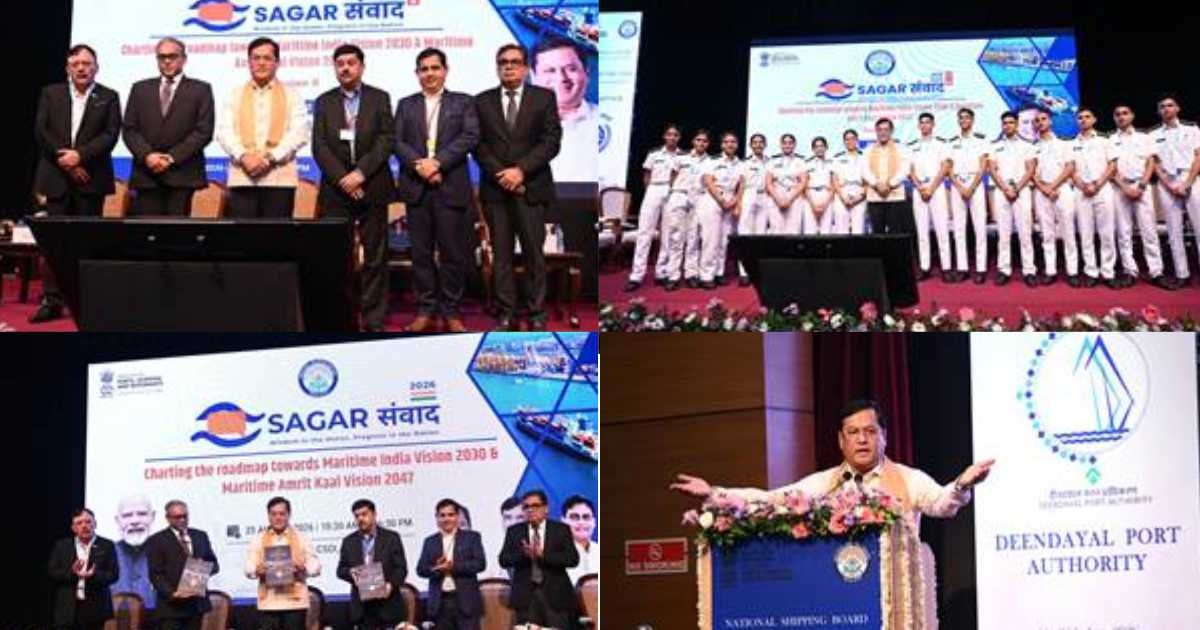
New Delhi: India plans to add 100 new ships to its merchant fleet within five years to reduce dependence on foreign shipping lines, Union Minister Sarbananda Sonowal said.
Sonowal made the announcement during the first ‘Sagar Samvad’ organised by the National Shipping Board (NSB) in New Delhi on Tuesday.
The day-long programme focused on the roadmap for Maritime India Vision 2030 and Maritime Amrit Kaal Vision 2047. It brought together government officials, shipowners, financiers, industry representatives and maritime trainees.
Sonowal also launched the NSB’s first official website during the programme. NSB Chairperson Sameer Kumar Khare presented the board’s annual report for 2025-26.
He also submitted reports from NSB subcommittees containing policy recommendations for the government. The board was reconstituted in May 2025.
Sonowal said the NSB had a long-standing role in shaping India’s shipping policy. He said the re-enacted Merchant Shipping Act, 2025, and new National Shipping Board Rules had strengthened its mandate.
The minister also welcomed the board’s five-point roadmap for strengthening Indian shipping. The proposals cover fiscal reform, assured cargo support, competitive financing, regulatory streamlining and ease of doing business.
He said these measures would help Indian shipowners participate in the country’s expanding maritime economy. Sonowal also said India was working to quadruple port capacity to 10,000 million tonnes a year by 2047.
The minister highlighted the Container Manufacturing Assistance Scheme, which carries an allocation of ₹10,000 crore. He said global shipping company Maersk had ordered containers manufactured in India.
Five reforms proposed to strengthen Indian shipping
Union Minister of State for Ports, Shipping and Waterways Shantanu Thakur said India pays nearly $75 billion every year to foreign shipping lines for freight services.
He said these payments cover important cargo such as crude oil, gas, coal and urea. Therefore, he stressed the need to strengthen Indian ownership of shipping capacity.
Thakur said the issue was linked to competitiveness and demand partnerships rather than the performance of Indian shipowners. He said India needed greater control over its trade routes as it worked towards becoming a developed nation by 2047.
A panel at the event examined the challenges involved in expanding Indian tonnage. Panel members said operating ships under the Indian flag costs 16% to 20% more than operating under foreign flags.
They linked the cost gap to several factors. These included taxes on ship imports and maintenance services, deductions from seafarers’ wages, freight taxation and higher domestic capital costs.
The panel also pointed to the Right of First Refusal mechanism. Under the system, Indian shipowners must match foreign freight rates to secure certain cargo.
The panel proposed five measures to address these challenges. They include fiscal reform, assured cargo support, access to competitive finance, regulatory changes and improved ease of doing business.
If adopted, the measures could help India add 100 ships to its fleet over five years. The expansion would support the country’s goal of becoming one of the world’s top five ship-owning nations by 2047.
The programme also focused on India’s maritime workforce. Labour and Employment Minister Mansukh Mandaviya chaired a session on opportunities and challenges facing seafarers.
Mandaviya said India’s maritime sector could become a major source of employment for young people. He also said India could emerge as a leading supplier of skilled seafarers.
He called for greater training capacity and stronger industry-led skill development. In addition, he stressed the need to create more employment pathways and reduce gender disparities in maritime jobs.
The minister also highlighted emerging areas such as cruise shipping and advanced shipbuilding. He said India needed a future-ready workforce to support its maritime ambitions.
Mandaviya urged the government, industry, trade bodies and training institutions to work together. He said coordinated efforts could expand training, improve employment opportunities and strengthen India’s position in the global maritime workforce.
The session also discussed wage taxation, pension gaps and welfare issues affecting Indian seafarers. These concerns formed part of the NSB’s broader assessment of the maritime labour force.
Union Minister of State Shantanu Thakur presided over the panel on augmentation of Indian tonnage. Capt. M.P. Basin and C.V. Subbarao also addressed the session.
The valedictory panel included representatives from the Indian Maritime Foundation, Indian National Shipowners’ Association, DGMA, International Financial Services Centres Authority and container shipping industry.
Participants discussed the need to make Indian shipping more competitive. They also examined financing, taxation and regulatory issues that affect domestic shipowners.
NSB Chairperson Sameer Kumar Khare said the board’s work supported the government’s Blue Economy vision. He linked the initiative to infrastructure development, port modernisation and green shipping reforms.
The NSB is a statutory advisory body under the Merchant Shipping Act, 2025. It advises the government on shipping policy, tonnage, seafarer welfare and port-linked maritime development.
The inaugural ‘Sagar Samvad’ brought stakeholders together across three sessions. The discussions covered maritime labour, workforce development, fleet expansion and India’s long-term maritime goals.
The programme provided a platform for industry and government representatives to discuss measures for a stronger and more competitive shipping sector.
The proposed fleet expansion is expected to strengthen India’s maritime capacity. It could also reduce dependence on foreign shipping services and support the country’s broader economic and strategic objectives.
