

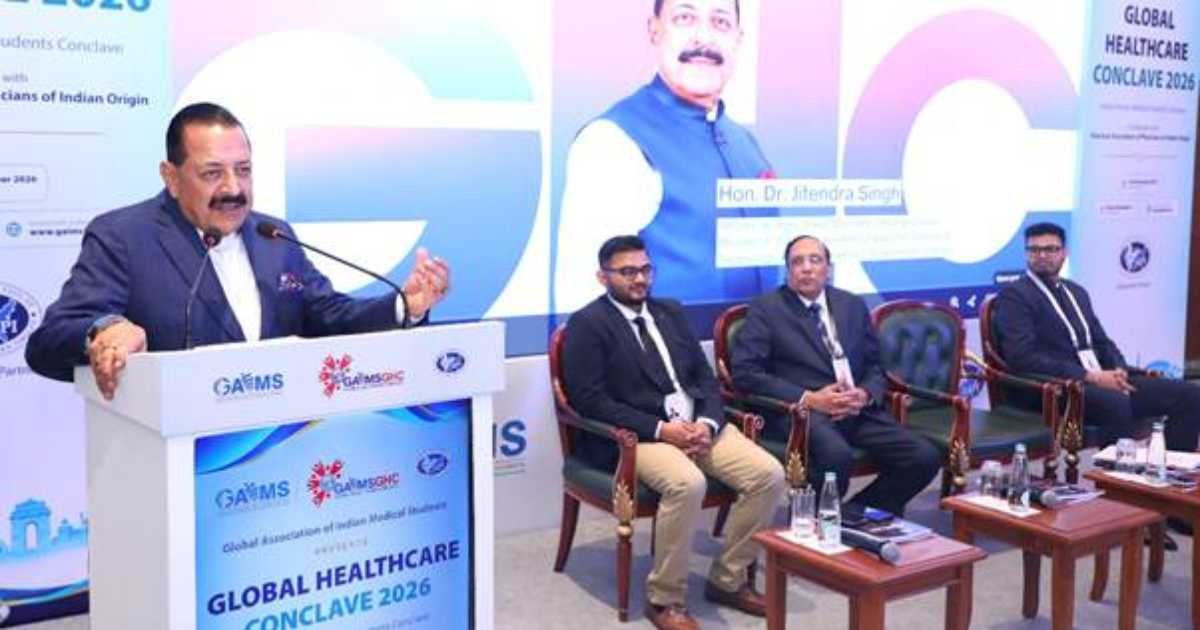
New Delhi: India is moving towards becoming a global healthcare powerhouse through indigenous research, medical innovation and affordable advanced treatment, Union Minister Dr Jitendra Singh said on November 28, 2026. He called for a careful balance between clinical medicine and technology-driven practices, stressing that technology must not replace a doctor’s clinical judgement.
Addressing the Global Healthcare Conclave 2026, organised by the Global Association of Indian Medical Students (GAIMS), Singh said India’s scientific capabilities and genomic diversity were opening new opportunities in healthcare. He urged young doctors to combine emerging technologies with strong clinical skills. The conclave brought together medical students, healthcare professionals and members of the medical fraternity to discuss developments and challenges in the sector.
Dr Minu Bhajpai, Vice President of the National Board of Examinations in Medical Sciences (NBEMS), attended as Guest of Honour. GAIMS National Chairman Dr Shubham Anand and other executive members were also present. Singh released the conclave’s official souvenir and interacted with medical students.
The Minister said India had moved from relying heavily on imported medical technologies and advanced treatment facilities to developing indigenous vaccines, antibiotics, gene therapies and cancer treatments. He also noted the country’s transition from conventional X-ray diagnostics to ultrasound, CT scans and MRI, alongside progress in treatment and disease management.
India now faces a dual burden of communicable and non-communicable diseases, Singh said. Type-2 diabetes, cardiovascular disease, hypertension, dyslipidemia and fatty liver disease have emerged as major public health challenges. He also highlighted the growing detection of metabolic disorders among younger people.
Singh said India’s population and genetic diversity offered valuable opportunities to study disease patterns and genetic variations. Under the Indian Genome Programme, researchers have sequenced around 10,000–15,000 individuals from 84 populations. The programme initially aims to expand sequencing to one million individuals, potentially strengthening precision medicine and global medical research.
The Minister said genomics and Artificial Intelligence (AI) were creating new possibilities for personalised treatment. He cited research into genetically engineering E. coli to produce GLP analogues, which could help address insulin resistance and related metabolic conditions. Such work, he said, reflects efforts to develop solutions for India’s specific health needs.
He also pointed to India’s growing role in vaccine development and global vaccination efforts. More than 50 lakh adolescent girls have received HPV vaccination under the programme he cited. Singh said India had developed two indigenous antibiotics in the past two years, with one being marketed by Wockhardt.
Indigenous therapies strengthen India’s medical research
Singh cited gene therapy trial work for haemophilia at Christian Medical College, Vellore, published in the New England Journal of Medicine. He also highlighted CAR-T cell therapy and cancer research at Tata Memorial Centre in Mumbai. These advances, he said, are helping make sophisticated cancer treatment more affordable and expanding India’s contribution to advanced medical care.
The Minister said Indian doctors and researchers were gaining greater international recognition. Progress in vaccines, antibiotics, cancer therapies and medical research had improved India’s standing and created a stronger platform for young professionals in global healthcare.
Drawing on his experience as a medical practitioner, Singh recalled how doctors developed expertise through hospital exposure and direct patient contact. He said symptom recognition, clinical assessment and diagnosis through observation remained central to medical practice. Investigations, he stressed, must support clinical findings rather than replace them.
Singh urged students to keep learning about AI, quantum technologies, genomics and precision medicine. These tools could improve diagnosis and enable targeted treatment, but doctors must apply them with sound judgement. He also called for greater emphasis on clinical competence and practical exposure in postgraduate medical education and selection.
A doctor, he said, should be able to provide medical assistance even when advanced equipment is unavailable. Clinical sense develops through sustained patient interaction and hands-on experience, he added.
The Minister also cited government efforts to improve affordable healthcare. Ayushman Bharat has expanded financial protection for patients, including coverage for pre-existing diseases. He also pointed to the expansion of dialysis facilities across district hospitals.
Singh said prevention would become increasingly important as lifestyle-related and metabolic disorders affect younger people. He highlighted central obesity among Indian populations, noting that people who appear lean may still have significant visceral fat. This can independently raise the risk of metabolic and cardiovascular conditions, he said, underscoring the need for India-specific medical data.
He encouraged GAIMS and other healthcare organisations to contribute to research, healthcare delivery, public health advocacy and private-sector collaboration. Singh said India’s growing scientific ecosystem and indigenous medical breakthroughs offered young doctors opportunities to address emerging health challenges.
He expressed confidence that medical professionals would help advance the vision of Viksit Bharat 2047 through research, innovation and patient care.
