
MoSPI tracks 1,853 central sector infrastructure projects worth ₹37.56 lakh crore

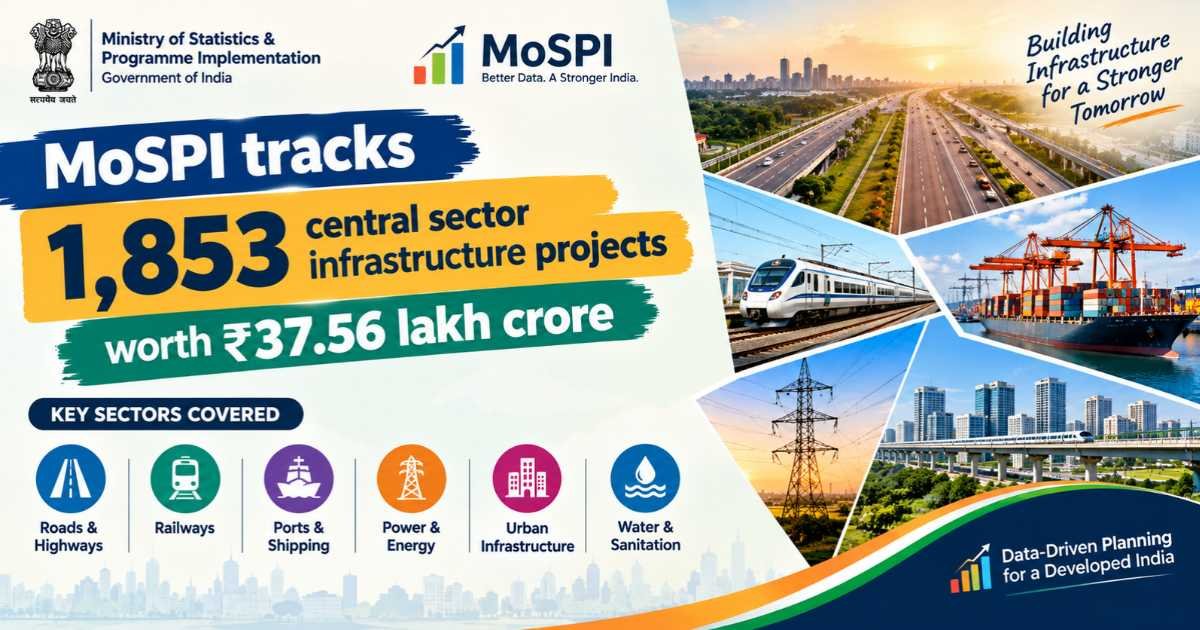
New Delhi: The Ministry of Statistics and Programme Implementation (MoSPI) is monitoring 1,853 central sector infrastructure projects worth ₹37.56 lakh crore, according to its latest monthly flash report. The figures are as of September 2026. MoSPI tracks the projects through its PAIMANA platform, which enables better tracking, timely reviews and data-driven decision-making across ministries. Transport and logistics and energy together account for 83.4 per cent of the projects, or 1,545 of the 1,853.
Seventeen central ministries and departments are implementing the ongoing projects. Cumulative spending stands at ₹17.73 lakh crore, about 47.21 per cent of the latest project cost. MoSPI said this indicates steady progress in implementation. Overall, 654 projects, about 35 per cent, have achieved over 80 per cent physical progress. Another 338, about 18 per cent, have crossed 80 per cent financial completion.
The report describes a balanced pipeline, with projects spread across early and advanced stages. It counts 780 Mega projects costing ₹1,000 crore and above, and 1,073 Major projects costing below ₹1,000 crore. Within the Department of Economic Affairs’ Harmonized Master List, transport and logistics has the most ongoing projects at 1,320, costing ₹20.07 lakh crore. MoSPI said this underscores the priority given to connectivity-driven growth.
Physical and financial progress broadly move in tandem. Many projects cluster in the initial (0–20 per cent) and advanced (81–100 per cent) stages, pointing to newly started projects alongside many nearing completion. In the 81–100 per cent range, physical progress exceeds financial progress. In the early stages, however, financial progress is relatively higher. MoSPI said this reflects upfront expenditure patterns.
Road transport and railways lead infrastructure projects by ministry
The Ministry of Road Transport and Highways has the most projects, with 974, or 53 per cent of the total. Their revised cost is ₹9.46 lakh crore, or 25 per cent of the overall ₹37.56 lakh crore. MoSPI said this highlights the ministry’s central role in national infrastructure development.
Next comes the Ministry of Railways, with 284 ongoing projects, or 15 per cent, and a revised cost of ₹7.21 lakh crore, or 19 per cent. The Ministry of Coal accounts for 121 projects, or 6 per cent, costing ₹2.22 lakh crore, also 6 per cent.
Four other bodies are implementing sizeable portfolios. Petroleum and Natural Gas has 115 projects costing ₹4.30 lakh crore, while Power has 106 costing ₹6.40 lakh crore. Housing and Urban Affairs has 49 costing ₹3.41 lakh crore, and the Department of Water Resources, River Development and Ganga Rejuvenation has 35 costing ₹1.95 lakh crore.
The remaining 169 projects, or 9 per cent, cost ₹2.62 lakh crore, or 7 per cent. They fall under ministries and departments including Higher Education, Civil Aviation, Steel, Telecommunications, Labour and Employment, Ports, Shipping and Waterways, Health and Family Welfare, Mines, DPIIT and Sports.
Big-ticket projects commissioned and 83 new additions
The report names three notable projects commissioned in September 2026. First is the 1,320 MW Buxar Thermal Power Project of the Ministry of Power, costing ₹13,756.56 crore. Officials commissioned it on September 12, 2026, and inaugurated it on September 14.
Second is Phase-I Package-I of the Delhi-Amritsar-Katra Expressway, costing ₹2,429.9 crore. The package runs from Jussur Kheri on the NH-KMP Expressway to the junction with the Rohtak-Panipat road (NH-709) near Rukhi Paani village, from Km 0 to Km 34. The Ministry of Road Transport and Highways commissioned it on November 4, 2025, and inaugurated it on July 17, 2026.
Third is the NMDC Slurry Pipeline Project Phase-1 of the Ministry of Steel, costing ₹5,427 crore. Officials commissioned it on September 26, 2026, and inaugurated it the next day.
During September, PAIMANA onboarded 83 additional projects. Of these, 57 belong to the Ministry of Railways, 16 to the Ministry of Road Transport and Highways and seven to the Ministry of Power. Two come from the Ministry of Ports, Shipping and Waterways and one from the Ministry of Coal.
Newly onboarded infrastructure projects under PAIMANA
The Ministry of Road Transport and Highways added a ₹575.07 crore project. It covers the upgradation to a two-lane carriageway with paved shoulder on Package II of the Dholavira-Mauvana-Vauva-Santalpur section of NH-754K in Gujarat, on EPC mode. The upgraded stretch runs from km 170300 to km 277254.
Power added three projects. They are the installation of two synchronous condenser units at the 765/400/220 kV Fatehgarh-II power station (₹1,157 crore), the transmission system for Krishnagiri REZ Phase-I (₹7,627 crore) and the augmentation at Bhadla-III, Ramgarh PS and Kanpur (PG) (₹1,015 crore).
Meanwhile, the Ministry of Ports, Shipping and Waterways added the mechanisation of a multipurpose berth on BOT basis, costing ₹630.67 crore. The report notes that it was inaugurated on August 21, 2026. Railways contributed the 147-km Hosur-Omalur umbrella work, costing ₹1,839.32 crore.
Transport and logistics: 1,320 projects, ₹20.07 lakh crore
Transport and logistics is the largest category. Its 1,320 projects make up 71.2 per cent of those monitored and about 51.02 per cent of the total project cost. The category covers roads and highways, railways, urban public transport, aviation, shipping and logistics infrastructure.
Roads and highways account for 974 projects, or 73.8 per cent of the category, while railways have 286. Together, they make up about 83.3 per cent of the category’s cost. Urban public transport has 29 projects, aviation 25, shipping five and logistics infrastructure one.
Cumulative expenditure of ₹10,23,890 crore represents 51.03 per cent of the category’s project cost. Shipping records the highest expenditure ratio at 63.37 per cent, followed by logistics infrastructure at 56.36 per cent. The ratios for roads and highways, aviation, railways and urban public transport are 52.13, 51.48, 50.28 and 48.95 per cent respectively.
Of the 1,320 projects, 504 (38.2 per cent) are in the 81–100 per cent physical-progress range, while 280 (21.2 per cent) are in the 0–20 per cent range. On financial progress, 236 projects (18.0 per cent) are in the 81–100 per cent range and 270 (20.4 per cent) in the 0–20 per cent range. According to MoSPI, the gap underscores the need to examine physical completion, expenditure, pending works and commissioning readiness together.
Energy projects trail, water and sanitation spending leads
The energy category has 225 projects costing ₹11.04 lakh crore, about 29.4 per cent of the total revised project cost. It covers oil and gas, transmission and distribution, electricity generation and energy storage. Oil and gas has the most projects, at 102. Electricity generation has the highest cost, at ₹4,27,249 crore across 38 projects. Transmission and distribution has 72 projects, and energy storage has 13.
Cumulative energy expenditure stands at ₹4,36,858 crore, or 39.58 per cent of cost. Energy storage records the highest ratio at 81.79 per cent, followed by oil and gas at 50.13 per cent. Electricity generation stands at 32.62 per cent, and transmission and distribution at 29.54 per cent.
Meanwhile, the water and sanitation category has 50 projects costing ₹1,98,837 crore. Spending totals ₹1,40,791 crore, a ratio of 70.81 per cent, the highest among all Harmonized Master List categories. Water resources accounts for 27 projects costing ₹1,90,927 crore, with an expenditure ratio of 71.32 per cent. The other 23 projects fall under waste and water, costing ₹7,910 crore, with a ratio of 58.39 per cent. Most projects in the category sit in the 81–100 per cent range of physical and financial progress.
Communication, social infrastructure and other sectors
The communication category has 31 telecommunication projects costing ₹1,33,708 crore. Spending stands at ₹65,064 crore, or 48.66 per cent of cost. MoSPI said the projects strengthen communication infrastructure and digital connectivity.
The social and commercial infrastructure category has 79 projects costing ₹95,348 crore, with spending of ₹39,782 crore, or 41.72 per cent. It covers education, healthcare, real estate, and tourism, hospitality and wellness. Education has 32 projects and the highest expenditure ratio among its sub-sectors, at 61.24 per cent. Tourism, hospitality and wellness follows at 55.57 per cent with one project. Healthcare has 31 projects at 41.29 per cent, and real estate has 15 at 35.93 per cent. In this category too, most projects fall in either the first or last progress range.
The Others category, which is not an HML category, has 148 projects costing ₹2,17,438 crore. Spending totals ₹66,679 crore, or 30.67 per cent. Coal dominates with 115 projects costing ₹1,82,780 crore and an expenditure ratio of 27.50 per cent. By comparison, steel has 23 projects at 42.02 per cent, metals and mining eight at 55.35 per cent, and construction two at 36.15 per cent.
Flash report coverage and next release
The flash report covers central sector projects costing ₹150 crore and above. Readers can find it on the PAIMANA-PROJ portal at paimana-proj.mospi.gov.in. The cost figures throughout are the latest available. The report covers selected categories and sub-sectors of the Harmonized Master List, based on data from the line ministries and departments. It does not cover the entire list, so readers should interpret it within that coverage.
MoSPI has renamed the project monitoring interface PAIMANA-PROJ, from PAIMANA. PAIMANA-CRIP, the Central Repository of Infrastructure Projects, launched in July 2026, serves as the underlying data repository. Nearly 80 per cent of its data updates through APIs. MoSPI will release the flash report for October 2026 on November 25, 2026.
