

New Delhi: Scientists have found new evidence that massive stars can trigger star formation in nearby regions, helping shape the evolution of star-forming molecular clouds.
Stars form inside large clouds of gas and dust known as molecular clouds. While most stars have masses similar to the Sun, some are more than eight times heavier. Although such massive stars are rare, they strongly influence their surroundings.
Researchers from the Aryabhatta Research Institute of Observational Sciences (ARIES) in Nainital, under the Department of Science and Technology, studied a region called Bright Rimmed Cloud 44. The cloud is located about 900 parsecs from Earth in the Cepheus OB2 star-forming complex.
The team found that ultraviolet radiation from nearby massive stars interacts with the cloud and affects its structure. The radiation heats and compresses the gas, which creates shock waves that move deeper into the cloud and increase its density. As a result, new stars begin to form in the region.
Scientists used a multi-wavelength approach for the study. They combined observations from optical telescopes in India with infrared and radio data from international facilities. This approach allowed them to examine both the young stars and the surrounding gas in detail.
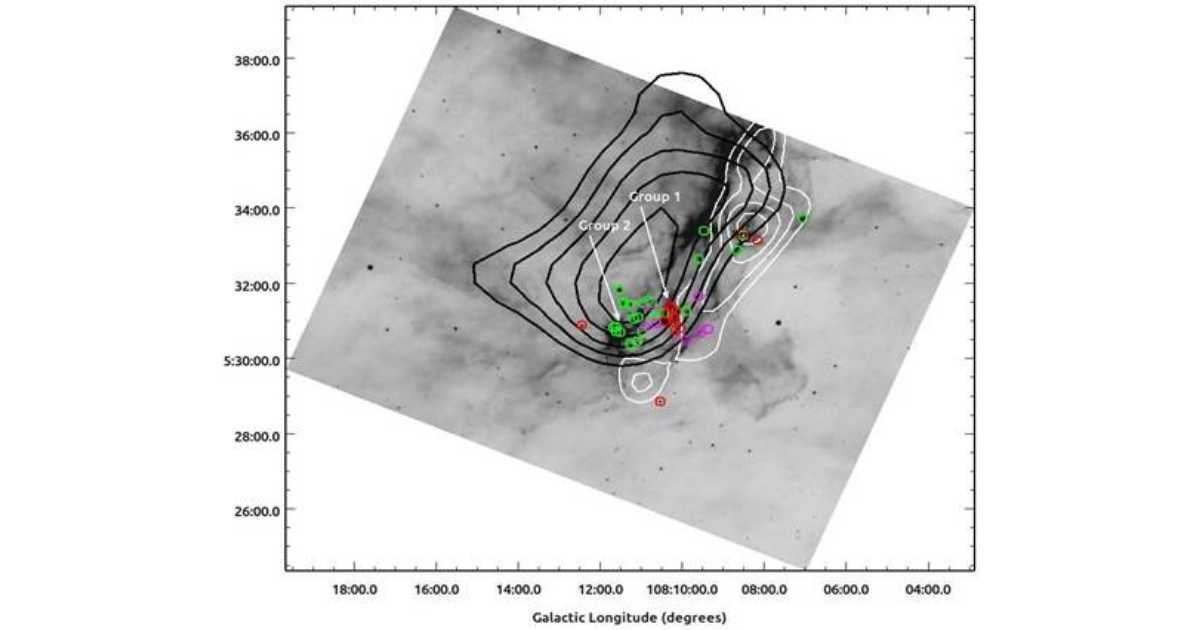
The study identified 22 new young stellar objects in Bright Rimmed Cloud 44. Among them were brown dwarfs, which are smaller than normal stars and cannot sustain hydrogen fusion in their cores.
Star formation study reveals new young stellar objects
Researchers also identified two groups of young stars in the region. One group formed due to the interaction between cloud material and radiation from massive stars. The second group formed around the same time as the nearby massive star.
Moreover, the findings show that massive stars do not only disrupt their surroundings. Instead, they can also initiate star formation under certain conditions.
The results were published in The Astrophysical Journal. Scientists said the study improves understanding of how radiation influences molecular clouds and contributes to the birth of new stars in the Galaxy.
