

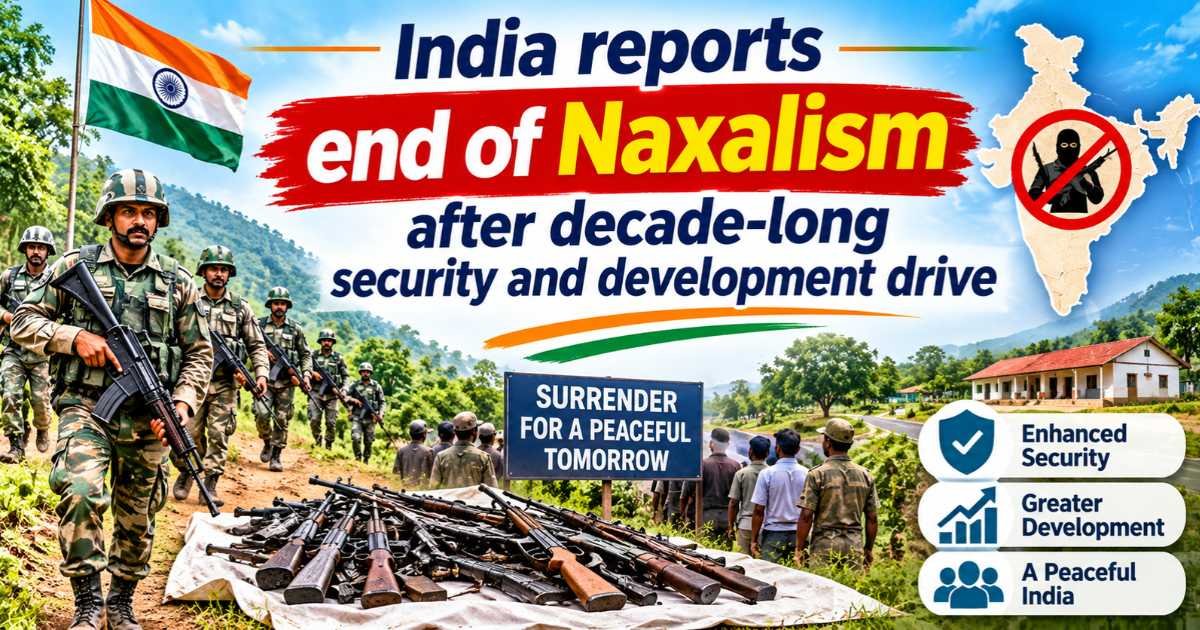
New Delhi: India has achieved a major security milestone, with no district remaining affected by Left-Wing Extremism (LWE), according to the Ministry of Home Affairs. The country reached this milestone on March 31, 2026, after a coordinated strategy involving security operations, development, rehabilitation and tribal welfare.
The Ministry detailed the progress in a report published by the Press Information Bureau on November 24, 2026. It said the strategy restored government presence in remote areas, reduced violence and expanded public services. The next phase will focus on maintaining peace, preventing extremist resurgence and sustaining development.
For nearly six decades, Naxalism affected tribal communities and remote villages, many of which lacked roads, schools and basic services. When the government took office in May 2014, the Red Corridor remained a major internal security challenge. Earlier efforts, the report said, often lacked coordination and focused on individual incidents.
The government brought together three priorities: restoring public trust, expanding infrastructure and delivering welfare with dignity. Security operations created space for development. Meanwhile, better services and community engagement helped strengthen trust in government.
LWE-free districts follow a unified security and development strategy
The Naxalbari uprising began in West Bengal in 1967, inspired by Maoist ideology and armed revolution. Several extremist organisations merged to form CPI (Maoist) in 2004. The report says nearly 92% of Naxalite weapons had come from looted police armouries.
Between 2004 and 2014, the report records 17,542 violent incidents, 1,913 security force deaths and 5,019 civilian deaths. It identifies 2010 as a peak year, with 1,936 incidents and 720 civilian deaths. However, another section records 1,005 fatalities for 2010.
The government approved the National Policy and Action Plan to address LWE in 2015. The plan introduced four priorities: strengthening security, accelerating development, ensuring rights and entitlements, and managing perception. It improved coordination between state police and Central Armed Police Forces (CAPFs), while also addressing socio-economic causes.
Since 2017, the government has released about ₹4,318.52 crore under the Special Central Assistance scheme. It sanctioned projects worth ₹1,761 crore under the Special Infrastructure Scheme. Since 2014-15, it has also released ₹3,877.98 crore under the Security Related Expenditure scheme. The funds support operations, training, rehabilitation and assistance to families of personnel and civilians killed.
The government set a target on August 24, 2024, to make India Naxal-free by March 31, 2026. According to the report, it achieved the target on schedule through intensified operations, stronger coordination, infrastructure expansion and development outreach.
Security grid and operations
The government built 668 new security camps, compared with 169 before 2014, and established 615 fortified police stations. It also constructed 68 night-landing helipads and supplied 400 bullet-proof and blast-proof vehicles. In addition, it built five hospitals for security personnel.
Specialised forces included CoBRA, CRPF, District Reserve Guard, Special Task Forces, Jharkhand Jaguar, Chhattisgarh Police units and Andhra Pradesh’s Greyhounds. Joint training helped establish an integrated force with a clear command structure.
Security operations used drones, satellite imagery, UAVs, AI-based analysis, location tracking, call-log analysis, mobile data and social media monitoring. The government also conducted Operation Black Forest, Operation Octopus, Operation Double Bull, Operation Thunderstorm, Operation Bhimbandh and Operation Chakrabandha.
Operation Black Forest dismantled a Maoist stronghold and led to the elimination of more than 30 Maoists. It also resulted in increased arrests and surrenders. Operation Double Bull helped make Gumla, Lohardaga and Latehar districts Naxal-free. The report says security forces have neutralised 41 CPI (Maoist) Polit Bureau and Central Committee members since 2014.
The National Investigation Agency created a dedicated unit to disrupt Naxal financing. By December 2025, it had seized assets worth more than ₹40 crore. The Enforcement Directorate attached assets worth ₹12 crore, while state agencies confiscated another ₹40 crore. By June 2026, the NIA had registered 112 LWE cases and filed 100 charge sheets.
Surrender and rehabilitation
The rehabilitation policy provides an immediate grant of ₹5 lakh to higher-ranked cadres and ₹2.5 lakh to others. Surrendered cadres also receive ₹10,000 per month for 36 months and an additional ₹50,000 incentive. The policy doubles that incentive for group surrenders and provides compensation for depositing weapons.
By November 2026, approximately 8,526 Naxalites had surrendered. Civil society members, journalists, community leaders and public representatives also helped encourage rehabilitation.
On July 28, 2026, 16 Maoists surrendered in Ranchi under the Nayi Disha, Nayi Pahal campaign. They included one Regional Commander, three Zonal Commanders, three Sub-Zonal Commanders, six Area Commanders and three cadre-level members. They handed over 11 firearms, 38 magazines and 1,562 rounds of ammunition.
On July 29, eight Maoists carrying a combined reward of ₹49 lakh surrendered before Bijapur Police. Security forces also arrested a top Maoist leader and Politburo member carrying a ₹1 crore reward near the Dhanbad-Giridih border. They also apprehended a Regional Committee Member carrying a ₹15 lakh reward, another cadre and two villagers.
Meanwhile, the government expanded roads, schools, healthcare, banking and digital connectivity in previously inaccessible areas.
Roads, railways and digital connectivity
The government built 15,189 km of roads under the Road Requirement Plan and Road Connectivity Project for LWE Affected Areas. The Border Roads Organisation also took up critical roads and bridges where security threats had stalled projects.
The government commissioned 9,561 mobile towers. In the most affected areas, 44,728 of 46,592 villages, or 96%, now have mobile connectivity, according to the report.
Rail projects include the completed 95-km Dalli Rajhara–Rowghat line and the approved 140-km Rowghat–Jagdalpur phase. Authorities also sanctioned the 153-km Dantewada–Manuguru line. The 150-km Kirandul–Jagdalpur doubling project is nearing completion, with 130 km of sections already commissioned.
Between April 2015 and March 2026, 1,804 bank branches opened, 1,321 ATMs were installed, 74,720 banking correspondents were appointed and 6,025 post offices established.
Governance measures included Aadhaar coverage campaigns with UIDAI and the postal department. Bastar division opened 294 post offices after physical surveys. In areas with poor banking and internet access, authorities allowed cash wage payments and offline attendance under the earlier VB-G-RAM G scheme.
The government routed toilet funds under Swachh Bharat Mission through Village Sanitation Committees. An offline application also helped officials issue Ayushman Bharat cards.
Health, education and welfare
The government sanctioned a 240-bed super speciality hospital at Government Medical College, Jagdalpur, under the Pradhan Mantri Swasthya Suraksha Yojana. The hospital is operational and was inaugurated on May 18, 2026. Authorities also opened 11 CAPF field hospitals to local tribal communities.
The government sanctioned 259 Eklavya Model Residential Schools, of which 179 are functional. It also developed 47 Industrial Training Institutes and 49 Skill Development Centres, investing nearly ₹800 crore. More than 90,000 youth and women received skill training.
Since 2014, 37,655 tribal youth have participated in the Tribal Youth Exchange Programme. The Civic Action Programme released ₹221.88 crore to CAPFs for medical camps, sports events and distribution of essential items.
The report also cites 21,26,273 title deeds distributed under the Forest Rights Act. The Aspirational Districts Programme, PM-JANMAN, Eklavya schools and the Dharti Aaba Janjatiya Gram Utkarsh Abhiyan supported tribal development. Welfare initiatives included housing, safe drinking water, education, healthcare and connectivity for Particularly Vulnerable Tribal Groups.
Children of surrendered cadres received free education up to Class XII. The government also offered surrendered cadres skill development, livelihood support, housing assistance under Pradhan Mantri Awas Yojana and self-employment aid. Villages that eliminated Naxal influence and established elected panchayats received development grants.
Bastar’s development transition
In Chhattisgarh, the Bastariya Battalion formed in 2017 and recruited 1,143 personnel. Around 400 recruits came from local communities in Bijapur, Sukma and Dantewada. The report says local recruitment strengthened intelligence networks and trust between security forces and tribal communities.
Authorities built more than 3,240 km of roads across Bastar, Bijapur, Dantewada, Sukma, Narayanpur, Kanker and Kondagaon districts. They also installed 889 mobile towers. A rehabilitation plan for around 3,000 surrendered cadres received an initial allocation of ₹20 crore for education, skills and livelihoods.
The Shaheed Veer Gunda Dhur Seva Dera initiative began in May 2026. Authorities are converting around one-third of CAPF camps into integrated development centres. These centres will offer government services, healthcare, banking, agricultural support and skill training. A centre at Netanar, the birthplace of Veer Gundadhur, represents the return of government services to a formerly affected area.
Cultural programmes, including Bastar Pandum and the Bastar Olympics, brought together lakhs of tribal youth and artists. The report says these activities strengthened tribal identity, social integration and community participation.
Violence indicators and post-Naxalism initiatives
The number of LWE-affected districts fell from 126 in 2014 to zero by March-April 2026. The number of most-affected districts also dropped from 35 to zero.
Naxal-related incidents declined from 870 in 2014 to 33 in 2026, as of July 29. Fatalities fell from 310 to 12 over the same period. The report also cites 1,936 incidents and 1,005 fatalities in 2010 in its comparison of violence trends.
Since June 2026, authorities have planned to convert one-third of security camps in LWE-free areas into Seva Dera Kendras. These centres will provide government schemes and digital services, healthcare, nutrition, skills training, women’s empowerment activities, sports and tribal cultural programmes. They will also support the processing and sale of agricultural produce and minor forest produce, including Mahua, Tamarind and Tendu leaves.
The Ministry of Home Affairs signed an MoU with the National Institute of Design, Ahmedabad, to convert five Bastar security camps into Shaheed Veer Gundadhur Seva Dera Kendras. NID completed the feasibility study and work has begun, with funding from the Special Central Assistance scheme.
An independent survey in seven former LWE-affected districts of south Chhattisgarh assessed welfare scheme coverage, development and livelihood potential. It collected information on education, health and basic facilities, including schools, anganwadi centres and secondary health services.
On October 15, 2026, the Home Minister attended an assistive-device distribution programme for persons with disabilities, including victims of Naxal violence, under Seva Sankalp Abhiyan.
On November 8, Prime Minister Narendra Modi celebrated Diwali with security forces at the CoBRA Operations Base in Karanpur, Bastar. He described it as the first Diwali in which every district was free from Naxalism. He also noted that no CRPF jawan had died on duty in the previous year, marking the first such achievement in 47 years.
The report says 38 districts remain categorised as Legacy and Thrust Districts, where security and development support will continue. The next priorities include preventing a resurgence, completing rehabilitation and ensuring that security gains lead to sustained development, governance and public services.
