

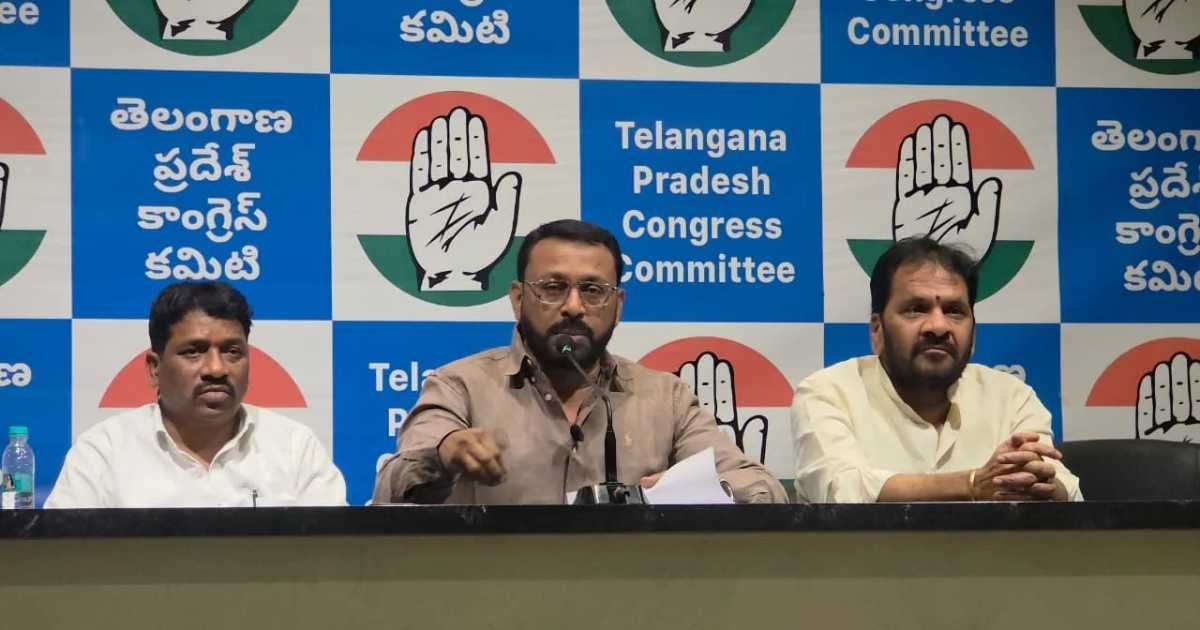
Hyderabad: TPCC Official Spokesperson Syed Nizamuddin on Monday, 26 October, accused the BRS of trying to politicise the El Niño water crisis. He alleged that the party was exploiting a natural climatic challenge for political gains instead of backing measures to protect farmers, workers and drinking water supplies. He made the remarks at a press conference at Gandhi Bhavan.
Nizamuddin said Telangana faces a genuine problem caused by deficient rainfall, low reservoir levels and rising pressure on groundwater. A climatic phenomenon caused these conditions, he said, and no government can be blamed for them. He alleged that the BRS had chosen to create fear and confusion when the State needed cooperation and preparedness.
Telangana received 615.5 mm of rainfall during the southwest monsoon between June and September, against a normal of 740.6 mm. That left a deficit of about 17%. Several districts recorded even higher deficiencies, and October also remained exceptionally dry in many areas. Nizamuddin said this had increased pressure on reservoirs, tanks and groundwater sources and made advance planning essential.
He said the BRS has every right to question implementation. However, it should not mislead people about the cause of the crisis, he added. According to him, the Congress Government headed by Chief Minister A. Revanth Reddy has treated the situation as a wider challenge rather than merely an irrigation issue. The Chief Minister has been personally reviewing drinking water availability, agricultural needs, power demand, employment concerns and urban water management.
Cabinet sub-committee and nodal officer named
Nizamuddin said the government had formed a Cabinet sub-committee headed by Deputy Chief Minister Mallu Bhatti Vikramarka to review the situation continuously. It had also named a nodal officer to improve coordination and ensure that accurate information reached the public. Such a mechanism, he said, was necessary because rumours and political misinformation could aggravate public anxiety.
Among the key measures, Nizamuddin cited the proposed four-month special employment programme, which will run from after Sankranti until the end of May. Agricultural activity could slow in water-stressed areas during this period, reducing income for rural labourers and vulnerable families. He said the programme would combine available Central scheme funds with additional State support. This, he said, would provide a livelihood cushion during the lean months.
The government has also asked public representatives to stay in close contact with villages for four months and respond quickly to local problems. Nizamuddin said this would help the administration identify difficulties at the grassroots level. It would also ensure that assistance reaches affected families without unnecessary delay.
The government has adopted a cautious approach towards agriculture, he said. It has advised farmers to take up rainfed crops and vegetables wherever possible. It has also asked them to avoid water-intensive cultivation where irrigation cannot be assured. The advisory against Rabi paddy in vulnerable areas, he said, is meant to protect farmers from larger losses later in the season. “This is responsible planning, not panic,” he said.
Nizamuddin said drinking water has rightly received the highest priority. Several major reservoirs carry substantially lower storage than in the corresponding period last year, he said, while many minor irrigation sources are also under stress. Power demand has risen as farmers increasingly depend on borewells and pump sets. These conditions, he said, make conservation of both water and electricity essential. He called the Chief Minister’s call to make people stakeholders significant. The government alone cannot handle a climate-related crisis, he added.
Green Water tankers to supply treated wastewater
Nizamuddin also referred to the Green Water tanker initiative of the Hyderabad Metropolitan Water Supply and Sewerage Board. It is scheduled to launch on 1 November. Under the initiative, GPS-tracked tankers will supply treated wastewater from sewage treatment plants for construction, industries, parks, greenery, road cleaning, dust control and other non-drinking purposes. The system will include online registration, booking, payments and delivery confirmation, while filling stations will have e-PoS facilities. He said the initiative would reduce the use of potable water for non-essential purposes. It would also ease pressure on Hyderabad’s drinking water sources and groundwater.
He said Telangana began preparing months earlier through expert consultations, contingency planning and repeated reviews of water, agriculture and power requirements. In his view, this showed that the government acted early rather than waiting for the situation to worsen. At the same time, he cautioned against exaggerated claims about El Niño. He described it as a recurring climatic phenomenon whose impact varies from one cycle to another.
Nizamuddin alleged that the BRS was ignoring the government’s measures because acknowledging them would weaken its political campaign. The party is free to point out shortcomings in implementation, he said. However, it should also place alternative solutions before the people instead of merely blaming the government. “Blaming the government for a rainfall deficit is political opportunism,” he said.
He urged people not to be misled by political propaganda and to rely on official information on water availability, crop advisories and government support measures. The coming months, he said, will require discipline, careful use of water and power, cooperation from farmers and industries, and active involvement of public representatives. “A crisis caused by nature should not be turned into a political battlefield,” he said.
