

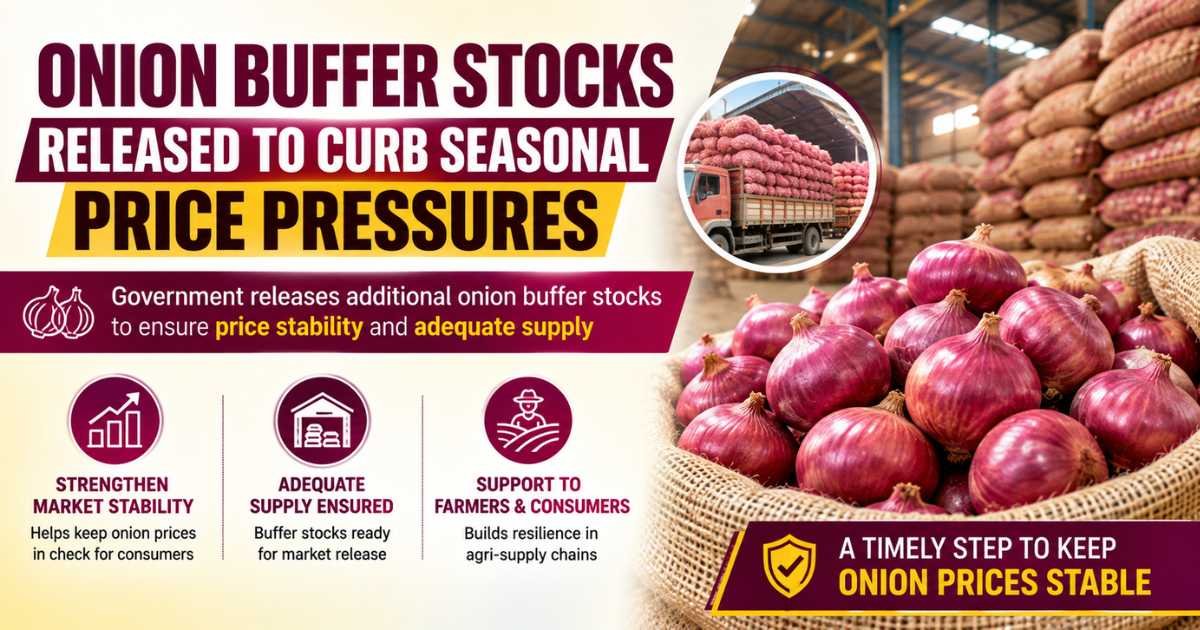
New Delhi: The government has begun a calibrated release of onion buffer stocks to ensure supply and moderate seasonal price pressures.
The government is using rail and road transport to move onions to major consumption centres. Officials will adjust the release based on market conditions and price trends.
The first Kanda Express carrying buffer onions left Nashik for New Delhi. At the same time, road shipments have started for other major consumption centres.
India expects onion production to reach 307.37 LMT in 2025-26. This remains broadly in line with the previous year’s production of 307.67 LMT.
The government said strong production and available buffer stocks would support domestic supplies in the coming months.
For 2026-27, the government set a target to procure 2.00 LMT of Rabi onions for the Price Stabilization Fund buffer. NAFED and NCCF began procurement on May 15, 2026.
They have so far procured around 1.21 LMT of onions for the buffer. The Central Warehousing Corporation has also joined the operation as the storage agency for the first time.
Onion prices usually rise during the festive and wedding seasons. Higher demand and supply-chain factors can create seasonal pressure during Onam, Ganesh Chaturthi, Durga Puja, Dussehra and Diwali.
Onion buffer stocks reach major consumption centres
The government has started releasing onion buffer stocks through a hybrid transport system. Railway rakes and road transport will move supplies according to market requirements.
The government will widen the quantity, coverage and sales channels when market conditions require further action.
Consumers will be able to buy onions at ₹35 per kg through selected retail outlets and mobile vans. NCCF will operate 9 outlets and 40 mobile vans.
NAFED will operate 13 outlets and 50 mobile vans. Kendriya Bhandar will sell onions through about 100 outlets.
Safal outlets will also participate in the retail intervention. The government said the targeted sales aim to keep onions available at an affordable price.
The Kanda Express has become an important logistics channel for moving buffer onions from producing areas to major markets.
During 2024-25, 14 railway rakes carried nearly 12,000 MT of buffer onions to five cities. Operations expanded in 2025-26, when 86 rakes moved around 88,000 MT to 16 cities.
In the current financial year, the first Kanda Express left Nashik for New Delhi. The consignment is expected to reach Delhi NCR.
Meanwhile, road transport is moving onions to Chennai, Kolkata, Ernakulam, Guwahati and Varanasi. Supplies are also moving to Lucknow, Patna, Chandigarh, Jammu and Amritsar.
The hybrid system will help move buffer onions to markets in line with demand and prevailing prices.
India’s onion exports have also remained strong. Between April and June 2026, exports reached around 3.82 LMT.
Major export destinations included Malaysia, Sri Lanka, the UAE and Nepal. The government said strong exports also reflected comfortable domestic availability.
The Department of Consumer Affairs monitors prices of 41 essential commodities every day. It tracks these prices across 579 centres nationwide.
Officials use price trends, arrivals and demand conditions to decide the scale and destinations of buffer releases. The government said it would take further action wherever necessary.
As of August 26, 2026, the All-India average retail price of onions stood at ₹37.87 per kg. Tomato prices stood at ₹38.33 per kg, while potato prices were ₹22.63 per kg.
Chana dal was priced at ₹86.71 per kg and atta at ₹40.48 per kg. Tur dal stood at ₹123.30 per kg, while milk was ₹60.82 per litre.
The government said prices of key pulses and vegetables remained stable and range bound. Tomato, potato and chana dal prices were lower than their levels a year earlier.
The government said it would continue monitoring onion prices, arrivals, availability and demand across states. It will adjust the scale, coverage and channels of buffer releases according to market conditions.
The approach aims to protect consumers while ensuring remunerative returns for farmers through evidence-based price stabilisation measures.
