

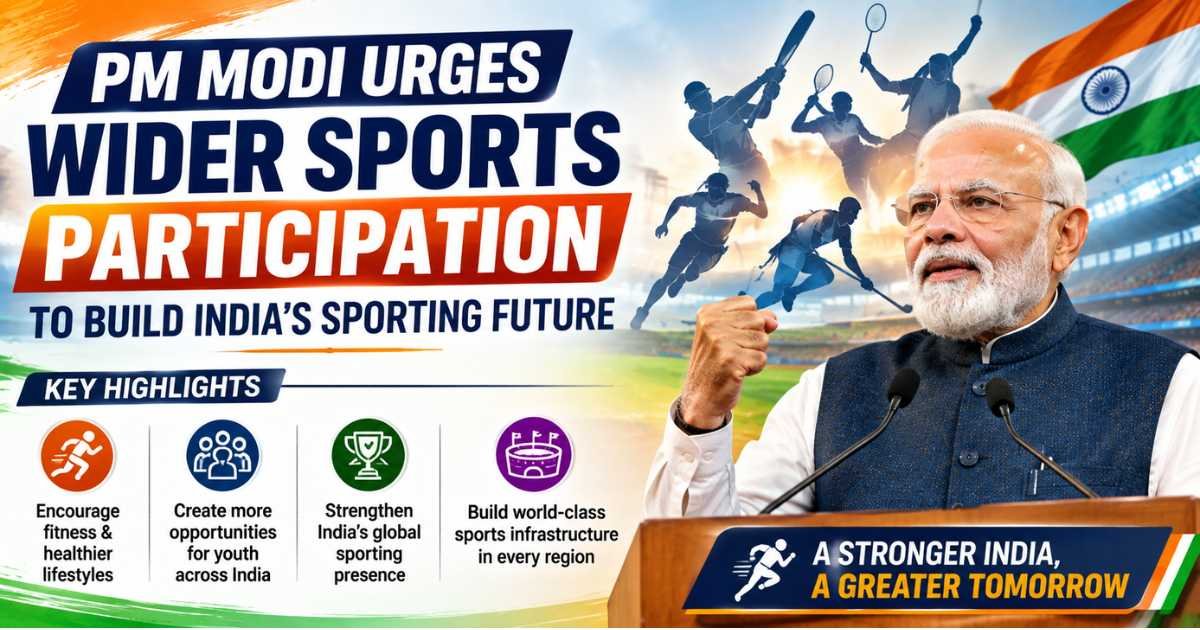
New Delhi: Prime Minister Narendra Modi urged wider sports participation to strengthen India’s sports ecosystem and support the country’s development goals.
He made the remarks while addressing the Khelo India Samvad through video conferencing on Thursday. The event brought together athletes, sports personalities, volunteers and public representatives.
Modi also greeted Union Cabinet colleagues, Chief Ministers, state ministers, Members of Parliament and My Bharat volunteers. Athletes from across India also joined the programme.
The Prime Minister noted that National Sports Day would be observed on August 29. He paid tribute to Major Dhyan Chand and recalled his contribution to Indian hockey.
According to Modi, sports should go beyond winning medals. He linked sporting activity with youth development and the wider objective of building a developed India.
He cited the phrase “jo khelega, woh khilega,” meaning those who play will blossom. Sporting success, he said, can raise the standing of athletes, families, schools and communities.
A successful player can also strengthen the identity of a district or state. Modi said every district has the potential to gain recognition on the global sports map.
The Prime Minister then highlighted India’s limited participation across Olympic disciplines. He said India competed in only 13 sports at the 2012 Olympics.
More than 20 other sports had no Indian participation during those Games, he said. Modi argued that greater participation across disciplines would help expand India’s medal prospects.
He cited surfing and sport climbing as examples. India has a long coastline and large mountainous areas that could support such sports.
Sports participation linked to 2036 Olympic preparations
Modi said India must begin preparing now for athletes who could compete at the 2036 Olympics. Accordingly, he announced a talent hunt for children aged between 5 and 15 years.
The initiative should assess both a child’s sporting interest and suitability, he said. Training can then match the child’s strengths and the demands of a particular discipline.
The government will provide the required support, Modi assured participants. Meanwhile, India is developing sports universities and modern training centres.
These facilities aim to support athletes from talent identification through international competition. India is also expanding cooperation with other countries on sports science, coaching and training.
Modi described Khelo India Samvad as a platform for policy dialogue. Young participants can share ideas on talent development, sports governance and the sports ecosystem.
Their suggestions, he said, can contribute to the policy process. He urged participants to use the platform to present practical and new ideas.
Beyond competition, the Prime Minister stressed the role of sports in developing discipline and resilience. He said athletes learn to deal with success, failure and setbacks.
Para-athletes, he added, offer strong examples of how sports can transform lives. Modi mentioned archer Sheetal and Paralympic medalist Avani Lekhara among athletes who inspire the country.
He also named Sumit Antil, Nitesh Kumar and Jhandu Kumar while discussing para-athletes. Their achievements, he said, can inspire families and wider society.
Fitness and quality of life also formed part of Modi’s message. He recalled Fauja Singh as an example of lifelong commitment to fitness and sports.
The Prime Minister further said sports can help young people stay away from drugs and addiction. He described this role as important amid the challenge of substance abuse.
India’s sporting culture has also changed, Modi observed. Growing participation in triathlons, 5K and 10K races, Hyrox, pickleball and badminton reflects this shift.
Such activities show that sports are becoming part of daily life, he said. More people are now making time for physical activity alongside studies and careers.
Schools also have a major role in building this culture. Modi said sports periods should become part of everyday life rather than remain only co-curricular activities.
He urged young people to give greater importance to sports centres and playgrounds. The Prime Minister contrasted this approach with excessive dependence on screens and gaming platforms.
A broader sports participation base can expand India’s pool of sporting talent. Stronger family support can also help more children consider sports as a career.
Opportunities are emerging beyond competitive athletics as well. These include sports equipment, technology, medicine, nutrition, psychology and analytics.
Modi urged young people to explore these emerging fields. He also called on them to contribute ideas that can strengthen India’s sports ecosystem.
The Prime Minister expressed confidence in India’s youth. He said their participation in sports and society would remain an important strength in the country’s journey towards becoming a developed nation.
He concluded the address by extending his best wishes to young people, athletes and the wider sports community.
