
Cabinet approves Pradhan Mantri Surya Sarovar Yojana for floating solar projects

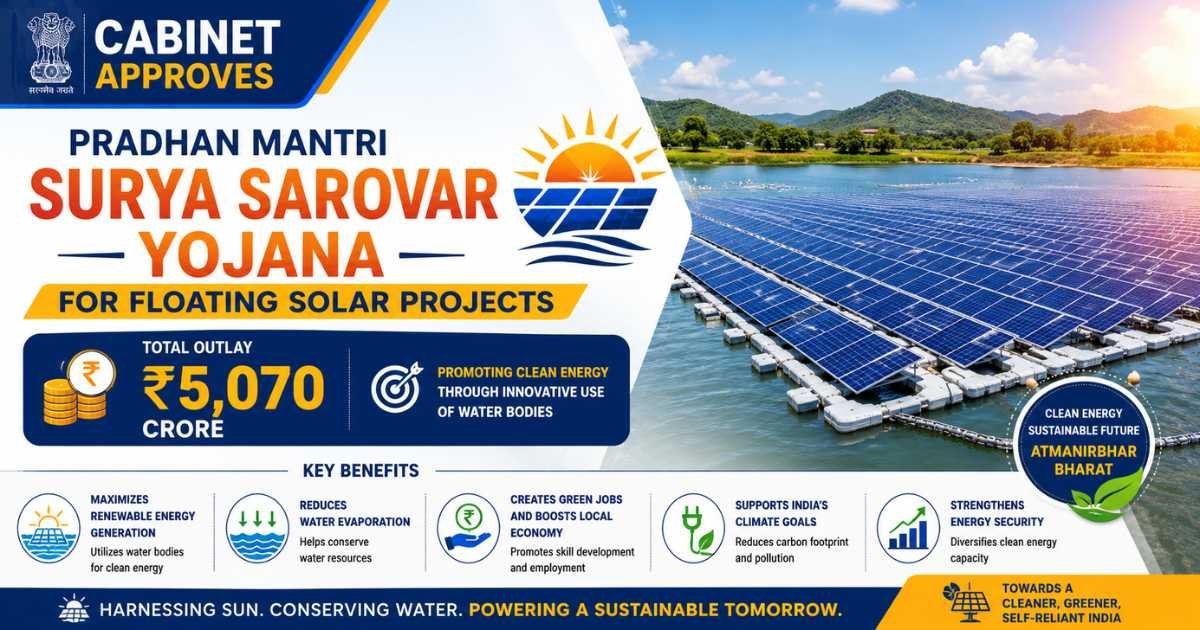
New Delhi: Union Cabinet has approved the Pradhan Mantri Surya Sarovar Yojana (PM-SSY) to develop floating solar photovoltaic projects with energy storage systems. Prime Minister Narendra Modi chaired the Cabinet meeting. The scheme has a total outlay of ₹5,070 crore.
The scheme aims to develop 5,000 MW of floating solar capacity with co-located energy storage systems. These systems will provide a minimum storage capacity of two hours, or 10,000 MWh. The government will sanction projects from FY 2026-27 to FY 2030-31. Financial support will continue until FY 2032-33.
The approval follows an assessment by the National Institute of Solar Energy. The institute estimated India’s floating solar potential at about 102.18 GWp across reservoirs and other suitable inland water bodies.
Under the scheme, the government will provide Central Financial Assistance of ₹1 crore per MW after successful project commissioning. It will also provide up to ₹50 lakh per project for feasibility studies. These studies include bathymetry, hydrography, environmental assessments and other preparatory work.
Pradhan Mantri Surya Sarovar Yojana to expand floating solar capacity
The scheme will benefit all States and Union Territories. It will increase India’s floating solar capacity by 5,000 MW. The country’s current floating solar capacity stands at around 700 MW.
The projects will make use of reservoirs and industrial ponds without competing for land. The integrated energy storage systems will also improve grid reliability. The government expects the scheme to reduce about 10 million tonnes of carbon dioxide emissions every year.
The initiative will create about 16,000 to 17,000 full-time equivalent jobs across the project value chain. It will also encourage domestic manufacturing of flotation systems, solar cells, modules and energy storage systems. The government said the scheme supports the vision of Aatmanirbhar Bharat.
The Pradhan Mantri Surya Sarovar Yojana will strengthen renewable energy capacity, support national climate goals and improve the use of water resources. It also aims to advance the vision of Viksit Bharat.
