

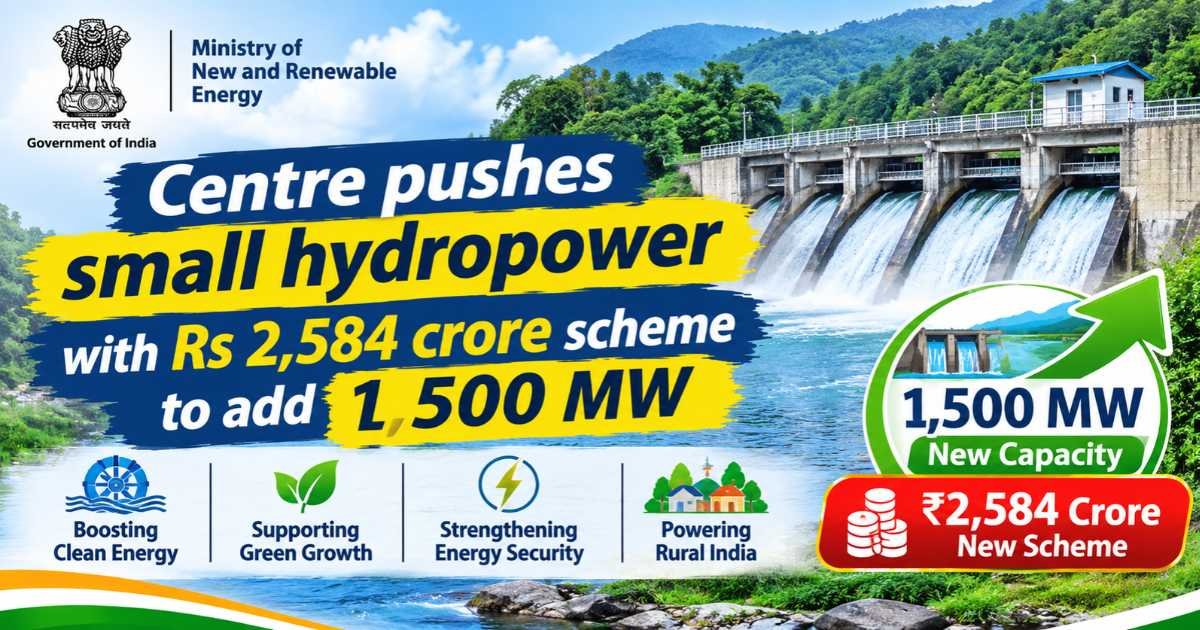
New Delhi: Centre has approved a Rs 2,584.60 crore scheme to expand India’s small hydropower capacity by 1,500 MW between 2026–27 and 2030–31. The initiative aims to unlock untapped water resources and improve electricity access in remote and hilly regions. The Ministry of New and Renewable Energy (MNRE) will implement the scheme, which also seeks to attract investments of around Rs 15,000 crore.
Small hydropower projects use the natural flow of rivers and canals to generate electricity. In India, projects with installed capacity of up to 25 MW fall under this category. These installations are particularly suitable for mountainous regions where difficult terrain limits larger power projects and grid connectivity.
India has identified a small hydropower potential of 21,134 MW across 7,133 sites. However, only around 5,182 MW, or nearly 25 per cent, had been harnessed as of September 30, 2026. The remaining 15,952 MW offers considerable scope for expansion.
Unlike large hydropower projects, small installations generally require less land and cause limited displacement. They also have long operational lives and can support local employment. In addition, they can strengthen electricity supply in areas with limited access to conventional power infrastructure.
The government has prioritised hilly states, northeastern regions and international border districts under the new scheme. Financial assistance, project preparation support and technical capacity building will help address challenges related to financing and implementation.
For northeastern states and international border districts, the scheme provides financial assistance of Rs 3.6 crore per MW or 30 per cent of the project cost, whichever is lower. The maximum assistance is capped at Rs 30 crore per project.
Other locations will receive assistance at rates of Rs 2.4 crore, Rs 1.78 crore or Rs 2.054 crore per MW, depending on project size and location. The assistance will be limited to 20 per cent of the project cost or Rs 20 crore per project, whichever is lower.
Small hydropower potential offers regional growth opportunities
The scheme also provides Rs 30 crore for preparing Detailed Project Reports (DPRs) for at least 200 projects. Central and state agencies will receive support to develop a stronger pipeline of future projects.
The government expects the initiative to generate around 51 lakh person-days of employment during construction. It will also create long-term opportunities in project operations and maintenance, particularly in rural and remote areas.
The scheme encourages the use of indigenous machinery and equipment. This approach is expected to strengthen domestic manufacturing and supply chains in line with the Atmanirbhar Bharat vision.
Small hydropower can also improve decentralised electricity supply. Projects located near consumption centres can reduce transmission losses and improve voltage stability. They can provide reliable electricity in remote, hilly and border areas without depending heavily on long transmission networks.
Furthermore, these projects generate electricity without consuming fuel. Their relatively small land requirements and limited displacement make them suitable for environmentally sensitive locations. They can also support rural industries, agriculture and local economic activities.
India’s regional distribution of small hydropower resources highlights considerable opportunities for development. The Northern region accounts for the highest potential at 8,030 MW, followed by the Southern region with 5,490 MW. The northeastern region has 2,995 MW, while the Western and Eastern regions account for 2,912 MW and 1,707 MW, respectively.
The Northern region has significant resources because of its mountainous terrain and perennial rivers. Himachal Pradesh leads with 3,460 MW, followed by Uttarakhand with 1,664 MW and Jammu and Kashmir with 1,312 MW. Ladakh contributes another 396 MW. Despite this potential, utilisation remains moderate.
The northeastern region offers major opportunities for decentralised and off-grid electricity generation. Arunachal Pradesh accounts for 2,065 MW of the region’s potential. Meghalaya has 230 MW, Assam 202 MW and Nagaland 182 MW. Mizoram accounts for 169 MW, Manipur 100 MW and Tripura 47 MW.
Developing these resources could improve electricity access in remote and tribal communities. It could also create local employment and reduce dependence on conventional fuels.
The Southern region has relatively stronger infrastructure and higher utilisation levels. Karnataka leads with 3,726 MW, accounting for nearly 68 per cent of the region’s potential. Keralam has 647 MW, while Tamil Nadu accounts for 604 MW. Existing infrastructure could support further expansion and integration with other renewable energy sources.
The Eastern region has opportunities for decentralised projects in rural and tribal areas. Bihar accounts for 527 MW, West Bengal 392 MW and Odisha 286 MW. Sikkim has 267 MW, while Jharkhand contributes 228 MW. These projects could support agricultural productivity, local industries and rural livelihoods.
The Western region has considerable scope for projects using existing irrigation canals and dams. Chhattisgarh leads with 1,098.20 MW, followed by Madhya Pradesh with 820 MW and Maharashtra with 786 MW. Against a regional potential of 2,912 MW, the installed capacity stands at 730 MW.
Canal-based and dam-toe projects offer opportunities to generate electricity without developing entirely new water infrastructure. These installations use differences in water levels to operate turbines. After power generation, the water returns to the main canal or water system.
The government believes the Small Hydro Power Development Scheme will strengthen India’s renewable energy capacity and energy security. By combining financial incentives, domestic manufacturing and employment generation, the initiative aims to support development in underserved regions.
Small hydropower is expected to complement other renewable energy sources while improving grid resilience. The new policy push seeks to turn India’s untapped water resources into a long-term source of clean electricity and inclusive economic growth.
