

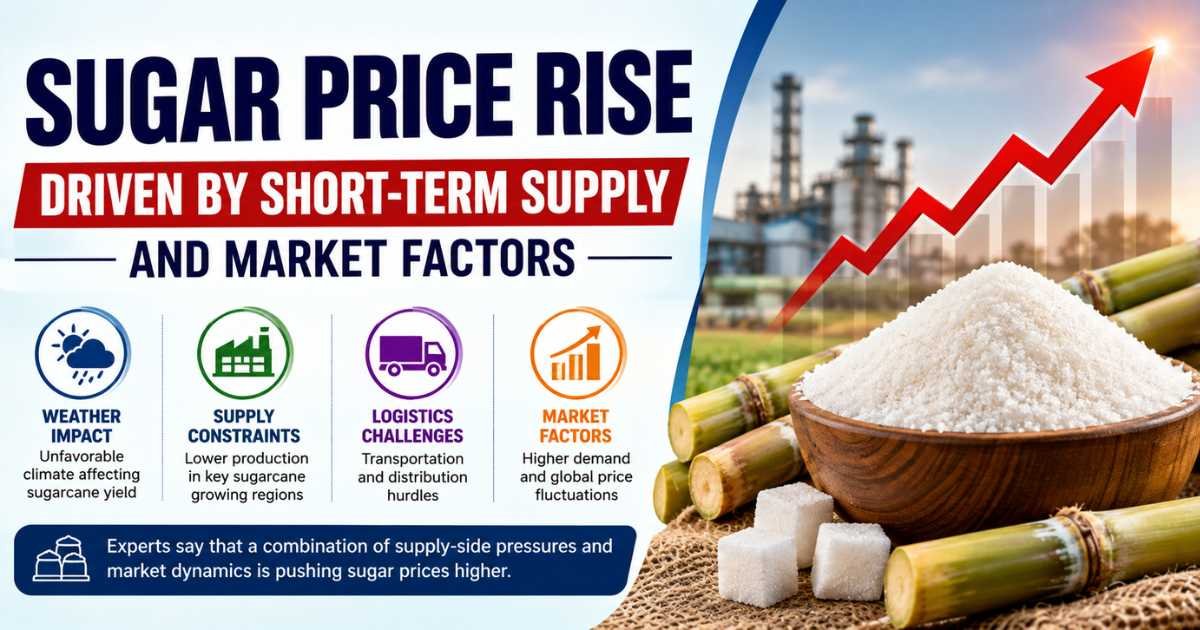
New Delhi: The Centre said the recent sugar price rise stemmed from short-term supply and market factors. It added that adequate stocks remained available for domestic demand.
Sugar prices climbed from ₹48.18 per kg on July 20, 2026, to ₹55.70 per kg on August 20. The increase reached around 15.6% within one month.
However, the government said this short-term movement differed from the longer trend. Retail sugar prices rose by only around 3% annually between August 2024 and July 2026.
Several factors drove the recent increase. These included lower-than-expected domestic production, higher festive-season demand and weather-related crop damage.
Tight global sugar supplies and higher international prices also added pressure. The government also said some industry sections contributed through speculation and hoarding.
Current sugar production is expected to reach around 306 lakh metric tonnes (LMT). The initial estimate stood at around 343 LMT.
Red Rot and Top Borer diseases affected sugarcane production. Excess rainfall and waterlogging also damaged crops.
However, the government said India had enough sugar stocks to meet domestic demand until the new crushing season begins in October.
Sugar price rise comes amid wider industry changes
The sugar price rise has occurred as India’s sugar industry continues to support farmers, mills, ethanol production and exports.
India is the world’s second-largest sugarcane producer. The sector supports nearly 5 crore farmers and around 5 lakh workers in sugar factories and allied industries.
Sugarcane production reached 500 million metric tonnes in 2025-26, according to the Ministry of Agriculture and Farmers Welfare’s Third Advance Estimate.
Production increased by about 43.5% from 348.44 million tonnes in 2015-16. The area under sugarcane cultivation also rose from 49.27 lakh hectares to 58.87 lakh hectares over the same period.
Uttar Pradesh and Maharashtra remained the leading sugarcane-producing states. India exported 8 lakh metric tonnes of sugar in 2025-26, compared with 0.47 lakh metric tonnes in 2016-17.
The government fixed the Fair and Remunerative Price of sugarcane for the 2026-27 season at ₹365 per quintal. The price provides a basic recovery rate of 10.25%.
The FRP stood at ₹230 per quintal in 2016-17, with a basic recovery rate of 9.5%. The latest rate is therefore ₹135 higher than the 2016-17 level.
The government said adequate sugar buffer stocks were available. It also expected 2025-26 sugar production to remain sufficient for domestic needs.
The ethanol programme has also changed the industry’s supply pattern. The share of sugar diverted to ethanol fell from around 12% in 2022-23 to around 9% in 2025-26.
At the same time, nearly three-fourths of India’s ethanol production now comes from grains, particularly maize. The government said ethanol diversion therefore did not cause a sugar shortage for consumers.
India produces around 300-340 LMT of sugar annually. Domestic consumption remains around 280-290 LMT each year.
During surplus years, excess sugar stocks can block mill funds and delay payments to sugarcane farmers. Mills have used surplus sugar for ethanol to address this issue and improve their finances.
As of August 20, 2026, sugar mills had paid 97% of the dues owed to farmers for the 2025-26 sugar season. Their stronger financial position has also reduced their dependence on government support.
Global market conditions have added further pressure. The estimated global sugar deficit for 2026-27 stands at around 33 lakh metric tonnes.
International sugar prices rose from $474 per tonne on June 30, 2026, to $552 per tonne on August 20. This represented an increase of more than 16% in less than two months.
The government has taken several measures to control the sugar price rise and prevent hoarding. It imposed a 400-tonne stock limit on sugar dealers from August 1 to November 30, 2026.
From September 1, bulk consumers cannot hold sugar stocks exceeding 15 days of consumption. Central and state officials are also conducting physical checks of sugar stocks at mills.
The government has additionally permitted duty-free imports of 10 lakh metric tonnes of raw sugar. The move aims to increase domestic availability.
States and sugar mills must begin crushing from October 15, following the government’s advice. The government expects October production to exceed 10 LMT, compared with the usual 3-4 LMT.
The higher output should improve sugar availability during the festive season. The government said its priority remains balancing consumer interests, timely farmer payments and industry stability.
