

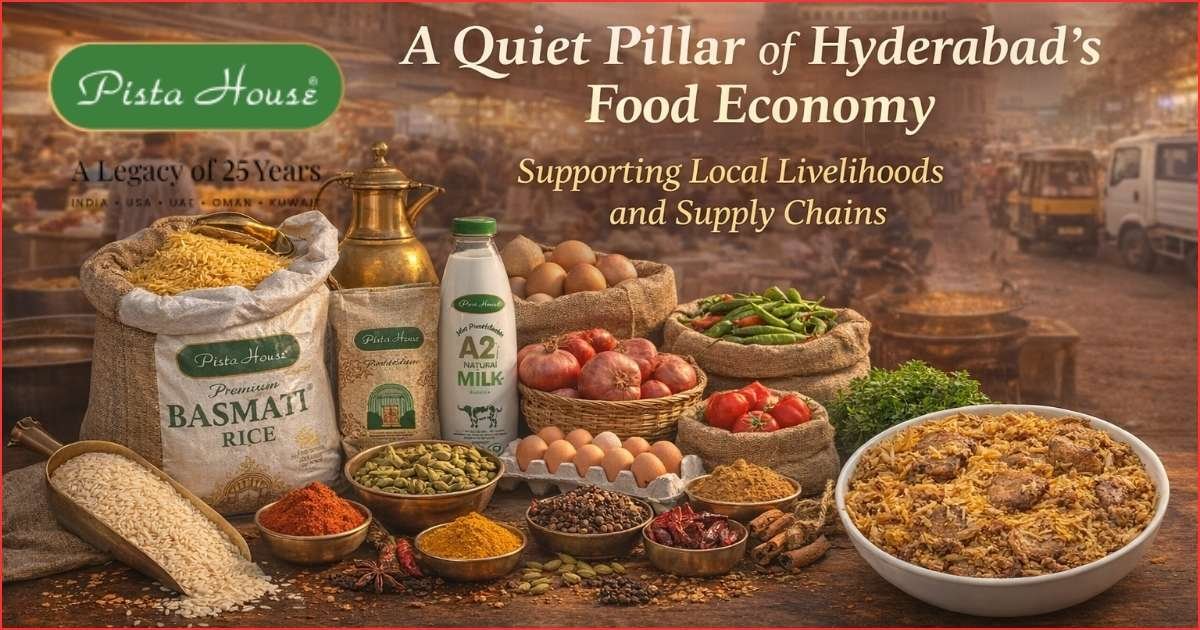
Hyderabad: Pista House food economy role continued to shape livelihoods and supply networks, making it a steady contributor to Hyderabad’s food ecosystem.
The brand’s growth translated into sustained employment across kitchens, bakeries, service units, logistics, and administration. These roles supported a diverse workforce and offered stability in a sector known for high turnover.
This continuity also encouraged skill development. Workers refined traditional cooking techniques that required time and experience. As a result, the Pista House food economy impact extended to preserving culinary skills.
Pista House food economy strengthens supply chains
Beyond direct employment, the Pista House food economy supported a broad supply chain. The brand sourced grains, spices, dairy, and bakery inputs through networks linking urban demand with regional producers.
Seasonal demand, especially during festivals, increased procurement at scale. This process benefited wholesalers, transporters, and other service providers. Therefore, the brand contributed to wider economic circulation.
Ramadan marked a peak period in this cycle. Preparations began weeks in advance with increased staffing and sourcing. For many small suppliers, this season ensured consistent demand.
The coordination required during this period reflected operational depth. It also showed how organised systems supported what customers experienced as smooth service.
Pista House food economy drives local business activity
The brand’s outlets influenced neighbourhood economies. Locations attracted steady footfall, which supported nearby businesses. Retail shops, eateries, and transport services benefited from increased activity.
This clustering effect highlighted how food establishments shaped urban micro-economies. At the same time, the Pista House reflected Hyderabad’s transition into a mixed consumption landscape.
Traditional dining, takeaway services, and large-scale catering coexisted within this system. By serving varied customer segments, the brand sustained demand across income groups.
Another key aspect involved knowledge preservation. Traditional cooking methods and flavour profiles remained part of daily operations. This ensured that such skills retained economic value.
Importantly, the Pista House operated through integration rather than scale alone. Its systems connected labour markets, supply chains, and cultural cycles.
In Hyderabad’s evolving food sector, such contributions often remain understated. However, long-standing brands provide continuity and stability.
The Pista House, therefore, reflected more than business growth. It demonstrated how heritage-based enterprises sustained livelihoods and supported interconnected economic networks.
