

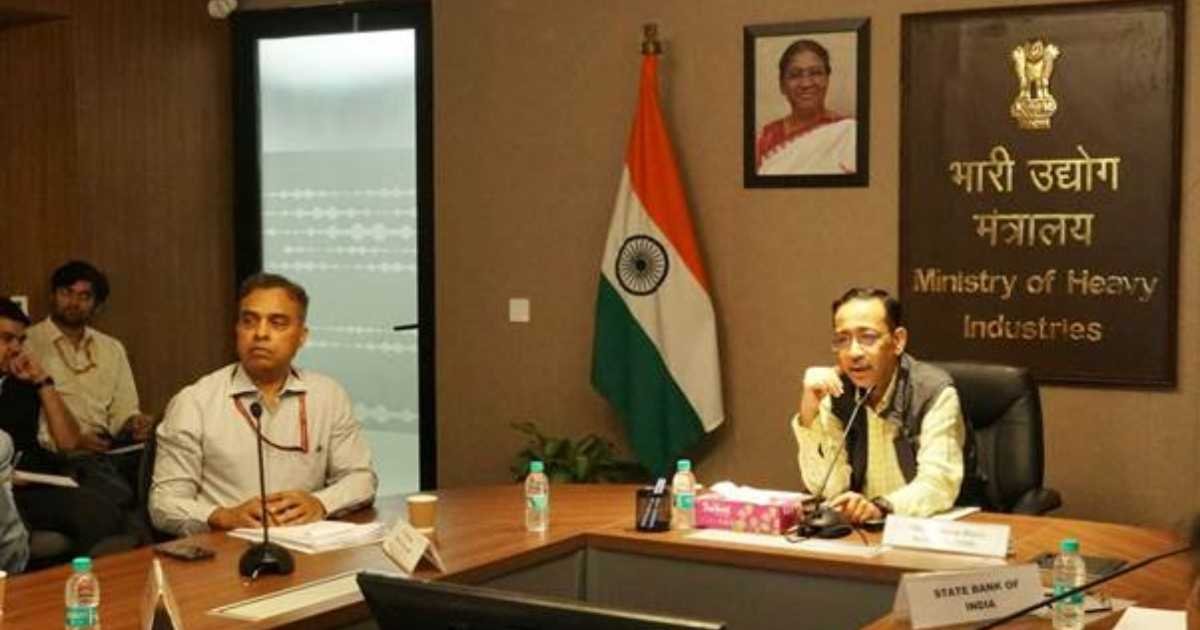
New Delhi: The Ministry of Heavy Industries held an EV financing meeting to develop mechanisms that can accelerate the adoption of electric buses and trucks in the private sector.
The meeting, chaired by Secretary Kamran Rizvi in New Delhi on April 29, focused on addressing financial barriers that slow down the transition to electric mobility. Officials examined current financing challenges and discussed possible government-backed solutions.
Key proposals included partial credit guarantee schemes to reduce risks for lenders. In addition, interest subvention mechanisms were considered to lower borrowing costs for private buyers. These measures aim to make electric commercial vehicles more financially viable.
Public transport buses and freight trucks form the backbone of India’s mobility system. However, they also contribute significantly to emissions and fuel consumption. Therefore, officials stressed that electrification in this segment is essential to meet decarbonisation goals.
EV financing meeting discusses credit support mechanisms
The EV financing meeting brought together stakeholders from across the financial and industrial ecosystem. Participants included government departments, banks, non-banking financial companies and global institutions.
Representatives from the World Bank and industry bodies such as SIAM, AIMTC and BOCI attended the discussions. Bus and truck operators, along with manufacturers, also shared inputs on financing challenges and sector requirements.
Officials said collaborative efforts are needed to create sustainable financing models. Moreover, they emphasised the importance of aligning financial tools with industry needs to boost adoption.
The Ministry of Heavy Industries said the initiative reflects its proactive approach to advancing electric mobility. By addressing funding gaps, the government aims to support energy security and reduce emissions.
The EV financing meeting is expected to lead to actionable solutions that can ease investment challenges. As a result, the transition to cleaner commercial transport could gain momentum in the coming years.
