

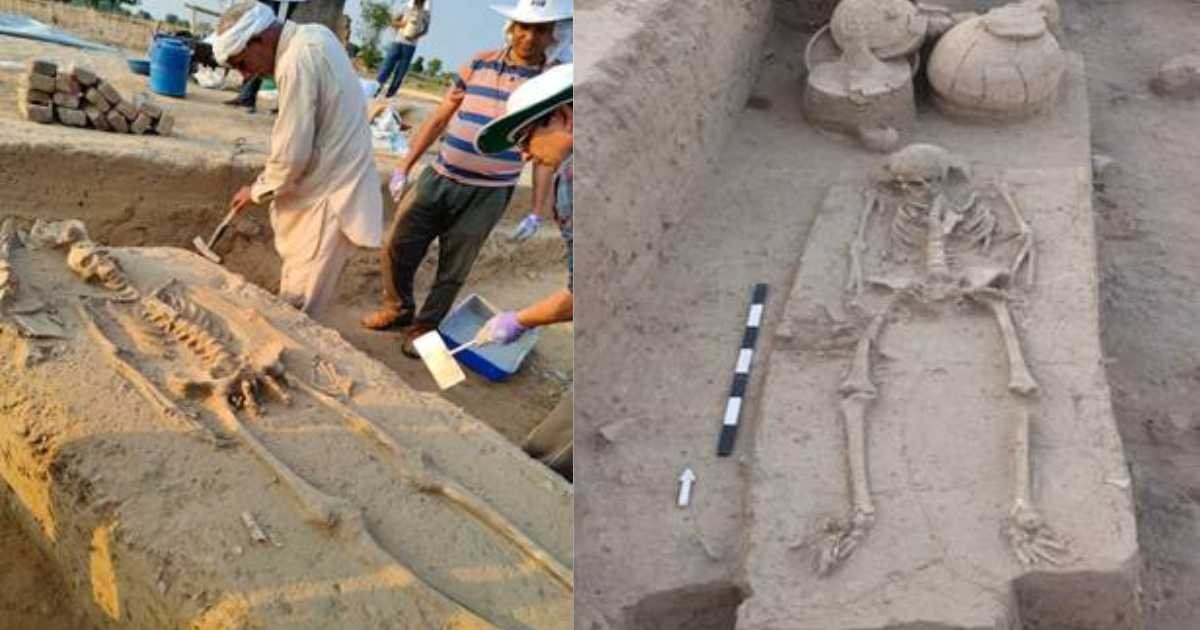
New Delhi: The Archaeological Survey of India (ASI) has transferred Rakhigarhi skeletal remains to the Anthropological Survey of India (AnSI) for advanced scientific research. The move follows a recent agreement between the two institutions. Moreover, it aims to deepen understanding of the Indus-Saraswati Civilization.
Archaeologists recovered the remains during excavations at Rakhigarhi in Haryana in the 2025-26 field season. The site is the largest known settlement of the Indus-Saraswati Civilization. It spreads across nearly 550 hectares.
Researchers uncovered eight burials at Mound No. 7, an area identified as an ancient cemetery. They recovered three complete skeletons and several skeletal fragments. Subsequently, officials transferred the remains to AnSI’s laboratory and repository in Kolkata for detailed examination.
Scientists believe the Rakhigarhi skeletal remains offer a rare opportunity to study the biological history of one of the world’s earliest urban civilizations. Therefore, they plan to conduct ancient DNA analysis, isotope studies and osteological assessments.
Rakhigarhi skeletal remains may reveal Harappan ancestry and lifestyle
The research will involve AnSI, the Birbal Sahni Institute of Palaeosciences, University College London and Banaras Hindu University. Together, these institutions will examine ancestry, migration patterns, diet and disease prevalence.
Furthermore, researchers expect the studies to provide insights into environmental adaptation during the Harappan period. They also hope to understand how ancient populations evolved over time.
AnSI Director Prof. B.V. Sharma said the project would strengthen multidisciplinary research. In addition, it would help build a valuable scientific record of the ancient population.
Several scholars welcomed the initiative. They described it as an important step for Indian palaeoanthropological research. Moreover, they said the findings could contribute to debates on urbanisation, health and population history.
AnSI officials noted that the institution has a long tradition of studying Harappan skeletal remains. However, such research declined in recent decades. Therefore, the organisation recently launched specialised training programmes and formed dedicated research teams.
The collaboration between ASI and AnSI integrates archaeology, anthropology, genetics and environmental science. As a result, researchers expect the findings from the Rakhigarhi skeletal remains to reveal new details about the origins, mobility and health of the Harappan people.
