
Government approves 20 industrial nodes under NICDP, sanctions ₹16,172.95 crore

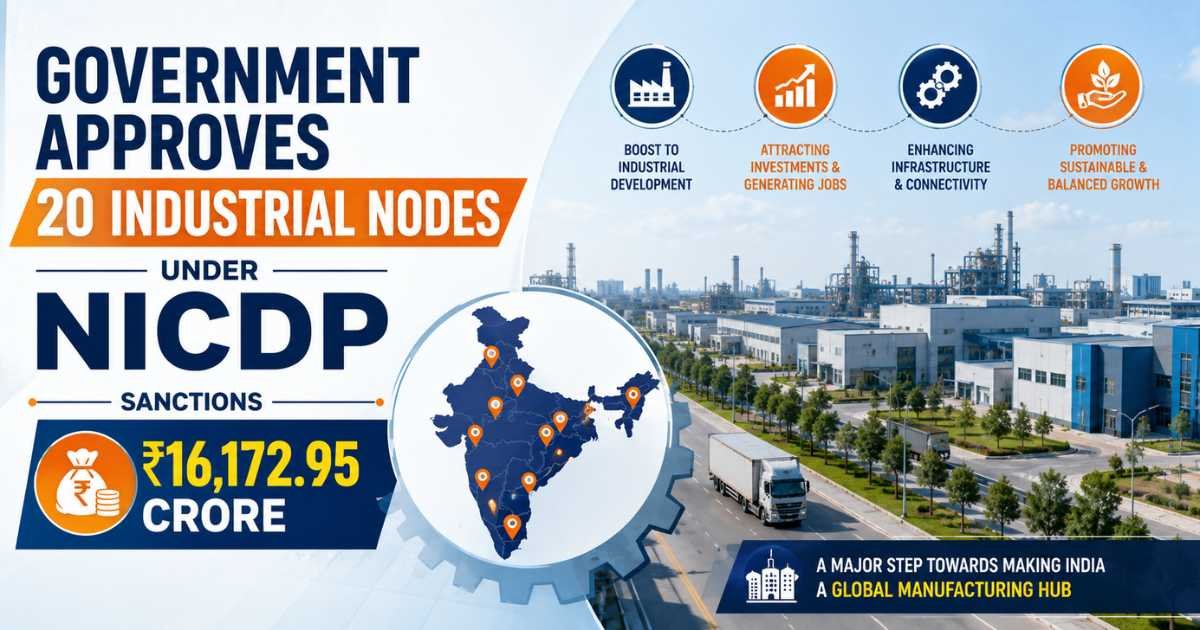
New Delhi: Centre approved 20 industrial nodes under the National Industrial Corridor Development Programme (NICDP) and sanctioned ₹16,172.95 crore to speed up industrial corridor development across the country, the Lok Sabha was informed on Tuesday.
Minister of State for Commerce and Industry Jitin Prasada said the government developed industrial townships through Special Purpose Vehicles formed jointly with state governments. States provide land, while the Centre contributes equity or debt funding for project development.
So far, the government has approved 20 industrial nodes under NICDP. Moreover, it approved 12 of these projects during the last five years. The projects span states including Andhra Pradesh, Telangana, Uttar Pradesh, Haryana, Kerala, Punjab, Bihar, Rajasthan, Maharashtra and Uttarakhand.
The Department for Promotion of Industry and Internal Trade (DPIIT) released ₹16,172.95 crore to the National Industrial Corridor Development and Implementation Trust (NICDIT). In turn, NICDIT released ₹14,569.97 crore to project-specific Special Purpose Vehicles to execute development work.
Four industrial corridor projects have already been completed. They include Dholera Special Investment Region in Gujarat, Shendra-Bidkin Industrial Area in Maharashtra, Integrated Industrial Township at Greater Noida in Uttar Pradesh and Integrated Industrial Township at Vikram Udyogpuri in Madhya Pradesh.
Industrial nodes receive infrastructure and faster execution
The completed projects now have roads, water supply systems, sewage treatment plants, power infrastructure, ICT facilities and administrative buildings. As a result, they offer world-class industrial infrastructure for investors.
Meanwhile, work continues on the remaining 16 projects. Most projects have appointed EPC contractors or completed key planning stages. However, the Agra Industrial Manufacturing Cluster awaits Supreme Court clearance because it falls within the Taj Trapezium Zone.
The government said each project follows a construction timeline of 36 to 48 months after the appointment of an EPC contractor. Project agencies also develop internal roads, water supply, sewerage and power distribution networks through EPC contractors.
In addition, authorities coordinate external infrastructure such as roads, telecom, bulk water supply and power through the PM Gati Shakti National Master Plan and state agencies.
Furthermore, the government regularly reviews project progress through the Apex Monitoring Authority, DPIIT and NICDIT. It also uses the PRAGATI and PM Gati Shakti portals to remove bottlenecks, secure regulatory clearances and speed up implementation.
The information was provided by Minister of State for Commerce and Industry Jitin Prasada in a written reply in the Lok Sabha.
