

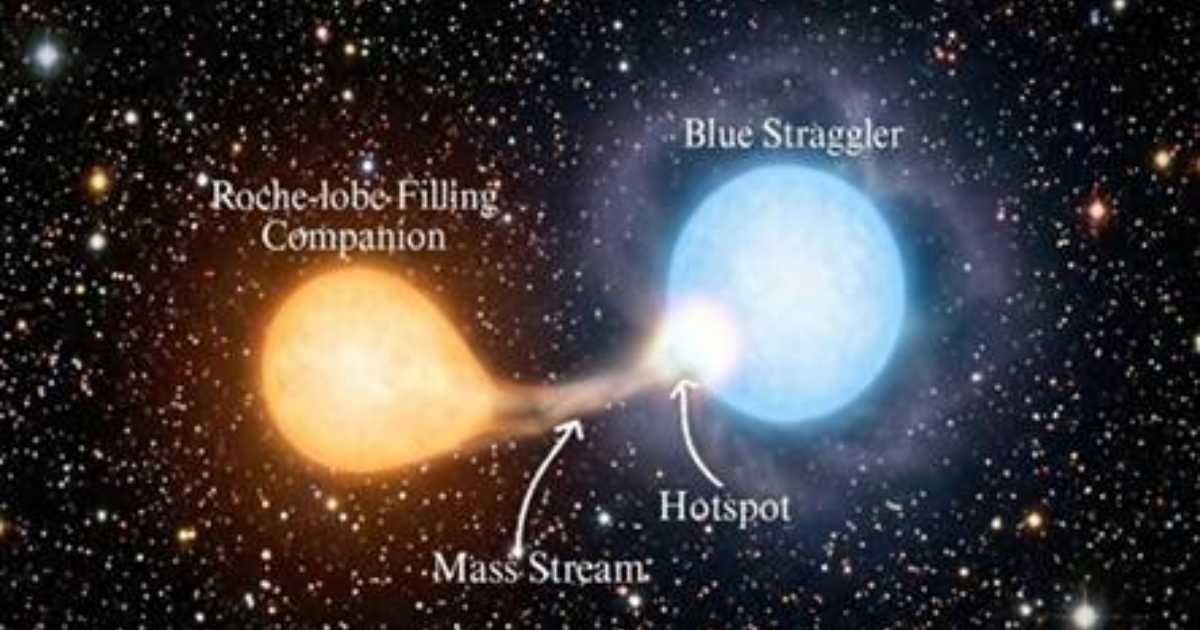
New Delhi: Indian astronomers and their international collaborators have observed a Blue Straggler Star while it was forming. The discovery provides rare evidence that these unusual stars grow by drawing material from a companion. As a result, the finding strengthens a long-standing theory about their origin.
The team studied the binary system TIC 327546480 in the old open cluster Collinder 261. The cluster lies about 9,500 light-years from Earth. Researchers selected the system because earlier observations suggested that the two stars were interacting. They analysed light curves from NASA’s TESS mission. They also used radial velocity data from the European Southern Observatory’s Very Large Telescope in Chile.
Annapurni Subramaniam of the Indian Institute of Astrophysics said the star is actively gaining material from its companion. Therefore, astronomers can now observe the formation process directly. She added that the discovery supports the mass-transfer theory for these stars.
Binary system reveals Blue Straggler Star growth
The researchers identified the system as semidetached. One star expanded beyond its Roche lobe. Consequently, it began transferring material to its companion. The transfer continues today. As a result, the companion remains hotter and brighter than other stars in the cluster.
Moreover, the team detected strong X-ray emission from the system. The signal matched the expected behaviour of material falling onto the growing star. Therefore, the X-ray data independently confirmed that mass transfer is still underway.
Lead author Ali Hasan Sheikh said the rejuvenated star has a mass about 1.67 times that of the Sun. Meanwhile, its companion has a mass of about 0.32 solar mass. The binary completes one orbit every 2.11 days. In addition, the star rotates at about 69.55 km/s. The researchers believe the incoming material increased its spin. Their models showed that mass transfer began about 5.46 billion years ago. It has continued ever since. The host cluster is about 7 billion years old.
Ram Sagar of the Indian Institute of Astrophysics said the discovery offers strong observational support for the binary mass-transfer model. Furthermore, he said the system provides an excellent laboratory for testing theories of stellar evolution and binary interaction. It will also help researchers understand how star clusters evolve.
The study appeared in The Astrophysical Journal Letters. Finally, researchers from Gauhati University, the Indian Institute of Astrophysics, IUCAA Pune, INAF Italy, LUX Observatoire de Paris and the University of North Florida contributed to the research.
