
Amit Shah unveils Arunachal Pradesh Cooperative Vision 2047, launches projects worth ₹5,610.95 crore

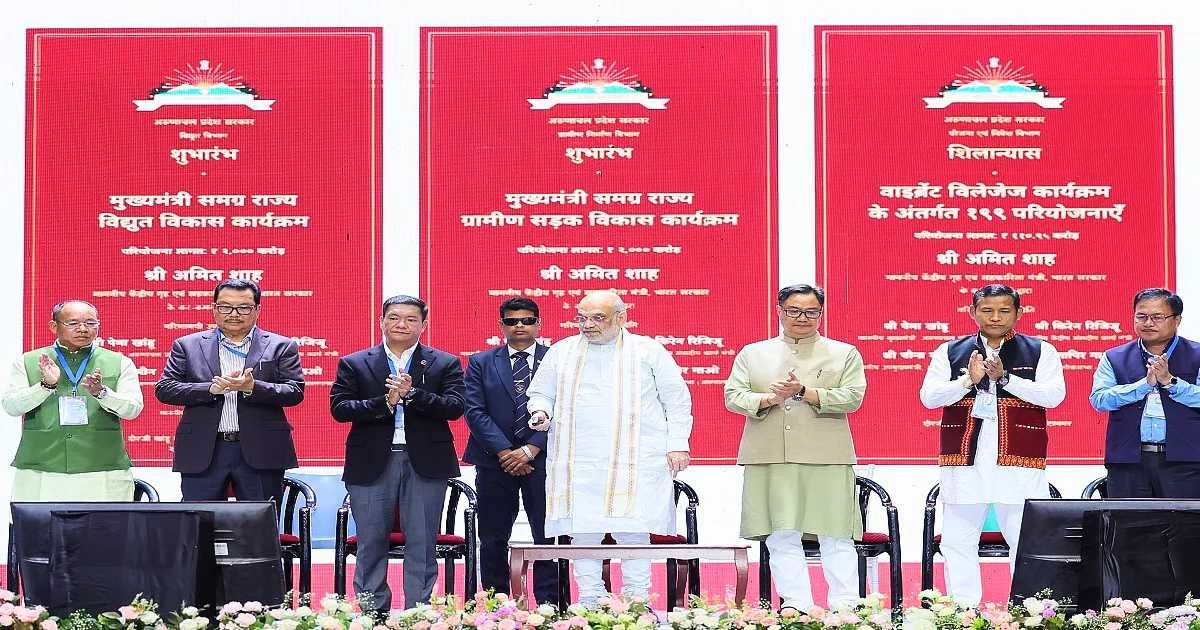
New Delhi: Union Home and Cooperation Minister Amit Shah unveiled the Arunachal Pradesh Cooperative Vision 2047 in Itanagar on November 22. He also launched development initiatives worth ₹5,610.95 crore to strengthen infrastructure, education, power and rural connectivity. In addition, he flagged off mobile medical vans and inaugurated the SARAS Mela.
The Cooperative Festival took place at the Dorjee Khandu State Convention Centre under Prime Minister Narendra Modi’s ‘Sahkar Se Samriddhi’ vision. Arunachal Pradesh Chief Minister Pema Khandu, Union Minister Kiren Rijiju and Deputy Chief Minister Chowna Mein attended the event. State ministers, elected representatives, officials and cooperative sector representatives also joined the programme.
Shah said the Northeast had received a major connectivity push during the last 12 years. Every State capital in the region now has rail and air links, he said. Moreover, roads, railways, flights and waterways have strengthened connections with the rest of the country.
He said Modi had reduced both physical and emotional distances between Delhi and the Northeast. The Prime Minister had promoted education, skills, employment and tourism in the region. At the same time, the Centre encouraged industrial development while protecting the environment and natural beauty.
Shah said Arunachal Pradesh’s budget had risen from about ₹12,000 crore before the present Central Government took office to ₹36,000 crore. He also welcomed the Arunachal Pradesh Police receiving the President’s Colour. The State became the 17th in the country to receive this honour for its police force.
The minister highlighted the Vibrant Villages Programme and its impact on border communities. Residents have begun returning to 40 villages along the China border after earlier migration, he said. Meanwhile, electricity, drinking water, education, healthcare and employment facilities have expanded in these villages.
The Centre has also directed the Army and ITBP to procure essential supplies from local villages and cooperative institutions. As a result, women and other residents supply dairy products, eggs, vegetables, millets, flour and other goods. These purchases support local livelihoods and strengthen ties between border communities and security personnel.
Cooperative Vision 2047 targets dairy and fisheries growth
Shah urged Arunachal Pradesh to become self-reliant in milk, eggs, meat and fish production. Local production in these four sectors could make at least 32,000 families economically self-reliant, he said. Therefore, he asked the State Government to prepare a focused programme through dairy and fisheries cooperatives.
More than 56,000 people in the State are associated with the cooperative movement, Shah said. They belong to 185 Primary Agricultural Credit Societies, 52 dairy cooperative societies and 43 fisheries cooperative societies.
He called for greater use of the State’s water resources and large hydropower reservoirs for cooperative-based fisheries. Such activities could create jobs for rural families. In addition, villages with suitable climatic conditions should develop well-equipped dairy facilities.
Shah assured the State that Amul and the National Dairy Development Board would procure locally produced milk. The Centre would also work to establish a milk-processing plant in Arunachal Pradesh. Representatives of NDDB and Amul will soon visit the State to prepare a district-level dairy development roadmap.
The availability of quality livestock and stronger cooperative institutions would support this effort. It would also improve rural women’s incomes and help families invest in education and children’s well-being. NCDC and NABARD would provide financial support wherever required.
Shah said development should not be measured only through budgets, Gross State Domestic Product or GST collections. Instead, it should improve employment, education, healthcare and family welfare. A developed society should ensure healthy lives, capable minds and respect for cultural values, he said.
The minister compared Central funding for Arunachal Pradesh across two periods. The State received ₹33,530 crore from the Centre between 2004 and 2014. However, it received ₹1,49,664 crore between 2014 and 2024 under the Modi government. Shah said the devolution fund had increased 18 times, while grants-in-aid had risen one-and-a-half times.
He cited several major infrastructure projects. The Centre approved the 1,500-kilometre Frontier Highway at a cost of ₹44,000 crore. Work on the 2,880 MW Dibang Hydropower Project began at a cost of ₹32,000 crore. Construction also started on eight packages covering 266 kilometres of National Highway-913, costing ₹6,600 crore.
Other projects include the Balipara–Charduar–Tawang road, which covers about 300 kilometres across West Kameng and Tawang districts. The Nechiphu Tunnel and a bridge over the Sisiri River in Dibang Valley also form part of the infrastructure expansion. Shah said the Likabali, Hollongi and Tezu airports came up during the Modi government’s tenure.
He also addressed the demand for another daily flight between Itanagar and Delhi. Chief Minister Pema Khandu had raised the request the previous day. Shah said he spoke to Air India that same day. An additional flight is expected soon as new aircraft become available.
The minister cited the reach of several Central welfare schemes in Arunachal Pradesh. More than 1.28 lakh farmers have benefited from PM-KISAN. Tap water connections have reached 2.30 lakh households, while 1.90 lakh people receive treatment facilities of up to ₹5 lakh under Ayushman Bharat.
Additionally, the Centre has supported the construction of toilets in 1.68 lakh households. Under the foodgrain scheme, 8.32 lakh people receive five kilograms per person every month. The government has also provided 56,000 gas cylinders and housing to about 48,000 families.
Kiren Rijiju said Arunachal Pradesh must protect its tribal identity, culture, traditions and land rights while pursuing development. He called for better roads, education, healthcare, technology and employment opportunities for the next generation. He also stressed the need to attract investment without weakening constitutional protections or local communities’ land rights.
Rijiju said cooperatives could strengthen agriculture, horticulture and tourism. He credited the Centre’s efforts since 2014 with improving roads, national highways and border connectivity. The Vibrant Villages Programme had also encouraged people to return to border settlements, he said. He expressed confidence that Arunachal Pradesh could achieve its development goals by 2047.
During the event, Shah felicitated four cooperative societies for their performance. Namsai Dairy Cooperative Society received the Cooperation Excellence Award. The Lower Subansiri Fish Farmers Cooperative Society won recognition as the Best Fisheries Cooperative Society. Kemli LAMPS received the award for the Best Handloom, Textile and Weaver Cooperative Society. Jang LAMPS won the Best PACS/LAMPS award.
NCDC presented a loan certificate to Lagun Multipurpose Cooperative Society Limited. Meanwhile, Bharatiya Beej Sahakari Samiti Limited distributed 25 vegetable seed mini-kits. NABARD provided a micro-ATM to Poma Jute Dairy and Livestock Cooperative Society. The Arunachal Pradesh State Cooperative Apex Bank presented a loan certificate to Wakro LAMPS.
Officials also presented a registration certificate to Khamyer Ane Multipurpose Cooperative Society Limited. A Cluster Level Federation of women’s Self-Help Groups formed the society.
The development package included Mission Shikshit Arunachal – Phase II, with an outlay of ₹1,500 crore. It also covered the Chief Minister’s Comprehensive State Power Development Programme and the Chief Minister’s Comprehensive State Rural Road Development Programme. Each programme carries an outlay of ₹2,000 crore.
The Centre also launched 199 projects under the Vibrant Villages Programme across 11 border districts. These projects carry an outlay of ₹110.95 crore. Mission SURAKSHA also featured in the launch. Together, the four major development initiatives carry a total outlay of ₹5,610.95 crore.
Shah virtually inaugurated a foodgrain storage warehouse at Raga LAMPS under the Grain Storage Scheme. He also launched an e-commerce webpage for products made under the Arunachal State Rural Livelihoods Mission. These initiatives aim to improve storage capacity, market access and business opportunities for women’s Self-Help Groups.
At the start of the programme, Shah flagged off mobile medical vans for villages in 11 border districts. The solar-powered units operate under the Vibrant Villages Programme. They include telemedicine, AI-based portable TB screening, digital X-ray, ECG and modern laboratory facilities.
He also inaugurated the SARAS Mela and visited its stalls. The event displayed local products, traditional crafts and goods made by women’s Self-Help Groups. It also offered these groups direct market access and opportunities to promote their products.
