

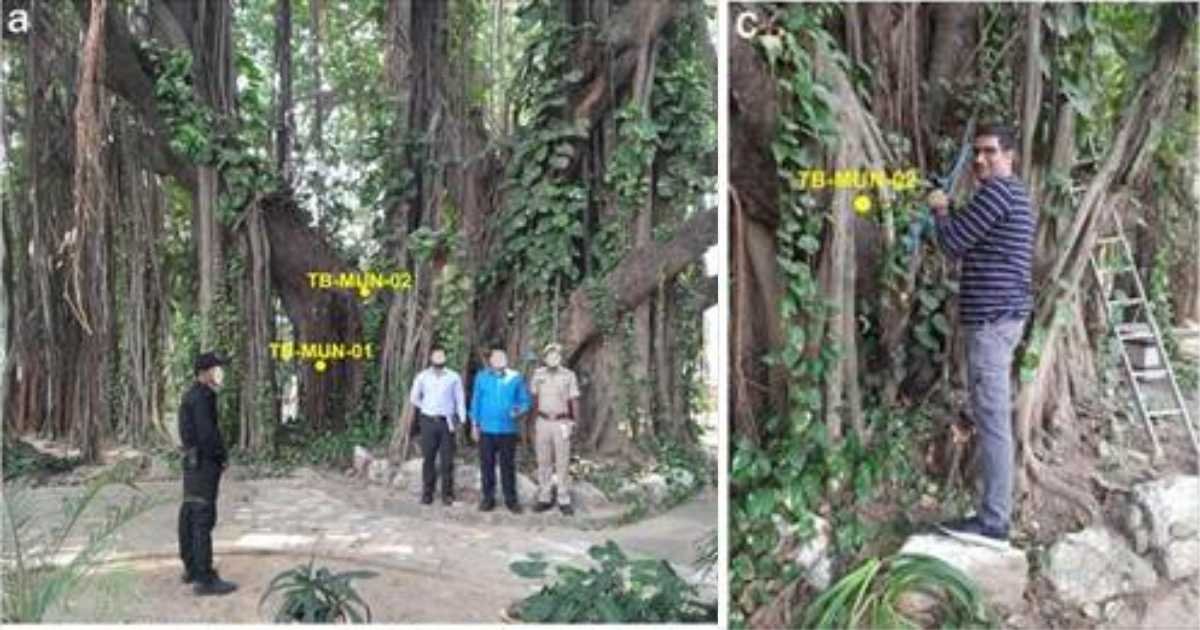
New Delhi: Scientists have confirmed that the Bihar banyan tree in Munger is around 700 years old, making it the world’s oldest accurately dated banyan after determining its age through high-precision radiocarbon analysis.
Researchers from the Birbal Sahni Institute of Palaeosciences, an autonomous institute under the Department of Science and Technology (DST), established the tree’s age using Accelerator Mass Spectrometry (AMS). Unlike earlier estimates based on folklore or historical accounts, the study relied entirely on scientific evidence.
The research began after the Bihar Forest Department invited scientist Dr. Trina Bose to determine the tree’s age. Since tropical broadleaf trees usually lack distinct annual growth rings, the team developed a new dating method instead of using conventional dendrochronology.
Dr. Bose, along with Dr. Mayank Shekhar and Dr. Akhilesh K. Yadava, extracted alpha-cellulose from wood samples taken near the pith of a secondary trunk and an ancient branch. They then dated the samples using AMS radiocarbon analysis and calibrated the results with the IntCal20 calibration curve and OxCal software.
Bihar banyan tree study rewrites local history
The study found that the tree predates the historic Burra Bunglow in Munger. Earlier assumptions suggested that people planted the banyan in front of the building around 300 to 350 years ago. However, the scientific analysis showed that the tree already existed centuries before the structure was built.
Researchers concluded that the banyan is likely the surviving remnant of a natural forest that once covered the region. Consequently, the findings redefine the historical sequence of development in the area.
The research, published in the journal Quaternary Research, introduces a reliable scientific method for dating heritage trees in tropical regions. Moreover, the methodology can help governments, forest departments and conservation agencies accurately identify and protect ecologically and culturally significant trees.
Scientists said the approach can also support biodiversity conservation, heritage management, environmental education and climate research. Furthermore, they noted that the technique could be applied to other ancient tropical trees across South Asia and elsewhere.
The breakthrough strengthens efforts to preserve natural heritage by replacing uncertain age estimates with scientifically verified evidence, providing a new benchmark for the study of heritage trees worldwide.
