

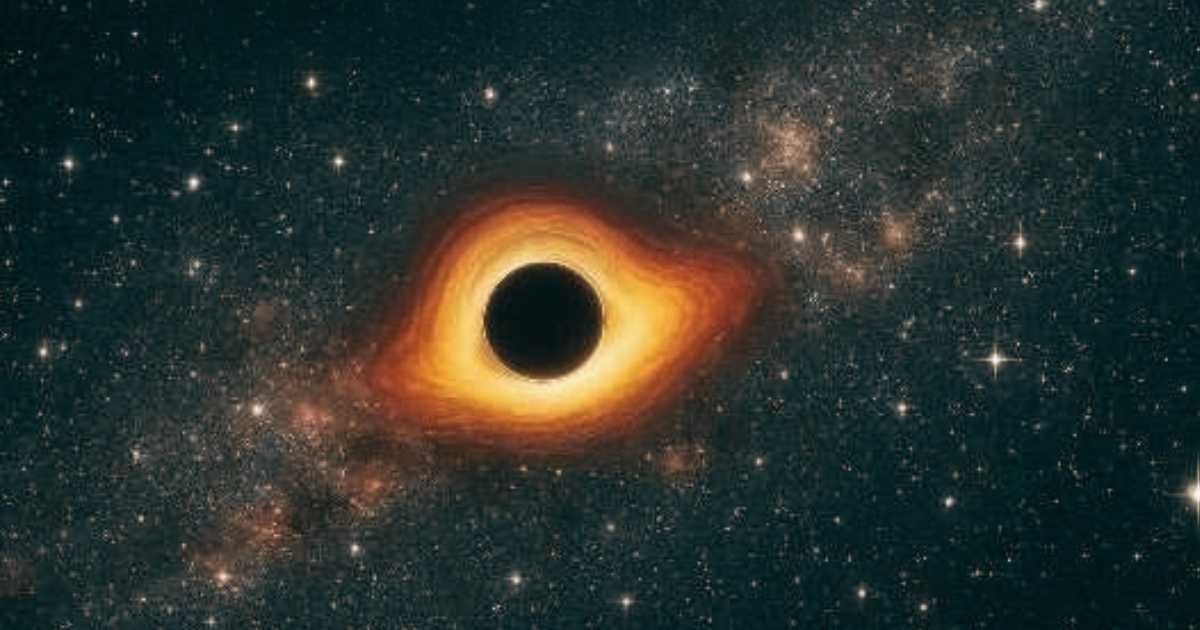
New Delhi: Scientists said a new study explored the possibility of dwarf galaxies black holes, offering fresh insights into black hole formation and galaxy evolution.
Researchers examined dwarf spheroidal galaxies orbiting the Milky Way. These galaxies are faint, gas-poor, and dominated by dark matter. As a result, detecting central black holes in them remains difficult. However, scientists said understanding such systems could explain how early black holes formed.
K. Aditya and Arun Mangalam from the Indian Institute of Astrophysics developed detailed dynamical models. These models included stars, dark matter halos, and a possible central black hole. They used stellar motion data to estimate the mass of any black hole present.
The team analysed stellar anisotropy, where star velocities vary in different directions. This method helped them build realistic orbital models. It also allowed them to constrain both dark matter distribution and black hole mass together.
Dwarf galaxies black holes study sets mass limits
The study, published in The Astrophysical Journal, examined several dwarf spheroidal galaxies. Researchers derived strong upper limits on black hole masses. Most galaxies showed limits below one million solar masses. Some cases suggested even smaller values.
Scientists said the data did not require the presence of massive black holes. Instead, the findings supported the possibility of intermediate-mass black holes. The team also created a unified relation between black hole mass and stellar velocity dispersion.
This relation extended across galaxies with velocity dispersions from about 10 to 300 km per second. It linked dwarf galaxies to larger systems under a common scaling law. However, uncertainties remained higher at lower masses.
Researchers compared their findings with theoretical growth models. Momentum-driven gas accretion predicted black holes of about 1,000 solar masses. Meanwhile, stellar capture processes allowed growth up to 10,000 solar masses or more.
They also explored tidal stripping scenarios. In such cases, dwarf galaxies may have once been larger systems. Over time, they lost stars due to interactions with the Milky Way. This offered another explanation for current observations.
Scientists said the study provided a strong benchmark for future research. They noted that upcoming facilities like the National Large Optical Telescope and the Extremely Large Telescope would improve observations. These instruments could measure stellar motions in faint galaxies with greater precision.
The study said future observations could test predictions on dwarf galaxies black holes. It added that such work would help confirm whether these galaxies host early black hole seeds.
