

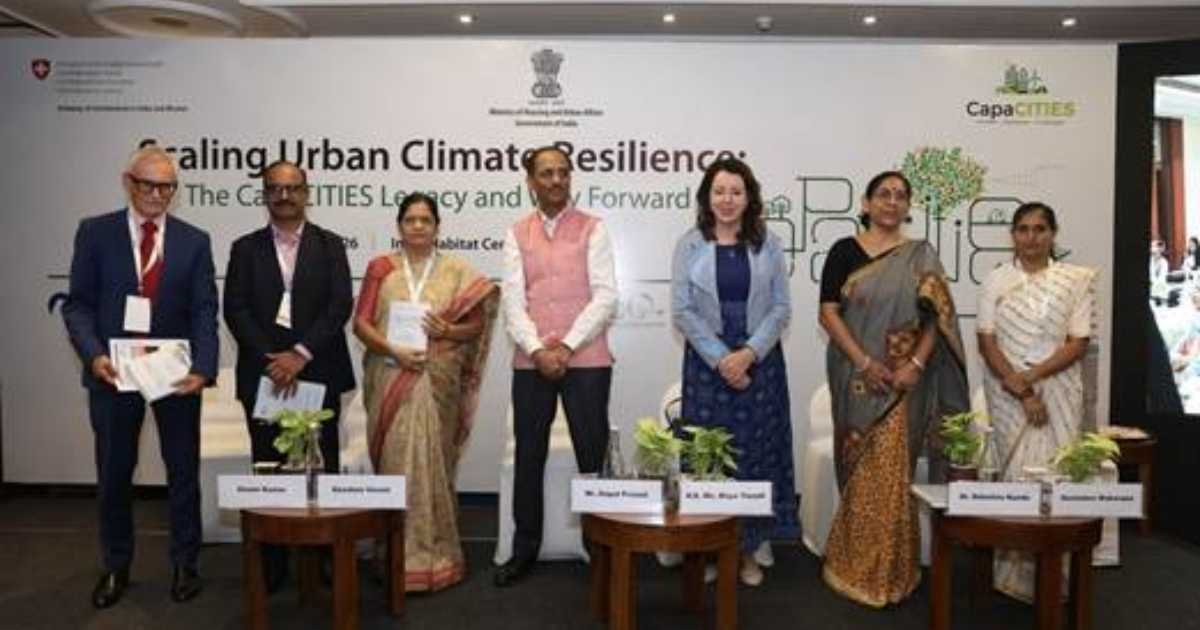
New Delhi: The CapaCITIES programme marked a decade of advancing urban climate resilience at an event in New Delhi on Tuesday. Organisers launched three knowledge products. They also outlined a roadmap to help Indian cities expand climate action.
The event was organised by ICLEI South Asia and the National Institute of Urban Affairs at the India Habitat Centre. It brought together government officials, mayors, municipal commissioners, engineers, financial institutions and experts. Meanwhile, participants reviewed the programme’s progress and discussed future priorities.
Launched in 2016 with support from the Embassy of Switzerland to India and Bhutan, the programme promotes low-carbon urban development. It also helps cities integrate climate planning into governance. As a result, local actions now align better with India’s 2070 net-zero target.
Gopal Prasad, Economic Adviser in the Ministry of Housing and Urban Affairs, said cities should create dedicated climate cells. He added that the programme’s model could be expanded across India.
Swiss Ambassador Maya Tissafi said the India-Switzerland partnership has strengthened institutions and built local capacity. She said cities now have stronger systems to include climate goals in planning and budgeting.
Urban climate resilience tools launched for cities
The event introduced the urban climate resilience toolkit, the Net-Zero Climate Resilient Cities Methodology Toolkit, the Energy Transition for Urban Local Bodies in India: A Practitioner’s Guidebook and the white paper on climate finance. In addition, organisers launched a video training series on the National Urban Learning Platform.
NIUA Director Debolina Kundu said the programme created jobs, restored ecosystems and supported women’s empowerment. Moreover, she said participating cities can guide others across the country.
ICLEI South Asia Executive Director Emani Kumar said the initiative supports Mission LiFE, the Smart Cities Mission and AMRUT. He added that it prepares cities for future climate challenges.
Later, technical sessions focused on climate planning, project financing and scaling successful city models. State and municipal officials also shared their experiences.
Over the past decade, the programme prepared climate action plans for eight cities. It established climate cells in six cities. Additionally, it supported more than 35 cities with planning tools and trained over 1,000 people. It also identified climate investments worth ₹7,142 billion and helped mobilise funding for pilot and expansion projects.
