
Gudur Narayana Reddy proposes technical cell and water dashboard to tackle El Niño impact

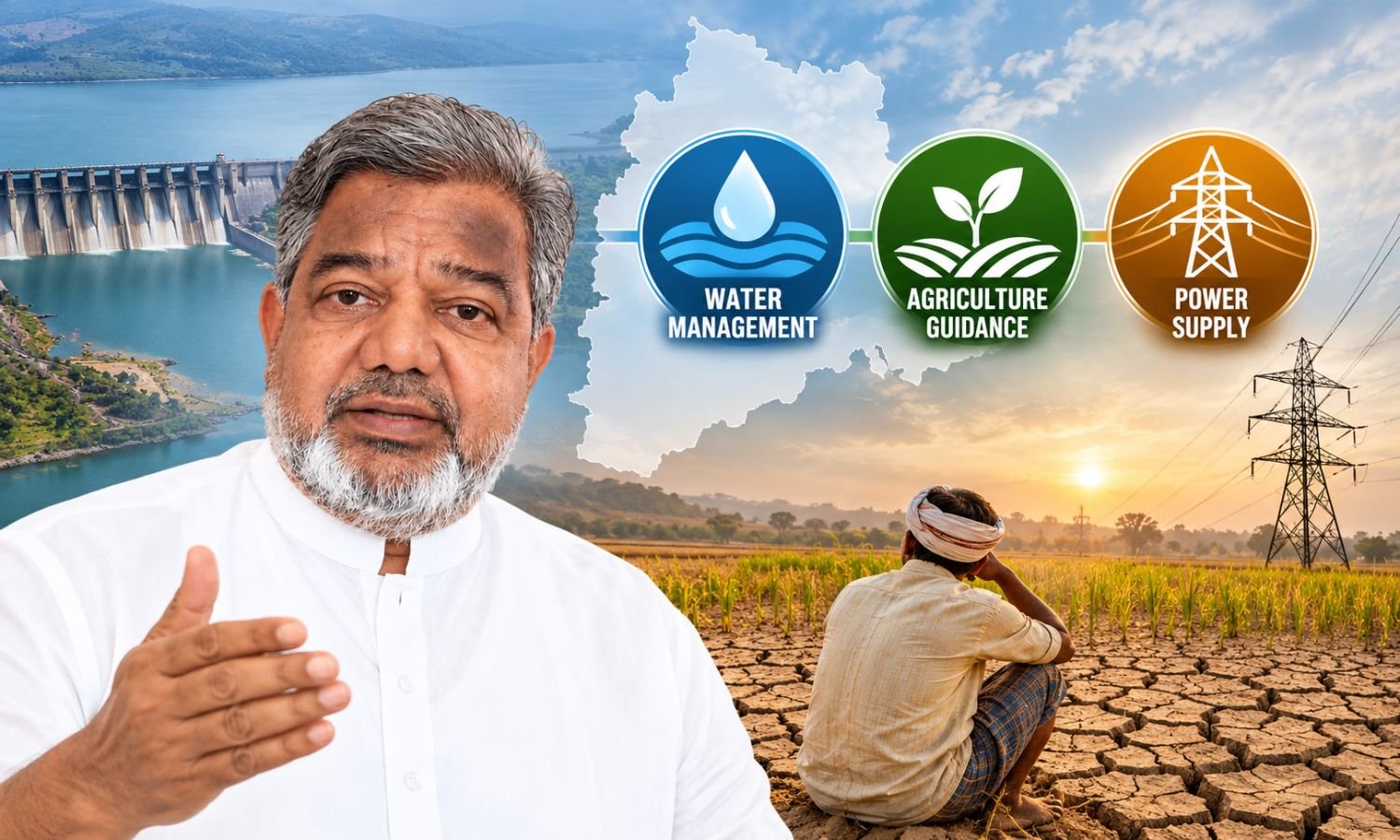
Hyderabad: Senior BJP leader Gudur Narayana Reddy on Saturday, 24 October, suggested a three-point action plan to help Telangana deal with prolonged water, agriculture and power challenges arising from El Niño conditions. He said the situation required practical coordination between the government, experts, farmers and local communities. The plan includes an El Niño technical cell, groundwater recharge works and a public monitoring dashboard.
Narayana Reddy was responding to the latest review by Chief Minister A. Revanth Reddy on the emerging water situation. He called the government’s emphasis on securing drinking water supplies appropriate. In his view, the next stage should convert broad policy directions into localised, measurable and publicly accessible action.
“The Chief Minister’s latest review correctly recognises the scale of the water and power challenge,” he said. With reservoir storage constrained, he added, protecting drinking water must remain the first priority. Farmers should also get clear and usable guidance on crop choices, he said. He offered the three suggestions to the State Government in a constructive and non-partisan spirit.
His first proposal was a small, time-bound El Niño technical cell. Officials from the Irrigation, Groundwater and Agriculture departments would form it, along with independent hydrologists and agronomists from agricultural universities, research institutions or ICAR institutes. He clarified that it should not become another large committee or bureaucratic structure. Instead, it should be a compact working group. Its mandate would be to provide mandal-wise assessments of water availability and agricultural options every week.
“The farmer in Kamareddy, Nalgonda, Mahabubnagar or any other affected district does not merely need a general warning that water is scarce,” he said. Farmers need to know the actual situation in their mandal, he added. They also need to know what decisions they can safely take that week.
El Niño technical cell: weekly bulletin and recharge works
Narayana Reddy said the technical cell should answer three questions through a short weekly public bulletin. The first is how much groundwater extraction is sustainable in a mandal. The second is which short-duration or low-water crops remain economically viable. The third is where fodder or drinking-water arrangements for livestock need strengthening.
Such advisories, he said, would help farmers, agriculture officials, panchayats and district administrations make informed decisions. They would not have to rely on general appeals to reduce water use. He suggested the cell function until June 2027, after which its utility could be reviewed. Its reports should be public and reach the mandal and village levels.
His second recommendation was to accelerate community-level groundwater recharge and water-conservation works in the most stressed mandals. He said the government could take up desilting of tanks and check-dams, farm ponds and percolation pits on priority before peak summer. “These are not massive projects requiring years of execution,” he said. He described many of them as comparatively low-cost interventions.
He suggested the government identify around 200 of the most water-stressed mandals and prepare a targeted works programme for them. The government could combine State resources and rural employment programmes for these works, he said. As a result, the works would also generate employment for agricultural labourers and rural households hit by reduced cultivation. He further suggested aligning the works with the special employment initiatives the State Government is planning.
The third proposal was a simple public monitoring dashboard. It would cover reservoir releases, movement of drinking-water tankers and electricity supply hours to agricultural feeders. Public availability of these figures, he said, would help the government, political parties, elected representatives and citizens identify stress points before they become emergencies. “If people can see the storage and releases from reservoirs, where drinking-water tankers are being deployed and how many hours of power agricultural feeders are receiving, it will create confidence,” he said. Transparency, he added, would also reduce speculation and anxiety among farmers and residents.
Narayana Reddy stressed that Telangana faces a climatic challenge that could affect agriculture, drinking water, electricity generation, groundwater levels, livestock and rural employment at once. Departments, he said, should therefore not respond in isolation. “Decisions in one sector will have consequences for the others,” he said.
He said farmers would have to reconsider crop choices wherever water is inadequate, but conservation should not rest entirely on them. The government, he said, must support farmers who shift to less water-intensive crops. That support should include seed availability, technical advice, procurement confidence and market access. “Otherwise, asking them merely to change cultivation patterns will not be sufficient,” he said.
Earlier warnings on rainfall deficits and El Niño had already highlighted the need for advance preparedness, Narayana Reddy said. BJP leaders had previously raised issues relating to crop diversification, reservoir management, power supply, damage assessment, farmers’ compensation and consultation with all political parties. However, he said the immediate need was to move beyond debate over responsibility. The State, he said, should build a system that can respond to changing conditions every week. “Telangana therefore needs a dynamic response mechanism rather than a one-time review,” he said.
The BJP leader said political parties should be ready to contribute constructively wherever the State requires cooperation. If the government creates a transparent mechanism and takes evidence-based decisions, he said, the BJP will extend whatever technical or organisational cooperation is useful. That cooperation would aim at protecting farmers and ensuring drinking-water security. He added that the coming months should be a period of intensive water management and preparedness. Weekly monitoring, he said, should replace last-minute crisis management.
“Every available drop of water must be accounted for, every farmer should receive reliable local information, and every vulnerable habitation should be identified well before it faces a drinking-water emergency,” he said.
