

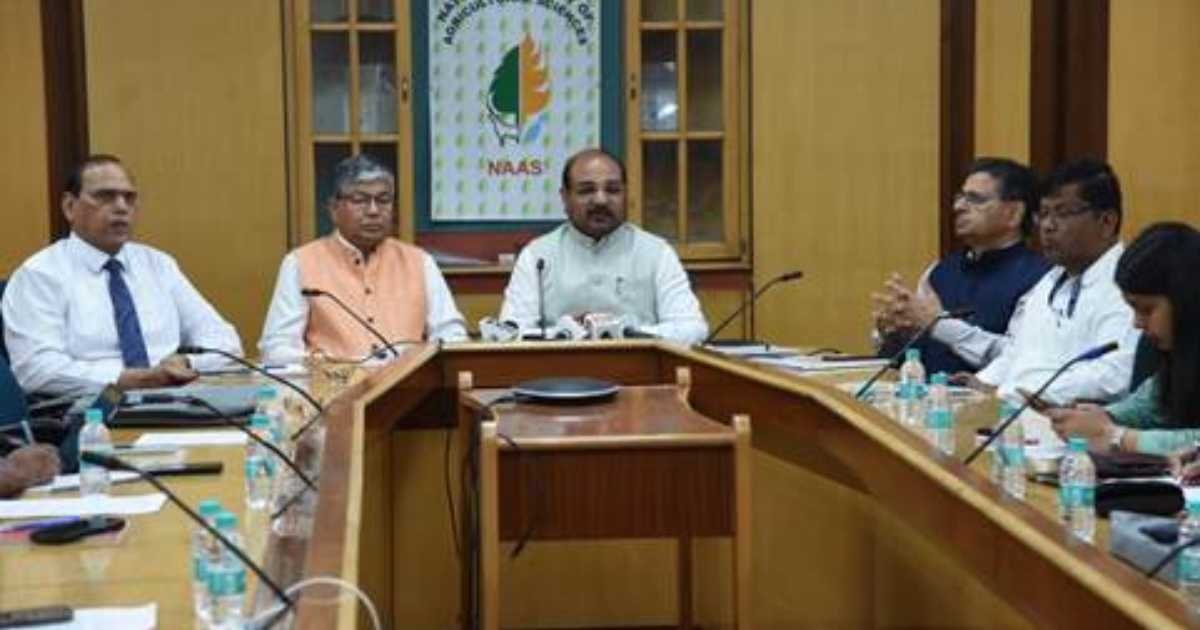
New Delhi: A roadmap for fertilizer self-reliance was discussed at a National Academy of Agricultural Sciences session, with experts backing policy reforms and technology-driven strategies.
The brainstorming session brought together representatives from government departments, academia, industry, and farmers. Participants stressed the urgent need to reduce India’s dependence on imported fertilizers.
After the meeting, Dr. M.L. Jat said agriculture would play a key role in achieving Atmanirbhar Bharat by 2047. He noted that fertilizers had boosted production during the Green Revolution. However, he warned that inefficient and excessive use now posed a major challenge.
India consumes nearly 33 million tonnes of fertilizers each year. A large share is imported, which increases costs and subsidy burdens. Therefore, Dr. Jat said reducing import dependence had become essential.
He added that improving soil health, promoting balanced fertilizer use, and raising farmer awareness were critical steps. Moreover, he called for the use of modern tools such as precision nutrient management, artificial intelligence, and sensor-based systems.
Policy push for fertilizer self-reliance strategy
Experts at the session proposed a multi-pronged fertilizer self-reliance strategy with short, medium, and long-term goals. They stressed the need to develop smart alternative fertilizers and use indigenous minerals and industrial by-products.
They also recommended greater use of biological inputs and better composting methods. In addition, crop diversification towards pulses and oilseeds can reduce reliance on chemical fertilizers. Recycling organic waste under Waste-to-Wealth initiatives was also highlighted.
Participants proposed a Mission Mode programme to promote Integrated Nutrient Supply and Management. The aim is to replace at least 25% of mineral fertilizers with organic manure within three years.
Further, experts called for policy reforms. These include bringing urea under nutrient-based subsidy and linking subsidies to soil health cards. They also suggested direct cash transfers to farmers to encourage efficient fertilizer use.
Background data showed that fertilizer subsidies reached ₹1.71 lakh crore in 2024–25. At the same time, nutrient-use efficiency remains low, leading to losses through runoff and soil degradation. Officials said these challenges underline the need for urgent reforms.
