
Green hydrogen mission targets 5 million tonnes of annual production by 2030

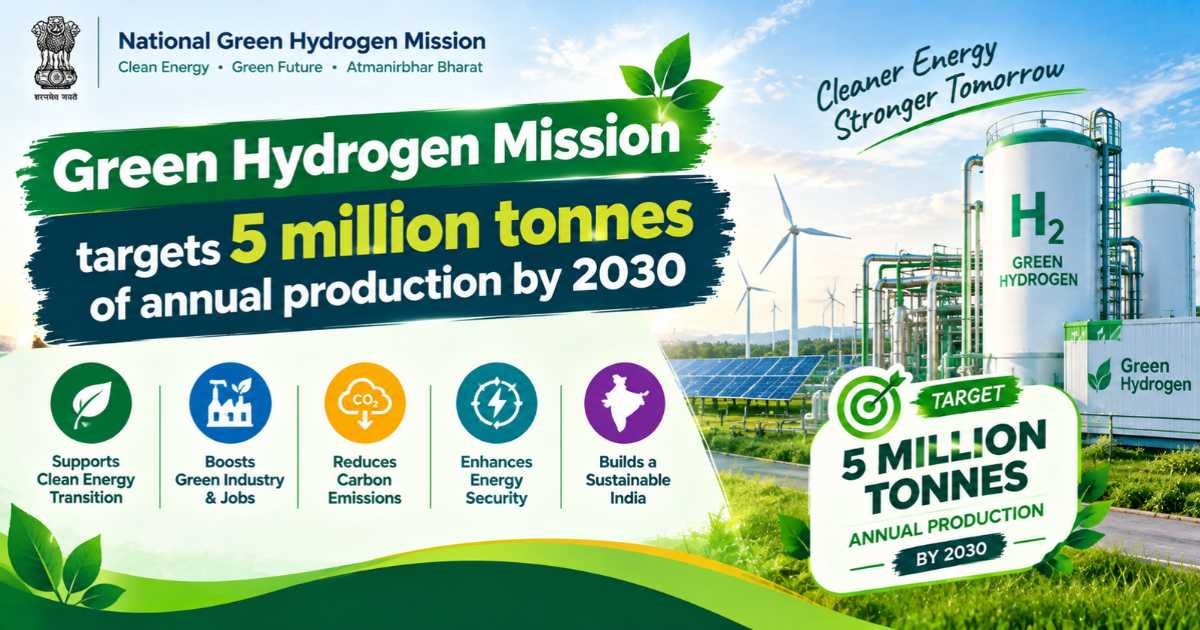
New Delhi: India aims to produce at least 5 million metric tonnes of green hydrogen annually by 2030 under the National Green Hydrogen Mission. The initiative seeks to reduce fossil fuel imports, cut industrial emissions and strengthen domestic clean energy manufacturing. According to the Ministry of New and Renewable Energy, the mission could also mobilise more than Rs 8 lakh crore in investment and create over 6 lakh jobs.
The Union Cabinet approved the mission in January 2023 with an outlay of Rs 19,744 crore. It supports domestic electrolyser manufacturing, green hydrogen production, infrastructure, research and development, and the development of reliable certification standards. With export demand, India’s annual production potential could reach 10 million metric tonnes.
Green hydrogen is produced by splitting water through electrolysis using renewable electricity, mainly from solar and wind power. Unlike conventional hydrogen production based on fossil fuels, this process can significantly reduce carbon emissions. It could help decarbonise sectors such as fertiliser manufacturing, petroleum refining, steel production, heavy-duty transport and shipping.
Green hydrogen standards and production progress
India introduced its Green Hydrogen Standard in August 2023. Under the standard, emissions must not exceed 2 kg of carbon dioxide equivalent per kg of hydrogen, measured on a well-to-gate basis and averaged over 12 months. The framework establishes a common benchmark for production and certification.
Under the mission’s Strategic Interventions for Green Hydrogen Transition programme, the government offers incentives for electrolyser manufacturing and hydrogen production. Incentives have been awarded to 15 companies for electrolyser manufacturing capacity of 3,000 megawatts annually. By February 2026, around 8,000 tonnes per year of green hydrogen production capacity had been commissioned. Incentives have also been awarded for 8.62 lakh tonnes of annual production capacity.
The mission is supporting pilot projects in steelmaking, heavy-duty mobility and shipping. Five steel-sector pilot projects have been sanctioned, including Rs 84 crore for testing 100% hydrogen injection. In transport, 12 projects will deploy 70 hydrogen-powered vehicles, comprising 27 buses and 43 trucks. The programme also covers 16 hydrogen refuelling stations across 21 routes, with Rs 41.58 crore released in financial assistance.
India has also begun developing hydrogen hubs and innovation clusters to bring production, users and infrastructure closer together. The Ministry of New and Renewable Energy has recognised Deendayal Port in Gujarat, V.O. Chidambaranar Port in Tamil Nadu and Paradip Port in Odisha as green hydrogen hubs. In July 2025, an indigenously built 1-megawatt green hydrogen plant was commissioned at Kandla Port.
Hydrogen applications extend across industry and transport
Green hydrogen can replace fossil-based hydrogen already used in fertiliser plants and refineries. It can also support lower-emission steel production, where hydrogen can remove oxygen from iron ore without releasing carbon dioxide during the reduction stage. In city gas networks, limited blending with natural gas may reduce fossil fuel use, subject to safety rules and infrastructure compatibility.
Transport is another potential application. Fuel-cell vehicles convert hydrogen into electricity to power electric motors, producing water vapour at the point of use. India’s first indigenous hydrogen-powered train was inaugurated on July 17, 2026, on the Jind–Sonipat section. The 10-car trainset can carry around 2,600 passengers, while a facility at Jind stores nearly 3,000 kg of hydrogen.
For shipping, hydrogen can be converted into green ammonia or green methanol as alternative marine fuels. These fuels could also create export opportunities as overseas markets seek lower-emission energy sources. However, wider use depends on infrastructure, safety requirements, engine compatibility and production costs.
The government is coordinating with central and state agencies to support adoption across sectors. Measures include waivers on interstate electricity transmission charges for eligible projects, renewable energy banking provisions and faster access to electricity networks. Eligible green hydrogen and green ammonia plants commissioned by December 31, 2030, are exempt from interstate transmission system charges for 25 years.
Research, skills and international partnerships
The mission also supports research into hydrogen production, storage and safety. Its research and development programme has an outlay of Rs 400 crore, while an initial roadmap worth Rs 113 crore was supporting approved projects as of June 2026. In addition, Rs 100 crore has been allocated to start-ups developing green hydrogen technologies. The first nine start-ups have been approved for total funding of Rs 22 crore.
The government aims to generate more than 6 lakh jobs across the green hydrogen value chain by 2030. So far, 8,149 candidates have received training and 7,248 have been certified in hydrogen-related qualifications across 14 states and Union Territories. Training covers renewable power, electrolysis, storage, transport, safety and industrial applications.
International cooperation forms another part of the strategy. India has signed agreements or declarations related to green hydrogen with Australia, Finland, France, Germany, Saudi Arabia, the United Arab Emirates and Uzbekistan. An India–US Hydrogen Task Force has also been formed under the Strategic Clean Energy Partnership.
At the state level, Gujarat, Andhra Pradesh, Maharashtra, Uttar Pradesh, Rajasthan and West Bengal have notified dedicated green hydrogen policies. Haryana, Punjab, Bihar and Kerala are preparing draft policies, while several other states have incorporated hydrogen into existing industrial and renewable energy frameworks.
The mission projects that green hydrogen production and use could help avert nearly 50 million metric tonnes of carbon dioxide emissions annually. It also aims to reduce cumulative fossil fuel imports by approximately Rs 1 lakh crore by 2030. These targets form part of India’s broader ambitions to achieve net-zero emissions by 2070 and build a cleaner, more self-reliant energy economy.
